Get Full Government Meeting Transcripts, Videos, & Alerts Forever!
Get email alerts on the Data Centers Sales Tax Exemption topic
No spam. Unsubscribe anytime.
Committee advances bill to limit sales-tax exemption for new data centers to seven years; testimony split
Summary
The committee advanced House Bill 315 to the fourteenth order after a lengthy hearing on limiting sales-tax exemptions for new data centers to seven years going forward.
The Senate Local Government and Taxation Committee voted on March 20 to send House Bill 315, as amended, to the fourteenth order for possible amendment. The bill would change the sales-tax exemption for qualifying new large data centers from permanent exemption to a seven-year sunset going forward (the amendment removes retroactive application to facilities already granted exemption, per committee discussion).
Sponsor Representative Bruce (District 23) said the amendment is not retroactive and that the seven-year limit was chosen to set a “clear endpoint” for the incentive. Bruce said the exemption covers more than servers — it also applies to building materials and other costs — and that setting a seven-year limit would allow the state to recapture some revenue to use for tax relief for schools or property taxpayers.
Industry witnesses strongly urged the committee to oppose the bill. Steve Thomas, representing Meta Platforms, said the company has invested about $800 million in a Kuna facility and that the House bill as written would prejudice companies that relied on the existing statutory exemption; Thomas asked that the bill be returned to the fourteenth order for clarification of retroactivity language. “It effectively precludes us as a state from getting more of this business,” Thomas said, arguing that many competitor states offer permanent exemptions.
Steve Del Bianco, president and CEO of the trade association NetChoice, testified that most competing states offer permanent exemptions and that a seven-year cap would make Idaho unattractive to large data-center investments. Del Bianco also addressed water and infrastructure questions: he said data centers can choose between water-based evaporative cooling (which uses less electricity but consumes water) and dry electric cooling (which uses more electricity but little water). He said the Meta facility in Kuna is using a dry-cooling approach and that water use depends on technology choices.
Local and industry-opposed testimony highlighted other concerns. Alex Sabo, president of the Idaho Association of Commerce and Industry, said data centers bring large private investments and build broadband ‘‘middle-mile’’ capacity that can benefit nearby communities; he opposed the bill as written and urged more targeted discussion of expectations for data-center operators. Local business owners and farmers — including Dustin Ferdinand, a small-business owner from Kuna, and Dennis Ferdinand, a local farmer — told the committee they fear loss of local customers, pressure on water and power infrastructure, and erosion of tax fairness for long-time residents.
Committee members debated trade-offs. Senator Ben Adams said his focus has been on infrastructure impacts — particularly electricity and water — and noted testimony that Meta’s Kuna center uses about 70,000 gallons of water per day compared with an industry example cited at 450,000 gallons per day for a Google facility. Representatives and senators also noted that a large data center may have a statutory property-value tax cap (testimony cited a $400 million taxable-value cap) and that other incentives and utility agreements also factor into economic return for host communities.
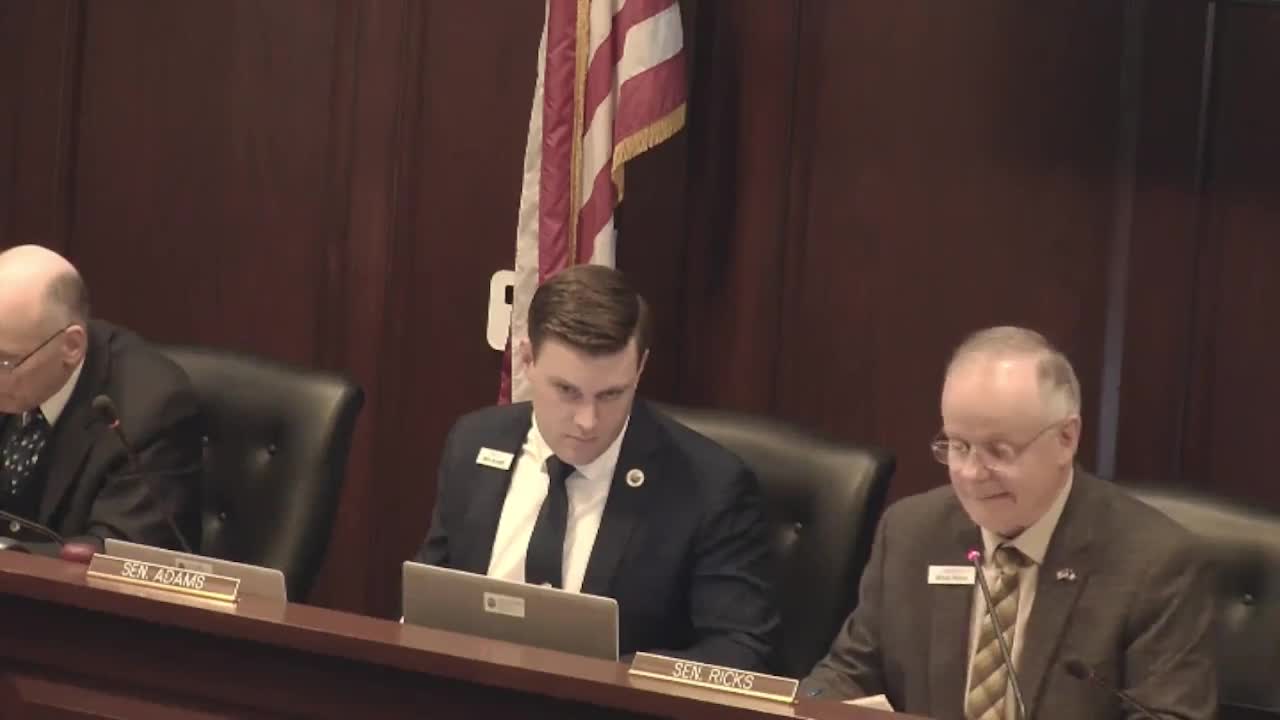
Procedural outcome: Senator Ben Adams moved to send HB 315, as amended, to the fourteenth order for possible amendment; Senator Taylor seconded. A substitute motion to hold the bill in committee (moved by Senator Berndt) failed for lack of a second. The original motion to send the bill to the fourteenth order carried on a voice vote.
Why it matters: supporters of the amendment said a sunset prevents permanent, open-ended subsidies and allows the state to reassess economic value; opponents said changing incentives now would jeopardize current and future large private investments, broadband infrastructure and potential national-security-related capacity tied to data centers.
What’s next: the bill will be placed on the fourteenth order for potential amendments and further floor consideration. Committee members signaled interest in broader policymaking on incentives, water use and grid impacts before final action.