Get Full Government Meeting Transcripts, Videos, & Alerts Forever!
Get email alerts on the Public Defense topic
No spam. Unsubscribe anytime.
Senate committee advances bill to clarify State Public Defender duties, workload standards and facility costs
Summary
The Senate Judiciary & Rules Committee voted to send Senate Bill 1181 to the fourteenth order for possible amendment after testimony about caseload limits, transition of county facilities to the state and funding needs for public defense.
The Senate Judiciary & Rules Committee voted to send Senate Bill 11‑81 to the fourteenth order for possible amendment after senators and witnesses debated caseload and workload rules, how the state will assume office costs now borne by counties and what enforcement or reporting will follow.
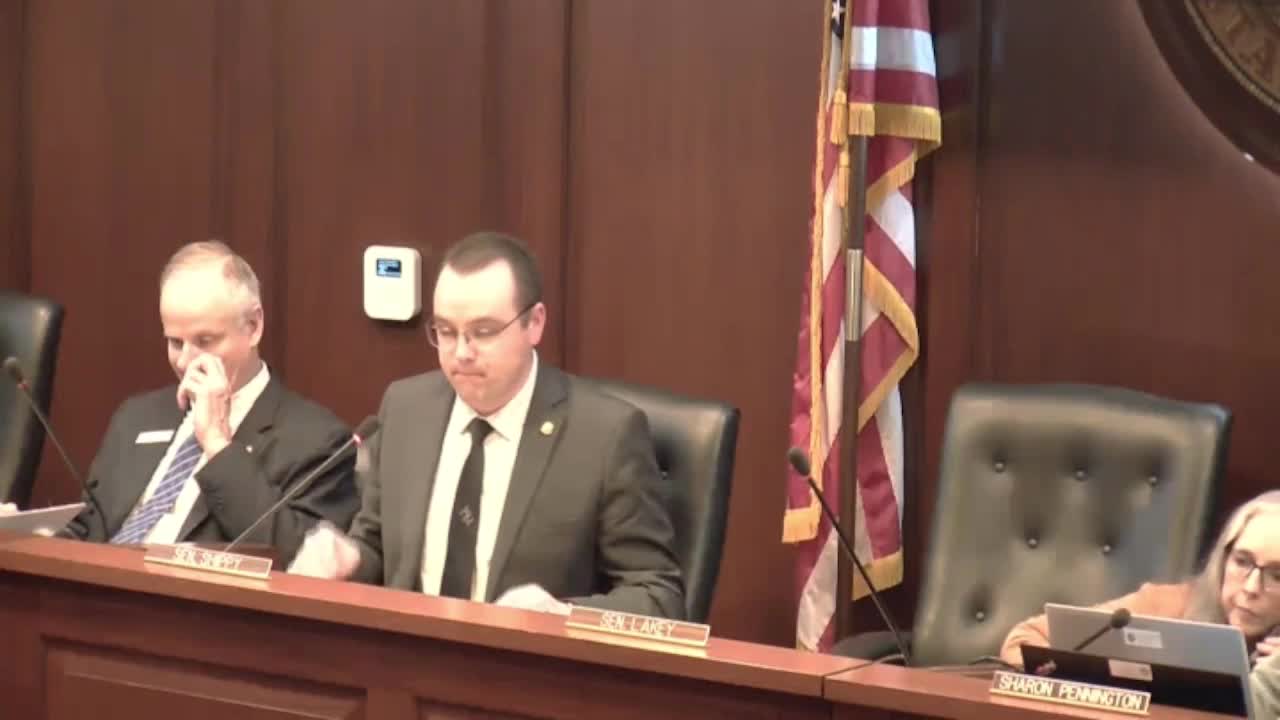
Senator Todd Lakey, sponsor of Senate Bill 11‑81 and state senator from District 23, told the committee the measure “provides some beneficial updates and clarity” for the State Public Defender after the state assumed responsibility for public defense. He asked the committee to send the bill to the amending order to correct a code citation and for further refinement.
The bill revises statutory language about which transcripts the State Public Defender must pay for, narrows the circumstances in which counsel is appointed in private parental‑termination cases to those constitutionally required, authorizes workload standards based on attorney education and case complexity, and clarifies responsibilities of district public defenders for supervising staff and coordinating litigation. The measure also includes a transition plan requiring the State Public Defender to submit a relocation plan with the 2027 budget and sets a 2029 target relocation date for offices that counties currently make available to the state.
Why it matters: The legislation attempts to resolve operational and fiscal friction generated when Idaho shifted public defense from counties to the state. Senators and witnesses said clearer statutory language could reduce confusion about who pays for specific office costs, protect constitutional representation, and create a data basis to set workload standards that minimize attorney burnout and litigation risk.
Testimony from defenders and county officials focused on two persistent concerns: how to measure and enforce reasonable workloads for public defenders, and how to pay for the transition from county office space to state facilities. Amy Smith, a public defender in Ada County, said she supports the bill but pressed for enforceable caseload limits. “I do feel, personally, based on my professional experience in public defense that we do need a number that is an upper limit,” Smith said, adding that under prior IDAPA standards she worked comfortably with about 35–40 active felony matters at a time but now carries “over 80 felonies” in her practice.
Eric Frederickson, State Public Defender, said the office intends to develop workload standards that differ from simple caseload counts by accounting for motions filed, hearings attended and trials — elements his office plans to measure with a new case management system. “Workload's really the only way to truly assess how busy our attorneys are so we don't have burnout, and we don't have attorneys that are overworked,” Frederickson said, adding that the office has relied on Public Defense Commission (PDC) standards as a stopgap while it collects data needed to set workload metrics.
Seth Grigg, executive director of the Idaho Association of Counties, said counties worked with sponsors to address concerns including accelerating the transition out of county facilities and clarifying district defender duties. He said some counties still expect disputes over utilities and maintenance but that the bill “largely addresses many of the needs that we had.”
Compass Public Defender Dana Bowes said services in northern counties are strained by travel distances, appointment practices and limited local funding; she urged the committee to consider how billing and appointment rules affect the ability to serve remote counties.
On expenses, Senator Lakey said the bill clarifies that the state pays for office space, equipment, technology and software while counties would remain responsible for landlord‑type costs such as utilities, building maintenance, snow removal and certain repairs. He noted a statewide estimate of about $250,000 for those county maintenance costs.
Committee action: Senator Keiser moved that the committee send Senate Bill 11‑81 to the fourteenth order for possible amendment; Senator Forman seconded. The committee approved the motion by voice vote; no roll‑call tally was recorded in the transcript.
Next steps: With the committee vote, the bill advances for further consideration and possible amendment. Funding decisions remain with the Joint Finance‑Appropriations Committee (JFAC); Senator Lakey and witnesses said JFAC will consider specific budget requests tied to implementing the statute and hiring staff or leasing facilities.
Provenance: The committee hearing contained multiple discussion points and witness statements recorded on the committee transcript beginning with Senator Lakey’s presentation and ending with the committee vote to refer the bill to the fourteenth order for possible amendment.