Get Full Government Meeting Transcripts, Videos, & Alerts Forever!
Get email alerts on the Campaign Finance topic
No spam. Unsubscribe anytime.
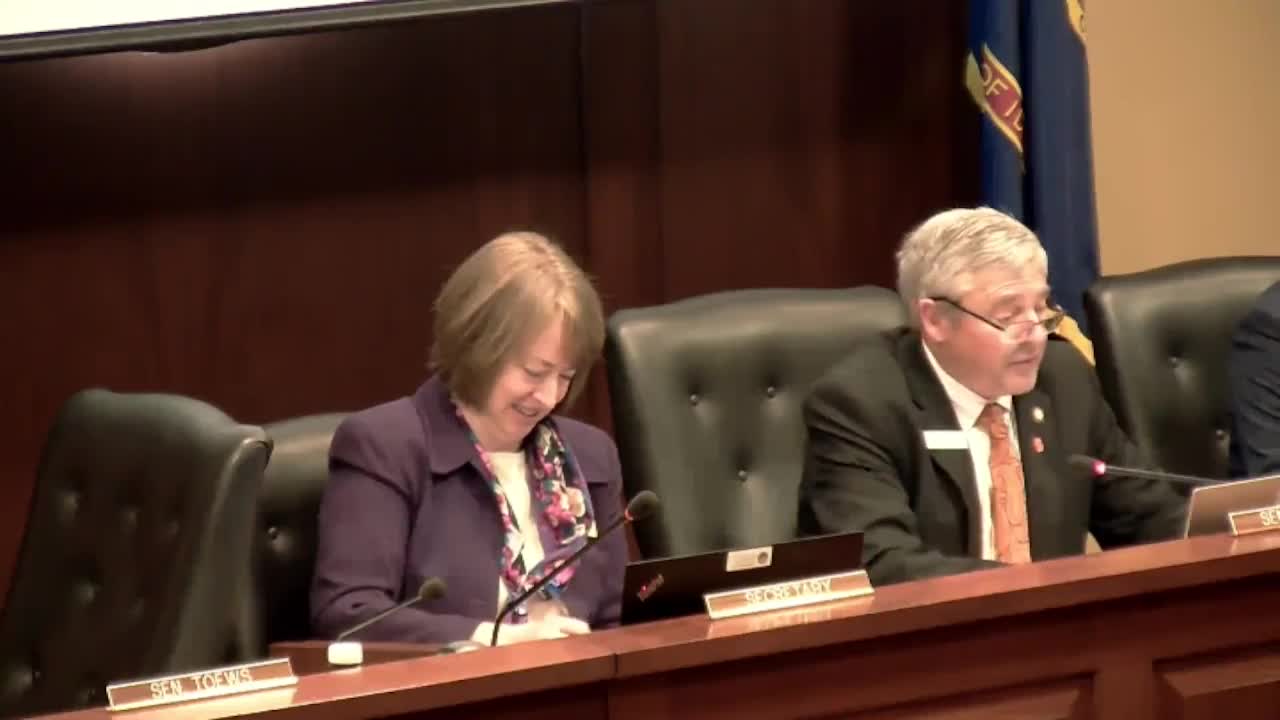
Senate committee advances broad rewrite of Idaho campaign finance law to 14th order
Summary
The Senate State Affairs Committee advanced Senate Bill 12-12, a recodification and update of Idaho's campaign finance laws that increases reporting frequency, adjusts contribution limits, and revises the fine structure; the measure was sent to the fourteenth order for possible amendment by voice vote.
The Senate State Affairs Committee on April 2 advanced Senate Bill 12-12, a recodification and update to Idaho's campaign finance laws, sending the bill to the fourteenth order for possible amendment after a voice vote.
The bill, presented by Senator Kelly Anton (R-District 27) with Secretary of State Phil McGrane in attendance, reorganizes campaign finance law from Title 67 into Title 74 (ethics and government), increases the frequency of reporting, raises some contribution limits modestly, and changes the current fine structure for violations. Secretary McGrane told the committee the goal is to make reporting easier to follow and to add more timely transparency for the public.
Committee members and the secretary said the bill is intended mostly as a recodification and reorganization of current statute with several substantive changes. "Our campaign finance laws, they were a citizen's 1970s," Secretary Phil McGrane said, arguing the statutes needed updating and better organization. McGrane detailed proposals including 48-hour reporting for expenditures over $1,000 at any time (not just close to elections), quarterly reporting for candidates in off years, monthly reporting for political committees at all times, and a revised fine schedule that scales penalties to the size of the activity.
McGrane cited statistics his office compiled showing roughly $17 million spent in legislative races last cycle, including about $7.66 million raised by candidates themselves and the remainder from political committees and independent expenditures. He told the panel that much of the attention prompting the bill is the rise in out-of-state spending on negative advertising and independent expenditures. "The majority of the attack ads are coming from out of state," he said, and added that the office publishes detailed spending information on VoteIdaho.
Among the bill's specific changes discussed: raising the candidate contribution threshold from $1,000 to $1,500 and statewide limits from $5,000 to $6,000; removing a previously proposed trigger that would increase limits in response to negative independent spending; eliminating a prior requirement for a PAC "ad library" upload; clarifying that campaigns should keep campaign funds in a bank account separate from personal funds; and replacing the current $50-per-day late-fee with a $50 initial late fee plus $10 per day and percentage-based penalties for more serious violations. McGrane said those changes were designed to make fines proportional to the violation and to give clearer guidance to his office on enforcement.
Heather Lauer, chief executive officer of People United for Privacy Foundation, testified in support of the bill's donor-disclosure language that applies when a donor gives money "with the intent" it will be used for political purposes. "S 12 12 requires disclosure if a donor gives money to an organization with the intent that it's going to be spent on political purposes," Lauer said, adding that the language balances disclosure and privacy.
Senator Harris moved to send the bill to the fourteenth order for possible amendment; the motion was seconded (second not specified in the transcript) and carried by voice vote. No roll-call tally was recorded in the transcript for that motion.
The bill will be returned to the floor at the fourteenth order, where senators said it could receive amendments and further debate.