Get Full Government Meeting Transcripts, Videos, & Alerts Forever!
Get email alerts on the Energy Policy topic
No spam. Unsubscribe anytime.
JFAC rejects then reconsiders Office of Energy’s package; home energy rebates, speed council fail on first rounds
Summary
The Office of Energy and Mineral Resources sought federal funding authority for home energy rebates and state funding for a 'speed council' to expedite permitting for critical infrastructure; initial motions failed in committee before later iterations were reconsidered but did not secure final approval in both houses during the meeting.
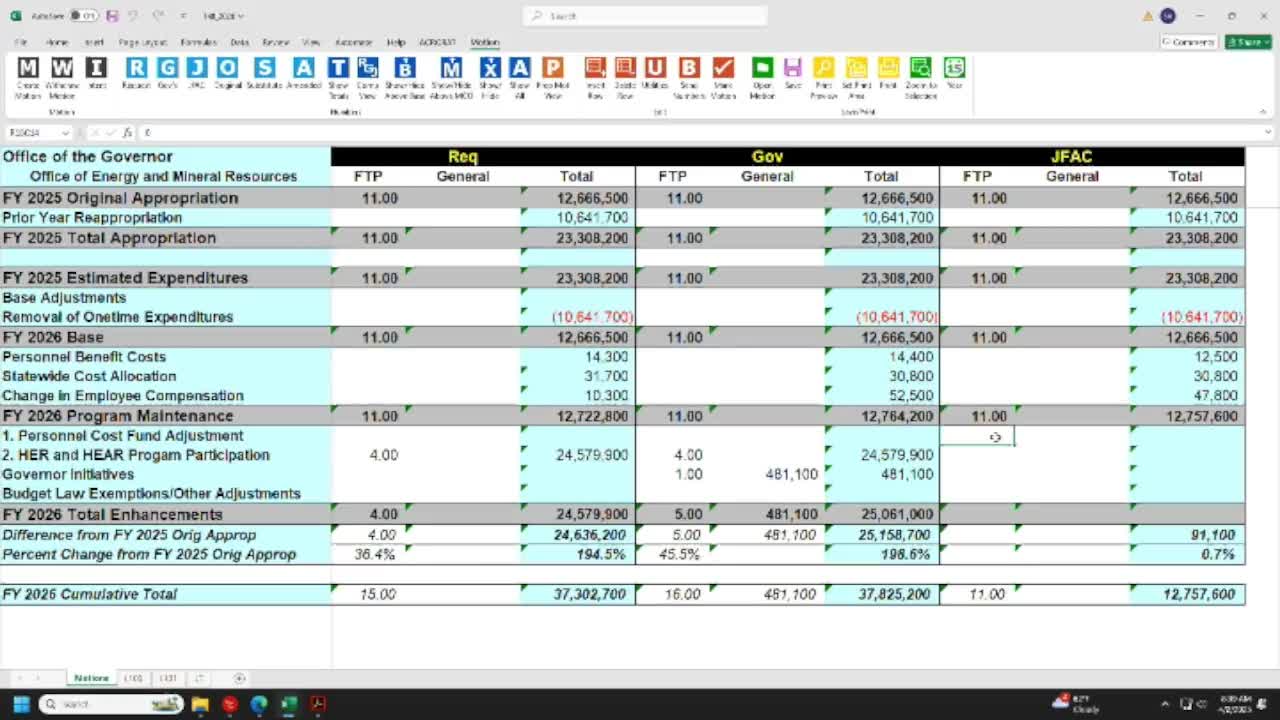
The Office of Energy and Mineral Resources asked the Joint Finance-Appropriations Committee for federal appropriation authority to run the home energy rebates program and requested general-fund support to stand up a governor-directed permitting 'speed council.' Committee members debated several variations of motions on the item; early proposals failed to secure majority support in both chambers before additional substitute motions were offered.
Kellen McGurkin, budget and policy analyst, told the committee the agency requested an ongoing federal appropriation of $24,500,000 to administer home energy rebates from the Inflation Reduction Act of 2022, with $20,000,000 designated for direct rebates and $4,000,000 for a third-party implementation contract. The agency requested personnel to administer the program and an additional general-fund request for a Speed Council to streamline permitting for large investments in critical minerals and infrastructure.
Callie Younger, identified as the new administrator for the Office of Energy and Mineral Resources, described the Speed Council’s mission to focus on permitting critical-minerals projects and to develop a public dashboard tracking project timelines. Younger said the council aligns with federal initiatives on permitting and 'energy dominance' and that the federal rebate funds would be lost to other states if Idaho declined to participate.
Committee debate produced a sequence of motions with differing dollar levels for the Speed Council and different combinations of rebate authority. One motion that combined rebate authority and the governor’s initiative failed to pass both chambers in committee. Subsequent motions adjusted funding amounts multiple times; a later motion to provide $330,000 one-time for the Speed Council passed in the Senate portion of the committee but failed in the House portion, and other alternate amounts were considered.
Committee members repeatedly cited the need to balance conservation (rebates) and energy production (speed council) when weighing motions. Because several iterations failed to gain the required majority in both the Senate and House panels, the committee did not forward a single, fully approved package for both items at the time the meeting ended.