Get Full Government Meeting Transcripts, Videos, & Alerts Forever!
Get email alerts on the Harm Reduction Centers topic
No spam. Unsubscribe anytime.
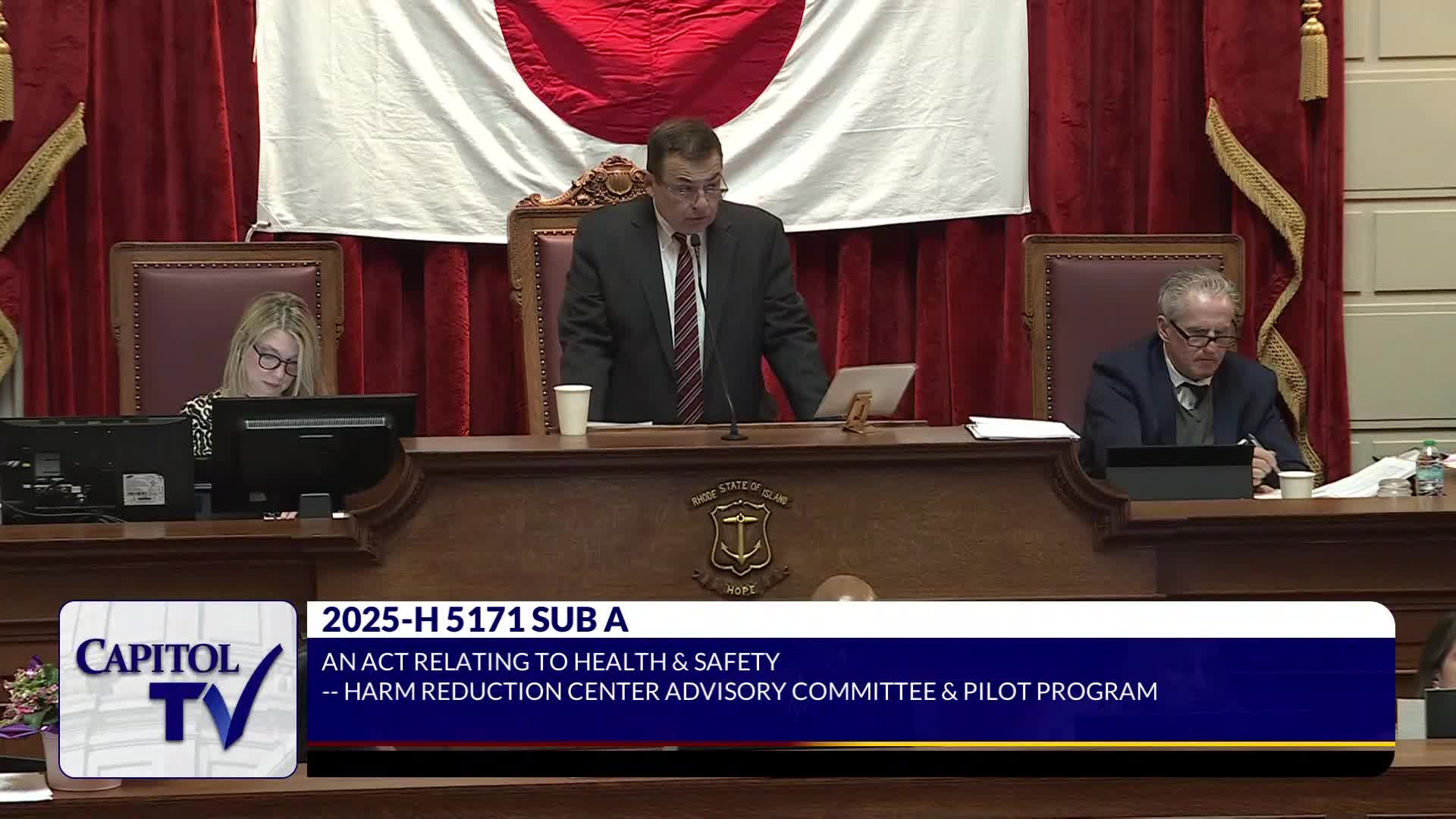
House extends pilot for supervised consumption sites to 2028 after heated debate
Summary
The Rhode Island House voted 51-17 on April 1, 2025, to extend the pilot program allowing supervised consumption (harm-reduction) centers until Jan. 31, 2028, and approved reporting requirements for health and legal officials; the measure drew prolonged debate over public-health benefits versus public-safety concerns.
PROVIDENCE — The Rhode Island House of Representatives voted 51-17 on April 1, 2025, to extend a pilot program for supervised consumption (harm-reduction) centers through Jan. 31, 2028, and to require a report from the director of the Department of Health and the attorney general on whether the program should continue.
The extension, carried in House Bill H 5171 (sub A), was amended on the floor to change the sunset date from 2026 to 2028 and to add specific reporting items, including the number of people served, the number connected to health services, and data on overdoses or deaths associated with the centers. The amendment passed 68-1; the final amended bill passed 51-17.
Supporters described the sites as a public-health intervention that keeps people alive and connects them to treatment. “About 35 different individuals have gone to the place near Rhode Island Hospital and used their drugs,” Representative Gregg M. Edwards said on the floor. “And there have been 22 interventions. That means people overdosed. And the staff had to bring them back.” Edwards, the bill sponsor, told colleagues the sites also provide “wrap-around services” and referrals into treatment.
Opponents argued the centers enable illegal drug use and can concentrate crime and disorder in surrounding neighborhoods. “I stood up here the day that these were created, and I spoke against these state-sanctioned opium dens,” Chairman Corvaci said during debate, adding he believed the policy sent a negative message to youth.
Lawmakers also described strong personal reasons for their votes. Several members recounted family losses to addiction and said they supported the extension to allow more data collection; others who opposed the bill cited concerns about neighborhood safety and the inability to require people to remain at the centers until no longer impaired.
The amendment that lawmakers approved adds reporting language requiring, on or before Jan. 31, 2028, that the director of the Department of Health and the attorney general submit recommendations to the governor and legislative leaders about continuation of the statute that governs the pilot program, unless extended by the General Assembly. Representative Edwards said the amendment reflects bipartisan agreement to gather clearer evidence before any further action.
During floor debate, members asked technical and operational questions: what kinds of staff work at the sites, how people get home afterward, whether centers are nonprofit and pay property taxes, and whether municipal governments decide whether to host a site. Sponsors said centers are staffed by medical personnel, nurses and peer-support specialists and that the current site coordinates with nearby hospital emergency services for acute problems.
Representative Edwards and other supporters said the sites have already prevented deaths and that extending the pilot will produce state-specific data. Opponents including Representative Lita Brienne and Representative Jason Fasha cited media accounts from other jurisdictions and argued the centers can increase public disorder, encourage dealers to congregate nearby, and do not substitute for long-term treatment capacity.
Votes at a glance
- H 5171 (sub A) — Extend supervised consumption pilot to 01/31/2028 and require DOH/AG reporting (amendment LC 000790/3 replaced date 2026 → 2028 and added reporting elements): Amendment passed 68-1; final bill passed 51-17. Sponsor: Representative Edwards. Outcome: approved.
Other calendar actions recorded during the same House session (selected):
- H 5797 — Enables municipalities to allow co-living housing in districts the municipality designates. Vote: 59-8. Outcome: approved. - H 5800 — Requires municipalities to provide for some residential development in commercial zones to promote mixed-use and medium/high density. Vote: 58-9. Outcome: approved. - H 5562 — Increases the independent-audit threshold for certain charitable organizations from $500,000 to $1,000,000. Vote: 66-0. Outcome: approved. - H 5300 — Classifies election officials and poll workers as public officials for the purpose of prohibiting threats and extortion against them. Vote: 57-10. Outcome: approved. - H 5686 — Requires municipalities to maintain and publish lists of CRMC-designated rights-of-way and public access areas. Vote: 68-0. Outcome: approved. - H 6027 — Extends reporting and expiration dates for the land-use commission studying housing, environment and development from 06/08/2025 to 06/08/2026. Vote: 69-0. Outcome: approved. - S 199 (Senate) — Ratifies amendments to the Barrington Home Rule Charter (duplicate of H 5189). Vote: 69-0. Outcome: approved.
Why it matters
The House’s vote keeps Rhode Island’s pilot in place while state health and legal officials compile a defined report that lawmakers requested. Supporters framed the sites as an emergency public-health measure to reduce overdose deaths and create routes into treatment; opponents said the policy risks increasing neighborhood disorder, trafficking and normalization of illegal drug use. The amendment narrows the issue to whether the pilot produces sufficient state-specific evidence to justify continuation beyond Jan. 31, 2028.
What’s next
Under the amended language, the director of the Department of Health and the attorney general must deliver recommendations on continuation of the statute by Jan. 31, 2028, to the governor and the leaders of both legislative chambers. Lawmakers said Brown University and local partners are collecting operational data that will be included in those reports; the General Assembly may then consider further action based on the findings.