Get Full Government Meeting Transcripts, Videos, & Alerts Forever!
Get email alerts on the State Budget Taxes topic
No spam. Unsubscribe anytime.
Senate Finance advances vehicle-fee cut, wireless tax break and other tax measures; income tax bill tabled
Summary
Montana Senate Finance and Claims held hearings and completed executive action on multiple tax and budget bills, advancing revisions to vehicle registration fees, a wireless infrastructure property-tax exemption, business equipment tax relief and other measures while tabling a large income-tax cut proposal.
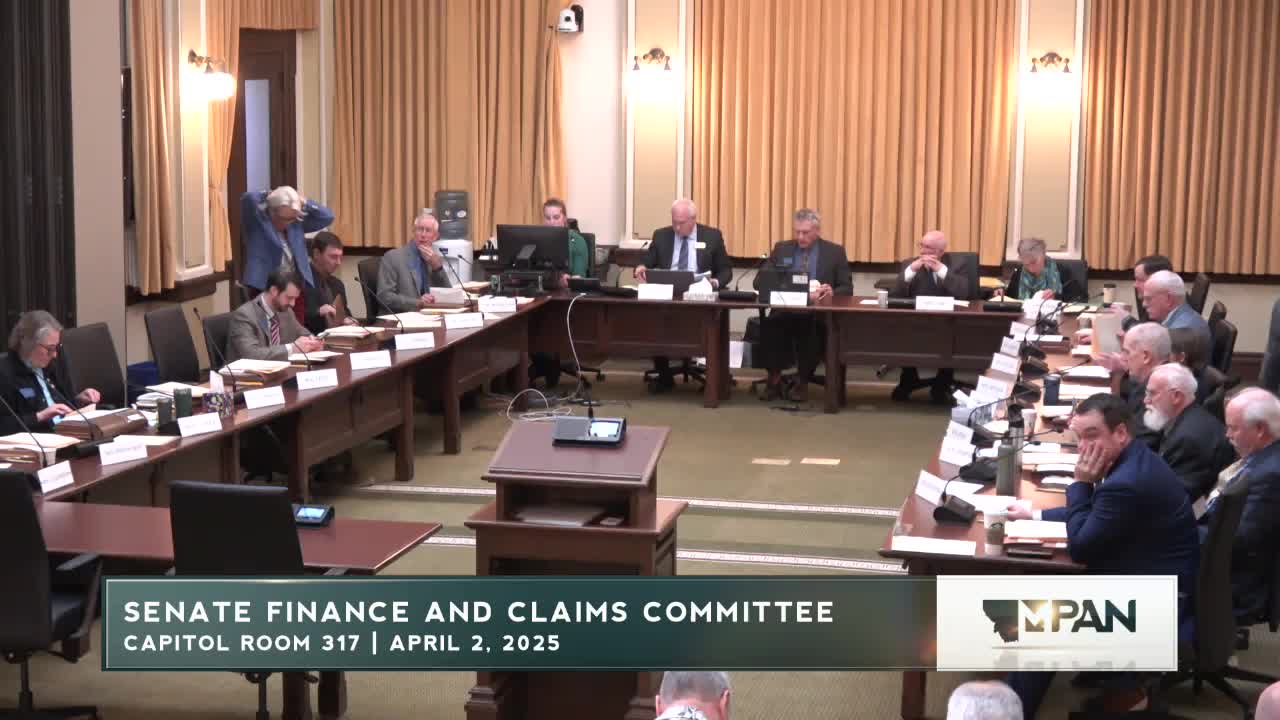
The Montana Senate Finance and Claims Committee on the morning session advanced a slate of tax and budget measures after hearings on several bills and then completed executive action on most items on its agenda.
Senators voted to move forward with a reduction in motor-vehicle registration fees (Senate Bill 327), an expanded exemption for wireless infrastructure (Senate Bill 534), an increase in the business-equipment tax exemption (Senate Bill 322, amended to $1.5 million), and several property-tax rebate and assistance proposals. A broad income-tax cut (Senate Bill 203) was debated at length and was tabled after a 10-12 recorded vote in executive action.
The vehicle registration bill, sponsored by Senator Greg Hertz, drew the committee’s first hearing. "I do have my money jacket on because we're here to talk about money," Hertz told the committee as he described the bill’s purpose to reduce registration fees and the fiscal work done to protect special revenue accounts and local entitlement-share payments. Department of Revenue and Legislative Fiscal Division staff described a negotiated amendment that inserts a floor in the entitlement-share growth formula (a guaranteed minimum growth rate of about 2.5%) and a cap (roughly 3–3.5%) so local governments’ entitlement-share payments continue to grow in normal amounts despite lower vehicle-fee revenue. Senator Hertz and Sam Shaffer of LFD said those technical adjustments aim to keep counties and special revenue accounts whole while producing relief for vehicle owners. The sponsor noted a modest additional general-fund cost in out years tied to the amendment; at close of hearing he referenced about a $3,000,000 incremental impact in one estimate.
On wireless infrastructure (SB 534), sponsors and industry proponents said the bill would allow a property-tax abatement on certain new wireless equipment while requiring companies to reinvest the tax savings into new deployment within two years. Amy Grimollis, representing Verizon, explained the reinvestment requirement in the bill’s draft: "To receive and maintain the exemption, the company must reinvest the tax savings... within 2 years." Proponents including AT&T and the Montana Chamber argued the exemption would spur investment in rural and underserved areas; the sponsor estimated a positive fiscal effect from new investment on the order of roughly $1.5 million.
Committee members also heard a subcommittee bill to change how cultural and arts operating grants are prioritized (House Bill 757). Representative John Fitzpatrick said HB 757 asks the Montana Arts Council to prioritize applicants by recent grant history and by annual operating budget so smaller or previously unfunded organizations can be identified during allocation. Montana Arts Council staff described existing vetting procedures and said priorities for this cycle emphasized smaller organizations and communities not among the seven largest in the state.
On property-tax matters, the committee advanced a one-time property-tax rebate concept (Senate Bill 434), and unanimously passed an expansion of the disabled-veteran property-tax assistance program to include veterans rated 60–90% disabled (Senate Bill 424). Supporters of SB 424 said the change would extend a modest property-tax benefit to several thousand veterans; Duane Cunningham of the American Legion testified in favor.
Business-equipment tax relief (Senate Bill 322) was amended in committee from a $3 million exemption to $1.5 million and passed by roll call. Proponents said the change removes many small and mid-sized businesses from the tax rolls and that the governor’s budget would backfill local jurisdictions. Opponents, including the Montana Budget & Policy Center, warned repeatedly that expanding exemptions shifts property-tax burdens to other classes of property, principally residential taxpayers, and urged caution on long-term structural implications.
A high-profile income-tax reduction bill (Senate Bill 203) drew extended testimony and multiple opponents in the hearing phase. Opponents including the Montana Budget & Policy Center and public-employee unions warned of large, ongoing reductions to the state’s tax base and recommended against the measure. During executive action the committee recorded a roll-call vote of 10 yes and 12 no and tabled the bill.
The committee also approved a transfer of a portion of the lodging (bed) tax to fund services for trafficking and domestic-violence survivors (Senate Bill 409). That measure passed with a recorded vote. During debate some senators raised concerns about programmatic impacts to other entities that currently receive lodging-tax funding; the committee chair declined to adopt a conceptual amendment on those allocations and suggested adjustments could be pursued in the House.
Votes at a glance
- Senate Bill 327 (vehicle registration fee reductions): Passed in executive action (recorded 12 yes, 10 no). Key details: amendment added a 2.5% minimum entitlement-share growth floor and a roughly 3–3.5% cap; sponsor said the change protects counties and special revenue accounts while reducing fees for vehicle owners.
- Senate Bill 322 (business equipment tax exemption): Passed as amended (amended from $3,000,000 to $1,500,000 exemption) (recorded 18 yes, 4 no). Backfill to local governments indicated in governor’s budget; opponents warned of shifting burdens to homeowners.
- Senate Bill 327 (note: same as first entry) — listed above.
- Senate Bill 409 (transfer of bed-tax funding to DOJ for trafficking/domestic violence services): Passed (recorded 19 yes, 3 no). Supporters said it will fund emergency lodging and services for survivors; some members sought to preserve other research or university-funded work that currently uses lodging-tax dollars.
- Senate Bill 534 (property-tax exemption for wireless infrastructure): Passed (voice vote, proxies assumed yes). Industry proponents said the exemption includes a reinvestment requirement and could spur new rural wireless investment.
- Senate Bill 434 (property-tax rebate; one-time payment): Passed (voice vote, proxies assumed yes). Sponsor described this as a backstop vehicle to deliver rebates similar to prior sessions; primary-residence rebate level discussed as $400 and an estimated program cost near $100 million was mentioned in testimony.
- Senate Bill 424 (expand disabled-veteran property-tax assistance to 60–90% disabled): Passed (voice vote, proxies assumed yes). Supporters estimated the expansion would affect several thousand Montana veterans.
- Senate Bill 203 (income-tax bracket changes): Tabled after executive action (recorded roll-call 10 yes, 12 no). Testimony emphasized a long-term large revenue loss and concerns about service funding and structural balance.
What happened next and what to watch
The committee completed executive action on most bills heard in the session and recessed until the next day; members indicated floor action and House consideration will follow on bills that passed. Committee leaders and staff repeatedly noted some allocations and backfill decisions are contingent on budget choices already made elsewhere (HJ 2 revenue estimates and governor’s budget assumptions). Several senators asked the fiscal staff for follow-up information — including median-income figures, comparative business-equipment-exemption levels in neighboring states, and the updated fiscal notes for amended bills — and staff said they will provide those figures to the committee.
Quotes and attributions in this report come from the committee record and witnesses: Senator Greg Hertz (sponsor) said the session was “to talk about money” and described the vehicle-fee bill as designed to "provide relief here to taxpayers." Dylan Cole, Department of Revenue, summarized the history of the entitlement-share approach: "The entitlement share was originally conceived back in 02/2001." Amy Grimollis, testifying for Verizon, described the reinvestment language in the wireless-exemption bill: "To receive and maintain the exemption, the company must reinvest the tax savings... within 2 years." Rose Bender of the Montana Budget and Policy Center opposed the income-tax bill, warning it would be "a sustained large loss of income tax revenue."
The committee asked staff to prepare updated fiscal notes where bills were amended and to supply additional data on revenue forecasts and distributional impacts. Several senators signaled they would press changes to bill language as the measures proceed to the floor or next chamber.
The session transcript and committee record contain the detailed roll-call tallies and verbatim witness testimony supporting the summary above.