Get Full Government Meeting Transcripts, Videos, & Alerts Forever!
Get email alerts on the Environment topic
No spam. Unsubscribe anytime.
DNREC highlights Indian River replenishment, shoreline work and a proposed permit‑fee update
Summary
DNREC told the Bond Bill Committee it completed a state‑funded sand replenishment at Indian River Inlet, expects the Army Corps to follow with a second phase, presented shoreline/dredging and debris‑pit needs and outlined a proposed fee package to shore up permit staffing funded largely by assessed fees.
A senior DNREC official and division leaders briefed the Bond Bill Committee March 26 on shoreline replenishment, dredging, property cleanup and a proposed fee package that would raise agency fee authority to support permit processing and other regulatory operations.
DNREC said it led a state‑funded replenishment of the north side of Indian River Inlet that delivered about 478,000 cubic yards of sand and that the U.S. Army Corps of Engineers plans a follow‑on placement of about 600,000 cubic yards later this year. The department also reported it expects the inlet’s sand bypass plant to be reactivated in the coming weeks, which will assist long‑term sand movement between inlet sides.
Why it matters: The replenishment was described as a large, immediate intervention to protect ocean beaches, roadways and infrastructure. DNREC emphasized that large coastal projects depend on both state match dollars and corps planning; the agency warned of uncertainty in federal construction funding and said it has already seen some slower federal grant obligations.
Dredging, bay beaches and shoreline planning DNREC said the corps is designing projects for six bay communities with program design funds totaling about $62 million and a 90/10 federal‑to‑state cost share (as authorized in federal legislation). The department cautioned that the corps' design funds may not cover all six bay beaches and that project prioritization decisions will follow design outputs.
The agency described an expanded statewide dredged‑material plan to identify beneficial use and disposal sites and reported progress on canal and river dredging projects, including completed and scheduled work in Assawoman Canal, Indian River, Lewis and Rehoboth Canal, and the Pennsylvaniadale (Penn Dale) Trail bridge replacement.
Debris pits and tax ditches DNREC summarized its debris‑pit cleanup program: 21 properties remediated in FY24, averaging about $52,000 per property; six properties remediated so far in FY25 and 22 more deemed shovel‑ready. About 89 properties remain on the backlog. The department said it is using two contractors to speed work.
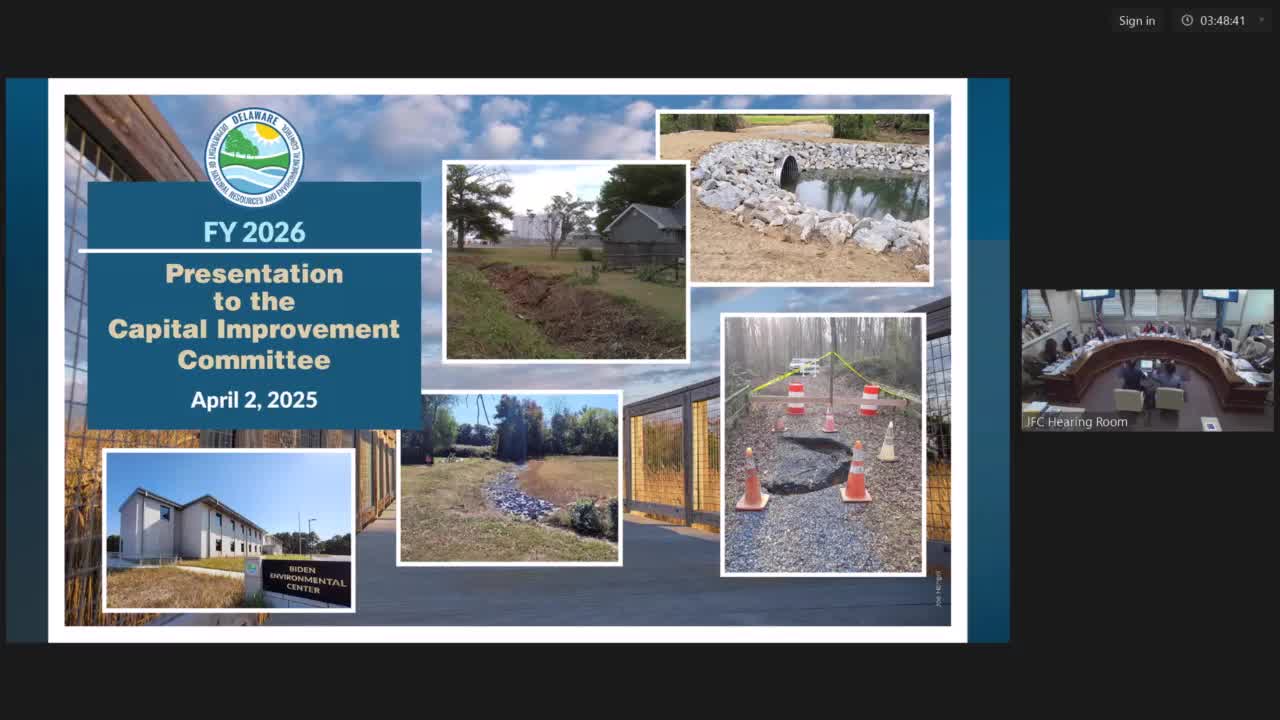
Resource conservation and development (RC&D) DNREC highlighted RC&D projects done in partnership with county conservation districts. Examples cited to the committee included a McKee Road drainage project in Kent County ($239,000 total cost) and a Wollston Walk drainage replacement in Sussex ($256,000) that included closed drainage installation and driveway crossing replacements. In New Castle County DNREC cited an Oak Ridge project that replaced a 30‑inch pipe with box culvert and a stream restoration project funded by community reinvestment dollars and RC&D funds.
Permit fee package and operating funding DNREC described a multi‑year effort to update permit fees that fund much of the agency’s regulatory work. The department said 52 percent of DNREC’s operating budget is funded by ASF (assessed fees and similar receipts), and many of the fees in watershed, air and waste programs have not been adjusted in roughly 30 years. The administration’s prior proposal included around 55 fee changes (101 increases, 45 new fees) and a net revenue estimate in the several‑million‑dollar range; DNREC said it is taking the package to stakeholder groups for further discussion before finalizing legislative proposals.
As an example, DNREC showed its onsite septic program pays modest permit fees today (averaging roughly $75) while the program’s full cost is roughly $903,000; raising some septic permit fees to about $250 in a prior proposal would move program revenue closer to the cost of service (an estimated $653,000 in revenue under that scenario), DNREC said.
Federal funding uncertainty Several DNREC leaders told the panel they are watching federal funding closely. The department cited a recent continuing resolution that reduced the corps’ construction budget nationally and said the corps will need to redesign schedules; DNREC said it is coordinating with the corps and the state’s federal delegation to understand the effects for Delaware projects.
Ending note DNREC asked the committee to support a capital program that includes parks rehabilitation, RC&D and shoreline/dredging funding while it continues stakeholder consultations on a permit fee package designed to stabilize long‑term regulatory capacity.