Get Full Government Meeting Transcripts, Videos, & Alerts Forever!
Get email alerts on the Free Speech Pronouns topic
No spam. Unsubscribe anytime.
Debate intensifies over 'Free to Speak' bill as Montana lawmakers weigh employees' and students' speech protections
Summary
Montana lawmakers heard sharply divided testimony on House Bill 400, which would bar discipline of students, public school employees and state employees who decline to use nonlegal names or preferred pronouns.
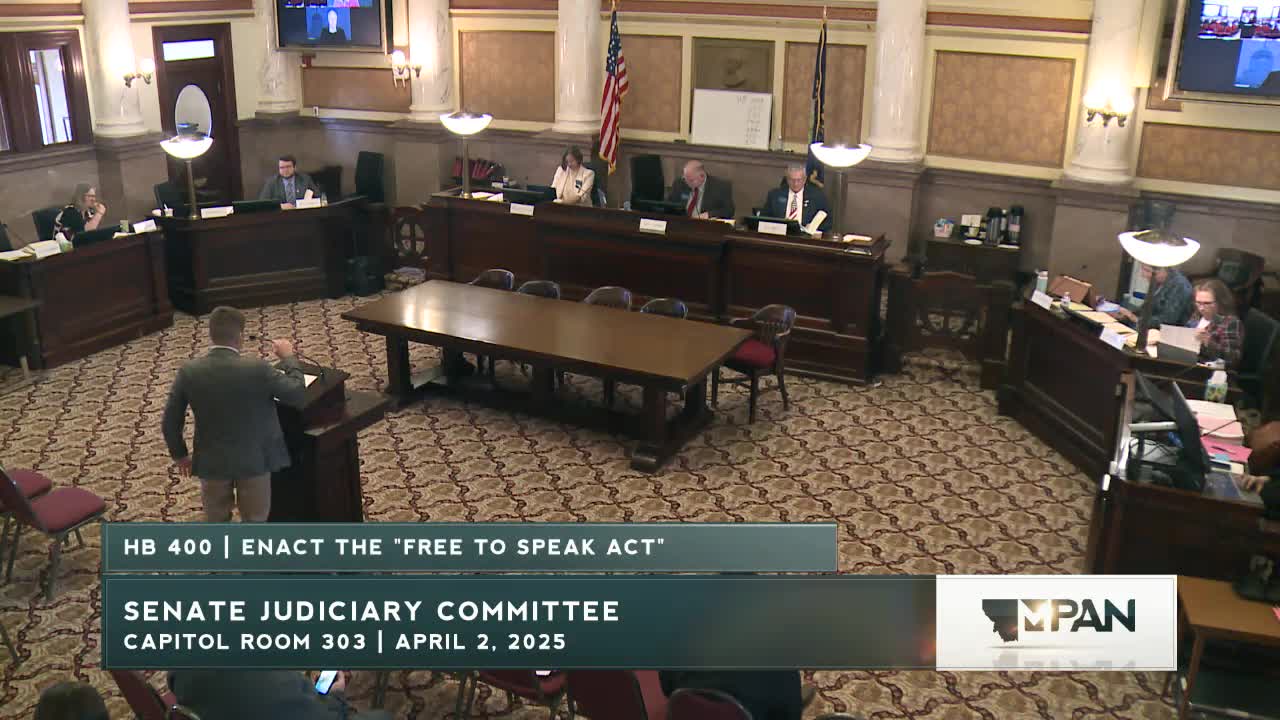
Montana's Senate Judiciary Committee heard sharply divided testimony on House Bill 400, the "Free to Speak Act," which would bar punishment of students, public school employees and state employees for declining to use nonlegal names or preferred pronouns.
Sponsor Rep. Braxton Mitchell, R, said the bill protects free expression and conscience. "This bill upholds the first amendment," the sponsor said, arguing the measure shields people from being compelled to use language they believe is false. "Men are men. Women are women. Biology is biology," Mitchell said, framing the measure as protection from compelled speech.
Proponents said students and teachers have faced discipline in campus and school settings over pronoun use and that recourse through lawsuits is slow and costly. Greg Chaffen, senior counsel with Alliance Defending Freedom, told the committee that teachers and public employees "should not be forced to accept and then profess an ideology with which they disagree." Several students and recent graduates also testified in favor, offering anecdotal accounts of being disciplined or fearing disciplinary action for refusing to use nonlegal pronouns.
Opponents argued the bill would undermine schools’ ability to address harassment and bullying and would protect misconduct. Rob Watson of the School Administrators of Montana said the bill "seeks to override the discretion of school administrators and other educators to determine when behavior crosses a line into bullying and harassment." Amanda Curtis, president of the Montana Federation of Public Employees and a high-school teacher, said the bill "impedes school staff's ability to protect all kids and our ability to follow parents' wishes regarding how their kids are treated and addressed."
Public-safety and health groups, civil-rights organizations and university advocates also testified in opposition. The ACLU of Montana said schools should be able to ensure "students learn best when they feel safe to be themselves and can develop trust with their teachers and peers." Opponents warned the bill could permit deliberate, repeated misgendering or "deadnaming" with no effective remedy from schools.
Why it matters: The proposal pits competing constitutional values — protections against compelled speech and protections against harassment and discrimination — and would affect how K–12 districts, colleges, and state agencies handle disputes over names and pronouns. School administrators warned it could increase legal exposure and complicate disciplinary decisions; supporters said federal litigation has shown courts sometimes side with employees and students disciplined for refusing to use preferred pronouns.
The committee heard both personal testimony and organizational positions; there was no committee vote recorded during this session.
Ending: Members said they would consider the competing constitutional and operational concerns as the bill moves through the legislative process.