Get Full Government Meeting Transcripts, Videos, & Alerts Forever!
Get email alerts on the Public Funds Collateral topic
No spam. Unsubscribe anytime.
Finance division outlines banking services and collateral program protecting public deposits
Summary
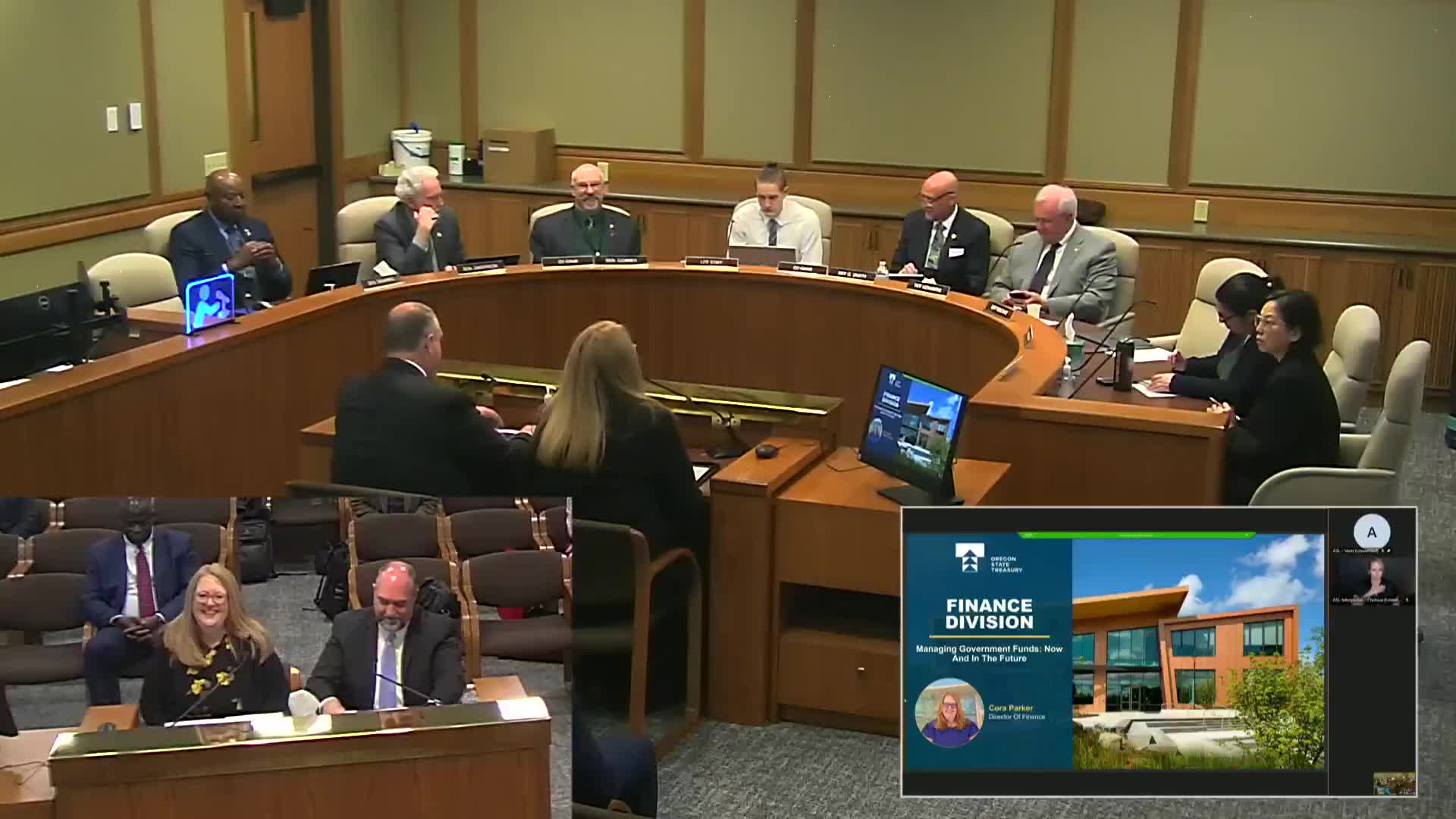
Finance Director Cora Parker told the General Government Subcommittee the Treasury provides centralized banking and cash-management services for about 80 state agencies, roughly 1,100 local governments and 10 public university entities, and runs a collateralization program that protects more than $3.3 billion in public deposits above FDIC limits.
Cora Parker, director of finance for the Oregon State Treasury, told the General Government Subcommittee on April 2 that the finance division provides centralized banking and cash-management services that enable state agencies, universities and local governments to collect and disburse funds securely and to earn investment returns in the Oregon Short Term Fund.
"Customer accounts are held at treasury and we provide daily and monthly account statements to our customers that reflect all of their transaction activity and their balances," Parker said. She said the division managed about 18.4 million transactions in 2024 that totaled roughly $419 billion.
Parker described the public funds collateralization program that requires qualified banks and credit unions to provide collateral for public deposits in excess of FDIC limits. "This program requires that banks and credit unions provide collateral for all public deposits that are in excess of that federal deposit insurance limit," Parker said, and she told members that as of the end of 2024 more than $3.3 billion in public deposits were protected by the program.
Why it matters: Centralized banking reduces costs through volume pricing, helps deploy operating cash into the Oregon Short Term Fund for returns, and adds a layer of protection for public funds above federal deposit insurance. Lawmakers questioned whether the collateral requirement limits participation by small rural institutions and how Treasury balances access and security.
Details and context
- Customers and participation: Parker said Treasury supports about 80 state agencies, nearly 1,100 local governments, and 10 public university entities. Participation by universities is permissive; institutions choose the level of services they use.
- Collateral methods: Banks and credit unions can meet collateral requirements by pledging securities or by letters of credit (often from a Federal Home Loan Bank), Parker said.
- Rural bank participation: Committee members asked whether smaller community banks can participate. Parker said the decision is ultimately a business one for each bank and that Treasury currently has a mix of large and small banks and credit unions in the program.
- IT, resiliency and modernization: Parker and Deputy Treasurer Naughton described ongoing modernization of treasury systems and a separate IT package to virtualize backups (agency files are stored off-site in Spokane under the current arrangement).
Quotes from the hearing
"Customer accounts are held at treasury and we provide daily and monthly account statements to our customers that reflect all of their transaction activity and their balances," Cora Parker, Director of Finance, said.
"This program requires that banks and credit unions provide collateral for all public deposits that are in excess of that federal deposit insurance limit," Parker said.
Next steps
The finance division said it is not requesting additional policy packages for basic banking services in this cycle but that it will continue modernization efforts and will present related IT and administrative requests later in the subcommittee schedule. No formal votes were taken during the informational session.