Get Full Government Meeting Transcripts, Videos, & Alerts Forever!
Get email alerts on the Municipal Judiciary Residency topic
No spam. Unsubscribe anytime.
Subcommittee adopts temporary protection for municipal judges after Tennessee Supreme Court ruling
Summary
Following the Tennessee Supreme Court's March 7 decision in McNabb v. Harrison, the subcommittee approved House Bill 4 90 to preserve the status and rulings of municipal judges elected before that ruling and to apply the one-year residency requirement prospectively.
April 2025 — The Civil Justice Subcommittee approved House Bill 4 90 as amended, a measure intended to address consequences stemming from a March 7 Tennessee Supreme Court decision (McNabb v. Harrison) that interpreted residency requirements for municipal judges.
Sponsor Representative Hilton Haynes said the legislation prohibits removal or disqualification of municipal judges who were duly elected or appointed before March 7, 2025 and who were qualified under the law as it existed at the time of their election or appointment. The bill treats those judges as de facto officers and declares their acts, judgments, and decisions valid and binding for the remainder of their terms. It also states the one-year residency rule articulated by the Tennessee Supreme Court will apply starting with the next regularly scheduled election for affected judgeships.
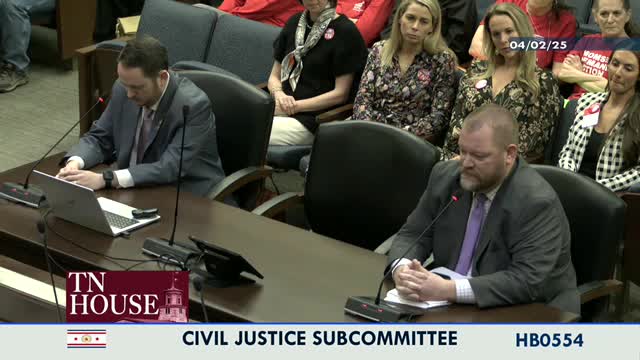
Mark Litchford, city attorney for East Ridge, told the committee the measure provides guidance and due process for municipalities that have sitting judges who met prior qualifications but may not meet the reading of residency articulated in McNabb. He said the bill affects about 20 to 25 municipalities, particularly in Hamilton County, and would avoid backlog in general sessions courts by preserving municipal adjudications during the current judges' terms.
The committee voted 6-0 to advance the bill to full judiciary as amended.
Background: The sponsor and municipal attorneys said the bill is intended to provide a prospective fix and protect municipal court operations and property owners from disruption while applying the Supreme Court's residency interpretation to future elections.