Get Full Government Meeting Transcripts, Videos, & Alerts Forever!
Get email alerts on the Nuisance Abatement topic
No spam. Unsubscribe anytime.
Subcommittee approves measure to speed civil action against businesses tied to repeated criminal activity
Summary
House Bill 10 50, amended in committee, creates a streamlined civil-nuisance pathway allowing prosecutors to seek abatement of properties after multiple unrelated arrests at the same location; the measure drew support from prosecutors and was approved unanimously.
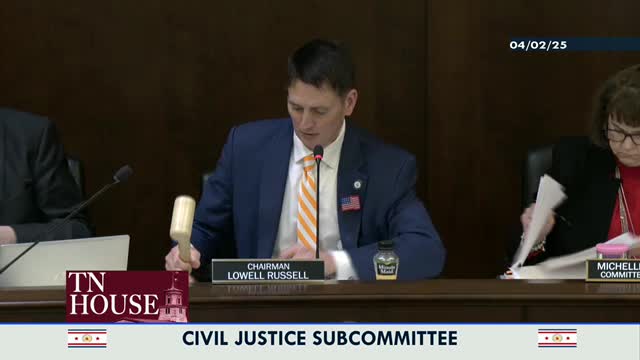
April 2025 — The Civil Justice Subcommittee unanimously approved House Bill 10 50 as amended, moving the measure to full judiciary. The bill provides a more streamlined procedure for district attorneys, city attorneys and county attorneys to bring civil nuisance actions against properties where a pattern of criminal activity occurs.
Sponsor Representative Parkinson said the measure was drafted after constituent complaints about recurring criminal incidents at particular properties, including a case he cited involving a daycare and businesses near a strip center. "This streamlines the process so we can close these hubs for crime down faster and save these businesses that are adjacent to these centers," Parkinson said.
Mike Donavan of the Tennessee District Attorneys General Conference explained the bill's operation: after notice is provided, three or more unrelated arrests for enumerated offenses (including drug charges, assaults, firearms offenses, prostitution-related offenses, trespassing and juvenile offenses) at the same property within a defined period can lead to a presumption of a public nuisance. Upon a subsequent (fourth) qualifying arrest, the property can be subject to an abatement action without the need to prove a broader pattern of conduct. Donavan said the draft was modeled on Georgia's law and that a judge could issue temporary orders, including padlocking properties, while abatement is pursued.
Sponsor and a representative of the DA conference emphasized the bill is intended to protect nearby businesses, residents and property values. The committee voted 7-0 to send the bill to full judiciary as amended.
Background: Current Tennessee law allows certain public officials to seek nuisance abatement, but witnesses said proving a pattern of behavior can be time-consuming. The bill creates a statutory per se nuisance after specified thresholds of arrests and related notice procedures.