Get Full Government Meeting Transcripts, Videos, & Alerts Forever!
Get email alerts on the Second Amendment Litigation topic
No spam. Unsubscribe anytime.
Bill creating private cause of action for Second Amendment infringements fails in subcommittee
Summary
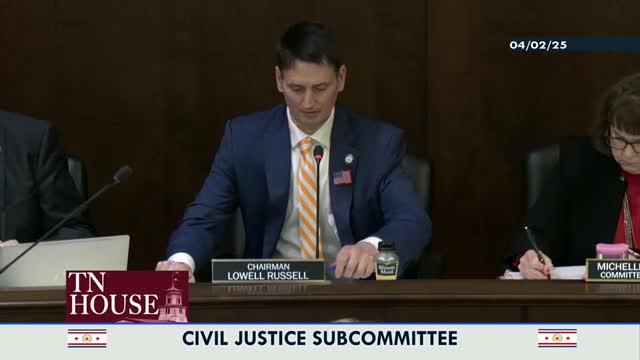
House Bill 554, which would create a civil action against government entities or officials who infringe on Second Amendment rights, failed in the Civil Justice Subcommittee after testimony from law enforcement and the Tennessee Bureau of Investigation raised concerns about liability for officers.
April 2025 — House Bill 554, described by its sponsor as the Firearms Freedom Protection Act, failed in the Civil Justice Subcommittee after law-enforcement witnesses warned the measure as drafted could expose officers and agencies to significant civil liability.
Representative Capley, the sponsor, said the bill creates a civil cause of action against any governmental entity, official, employee, or agent who "infringes upon a person's right to bear arms under the Tennessee Constitution or the United States Constitution." He said the measure's intent is to provide citizens a litigation remedy when officials exceed their authority.
Jimmy Musick, testifying for the Tennessee Sheriffs' Association and Tennessee Association of Chiefs of Police, said law enforcement does not intend to enforce statutes a court has declared unconstitutional but raised scenarios where officers executing search warrants or acting in good faith could be exposed to punitive damages or official-oppression charges if later a court suppresses evidence. "Our problem comes into, when you're looking in here about something like a search warrant, a search warrant that's later suppressed...that is where we would have a problem," Musick said.
Patrick Powell, policy director at the Tennessee Bureau of Investigation, called the bill "overly broad" and said it could allow many individuals to sue law enforcement and does not appear to include a statute of limitations. He said that, as drafted, officers could face suits years later for actions they reasonably believed lawful at the time.
Sponsors said they were open to clarifying amendments to address law-enforcement concerns, but the committee voted against the bill. The clerk reported 3 ayes and 4 nos; the bill failed to advance.
Background: Supporters described the bill as a way for citizens to seek redress when officials exceed constitutional authority; law-enforcement groups warned it could chill policing and create costly exposure for individual officers and agencies.