Get email alerts on the Animal Waste Ordinance topic
No spam. Unsubscribe anytime.
Residents press for regular water testing as county forms animal waste work group
Summary
Two residents urged more frequent water monitoring amid concerns about elevated phosphorus; county conservation staff says a 25-member animal waste ordinance work group will begin meetings in April to develop recommended amendments.
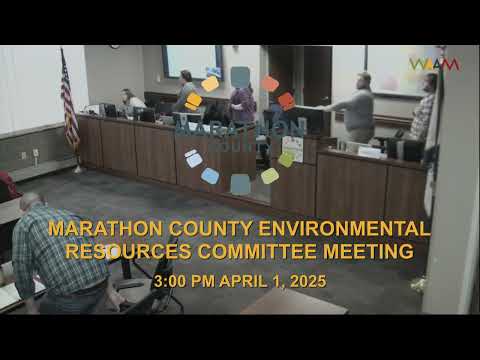
Two residents spoke at public comment during the Marathon County Environmental Resources Committee meeting on April 1, calling for verification and more research into elevated nutrients in local waterways, and county staff reported the formation of a 25-member animal waste ordinance work group to begin meetings in April.
Kevin Schmiedke (first-reference: “Town of Day, Kevin Schmiedke”) told the committee he had paid to test five local water samples for phosphorus and urged the committee to adopt a simple, recurring verification program. “I guess alls I ask for out of the committee is if we're going to research something, can we trust but verify?” Schmiedke said, offering his results and asking staff how to submit them to the county record.
Trin Spindler, introduced herself as a small Wisconsin dairy farmer from the Town of Day and a member of the Marathon County Farm Bureau board. She offered research sources and recommended that any ordinance work rely on nutrient-management plans and best management practices that help farmers reduce costs while protecting water.
Why it matters: Residents and farmers are directly affected by any county-level animal waste or manure ordinances; frequent, reliable monitoring data and buy-in from farmers are important to designing effective approaches.
County response and work group Conservation manager Kirsty Heidenreich told the committee that staff have convened a stakeholder work group to draft proposed amendments to the county’s animal waste ordinance. She said 25 participants have signed up and represent a broad mix of perspectives: regulated confined animal feeding operations (CAFOs), livestock farms, midsize farms, small dairy operators, cash-crop farmers, two town officials (including Supervisor Drabek), Wisconsin DNR representatives, and other stakeholders. Heidenreich said the first work-group meeting was scheduled for April 2 at a town hall and a second on April 24; staff plan to report back to the ERC in May.
Heidenreich described the work group’s goal as producing a short set of shared guiding principles and practical recommendations. She told the committee staff will take thorough notes, share them with participants and provide a robust update at the May ERC meeting.
What residents asked for Schmiedke presented five phosphorus test results he had paid to have analyzed (each sample cost about $20; total time to collect and process the samples about four hours). He described sample locations and values he said he received (transcript excerpts): 0.37, 0.23, 0.05, 0.38 and 0.11 (units as reported in the samples; county staff would need to verify laboratory calibration and reporting units). Schmiedke asked that the committee consider a modest recurring sampling program so the community “has something to go on” while staff and the work group consider ordinance changes.
Next steps The committee did not take formal action on the citizen-submitted samples during the meeting. Staff accepted Schmiedke’s offer to submit his paperwork and said staff will share submitted materials with the committee and work group. The work group will meet in April and is expected to provide a summary and recommended principles to ERC in May.
Notes on attribution and evidence: Direct quotes and sample values in this article are drawn from the public-comment portion of the committee transcript (April 1 ERC meeting). The county staff statements about the work-group membership and schedule were reported on the record by conservation manager Kirsty Heidenreich.
AI generated
The text on this page is AI generated. Summaries, highlights, analysis, and video transcripts are all produced from the original source material.
AI can make mistakes, so if you spot one, and we will fix it for everyone.
Note: the source content is unaltered by us. Any content source we link to, be it a video, an audio recording, or a document, is presented exactly as its publisher released it. That publisher is usually a government body, sometimes an individual official or another organisation.