Get Full Government Meeting Transcripts, Videos, & Alerts Forever!
Get email alerts on the Land Use Carbon Offsets topic
No spam. Unsubscribe anytime.
Senate rejects bill to create public registry for carbon offset agreements on private land
Summary
Senate Bill 730 — a proposal to require recording and public disclosure of carbon offset agreements and projects affecting West Virginia timberland — failed after an extended floor debate about landowner rights, fees, penalties and impacts on the timber industry.
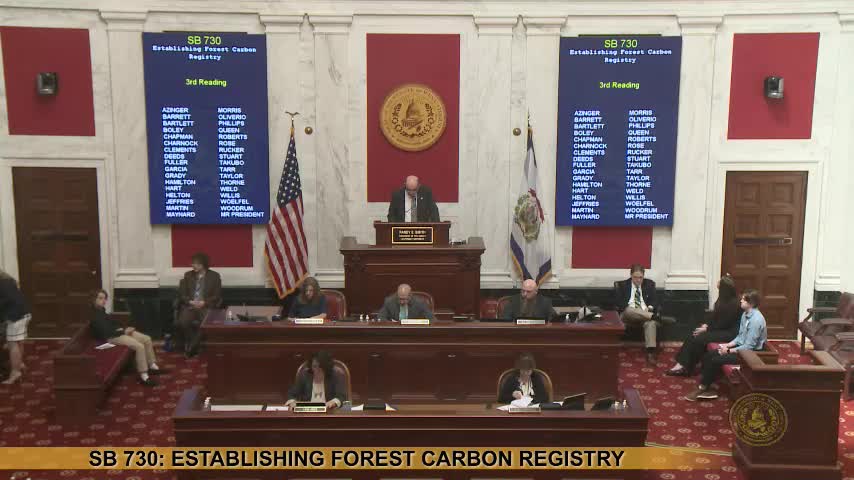
Senate Bill 730, which would have established a registry to record carbon offset agreements and projects encumbering West Virginia properties, failed on the Senate floor on April 1, 2025, by a vote of 16‑18.
Sponsors described the measure as a transparency tool: the division of forestry would have tracked properties encumbered by carbon offset agreements, required GIS shapefiles and deed references, and recorded parties and contract durations so potential buyers would see encumbrances before purchase.
“The motivation for what brought the bill before us is so that we can actually see how much land is actually encumbered,” the bill sponsor said, describing prior discussions about venture capital groups locking up timberland. The bill included possible civil penalties for failure to record: a $2,500 first offense, $5,000 second offense and, for subsequent offenses, suspension of a responsible party’s West Virginia business license. The measure authorized the forestry division to develop rules and to establish reasonable fees to administer the registry.
Opponents — including several legislators who identified themselves with farming, forestry and property‑rights concerns — argued the proposal could harm landowners, reduce property values and expose family farms to penalties. One senator said the bill would “raise taxes” because the forestry division could set fees; others said the penalty structure could effectively penalize farmers and landowners who lack business licenses.
Several members proposed alternative approaches that would require out‑of‑state purchasers or carbon credit developers to report details, rather than placing statutory recording obligations and potential penalties on West Virginia landowners. Supporters said an earlier proposal to impose an excise tax on such transactions was more intrusive and had been rejected by the Legislature; they characterized the registry bill as a transparency measure rather than a prohibition.
After prolonged debate and multiple clarifications on fees and enforcement, the Senate rejected the measure, with the chair declaring the bill rejected after the tally fell short of a majority.
Floor discussion also included concerns about whether the registry would raise administrative fees, whether civil penalties are the appropriate enforcement tool, and whether the bill would have a chilling effect on timbering and the forestry economy.