Get Full Government Meeting Transcripts, Videos, & Alerts Forever!
Get email alerts on the Taxes Small Business topic
No spam. Unsubscribe anytime.
Senate approves nonrefundable tax credit for small businesses after heated floor debate
Summary
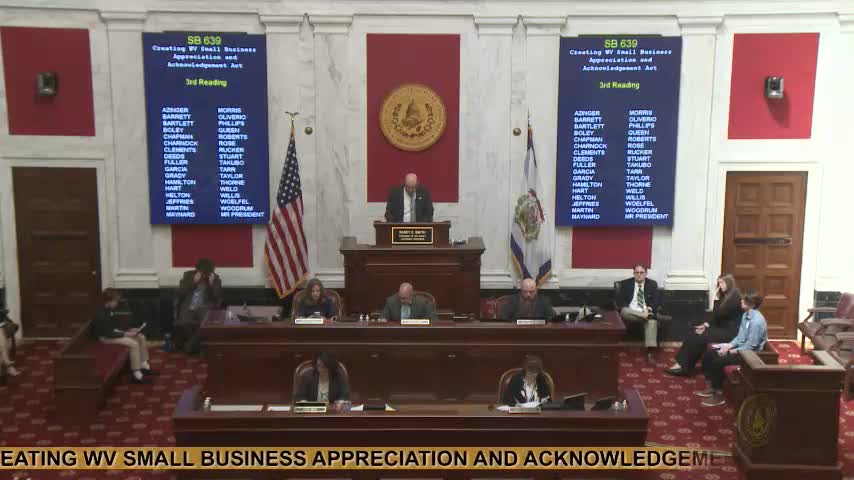
Senate Bill 639 creates a tiered nonrefundable tax credit for small businesses to offset compliance time; supporters said it rewards entrepreneurs, opponents said the state can't estimate cost and it risks city budgets.
The Senate passed Senate Bill 639, the West Virginia Small Business Appreciation and Acknowledgment Act, on April 1 by a vote of 27‑7. The bill establishes a tiered, nonrefundable state tax credit to offset time small business owners spend complying with state laws and regulations.
Under the bill, businesses with annual gross receipts under $2,500,000 qualify for a $2,000 credit; firms with less than $600,000 in annual receipts would get $500; businesses with less than $50,000 receive no credit. The sponsor said the credit is intended to acknowledge the time small proprietors spend on regulatory compliance and bookkeeping.
Floor debate was extensive. Supporters argued the measure helps “second‑income entrepreneurs” and family businesses and is a pro‑small‑business signal in a state that has awarded large incentives to out‑of‑state firms. Opponents, including the finance chair and other senators, argued the fiscal impact is uncertain: the finance chairman said the committee could not reasonably estimate the bill’s cost and noted that tax credits reduce state revenue the same as direct spending and must be offset by cuts or other revenues.
Several senators also raised concerns that municipal budgets depend on business and occupation taxes and that raising the threshold for local licensing and B&O taxes could hurt smaller cities and towns. The bill’s sponsor offered and won an amendment adjusting thresholds for municipal B&O and business licensing from $25,000 down to $10,000, a compromise intended to reduce municipal revenue impacts.
The Senate ultimately approved the bill and directed the clerk to communicate the passage to the House. Senators who opposed the bill cited fiscal uncertainty and potential harm to municipal finances; supporters argued the measure will reward local entrepreneurs and help small business formation.