Get Full Government Meeting Transcripts, Videos, & Alerts Forever!
Get email alerts on the Fisheries Bycatch Genetics topic
No spam. Unsubscribe anytime.
House Finance Committee approves $500,000 for Bristol Bay real‑time bycatch genetics program
Summary
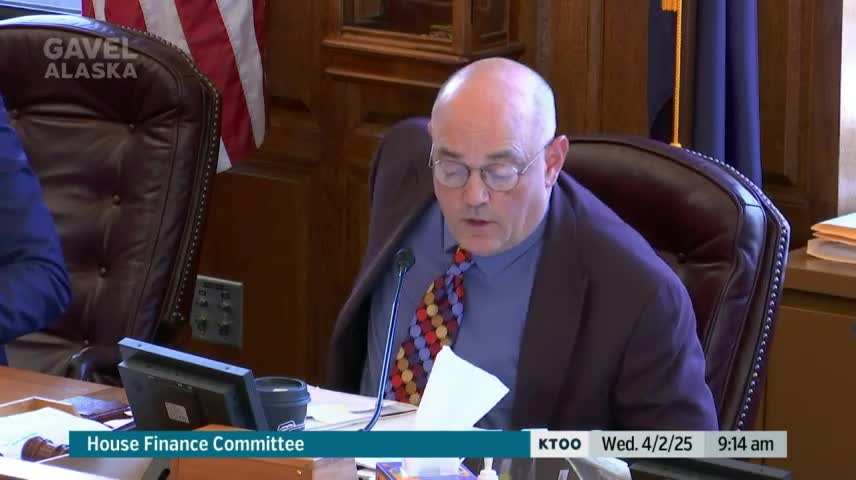
On April 2 the House Finance Committee adopted Amendment 93, adding $500,000 to support Bristol Bay Science & Research Institute’s real‑time chum salmon bycatch genetics work and added intent language requiring data sharing with the Alaska Department of Fish and Game.
The House Finance Committee on April 2 approved Amendment 93, adding $500,000 to the Bristol Bay Science & Research Institute (BBSRI) to support a real‑time genetic testing program aimed at reducing bycatch of Western Alaska chum salmon in the Bering Sea pollock fishery. The committee also adopted language clarifying that data produced with the appropriation should be shared with the Alaska Department of Fish and Game.
Committee co‑chair Josephson, who offered the amendment, said the funding would allow BBSRI to “conduct and process genetic sampling throughout the 2025 fishery” and described the program as providing real‑time information for fishery managers. Josephson likened the role of the testing to “air traffic controllers in in the fishery,” saying the data would help the industry avoid areas with high proportions of Western Alaska chum stocks.
The amendment continues a multi‑source effort. Committee members and staff cited a capital appropriation made in 2023 of nearly $1 million for BBSRI to develop the testing tools, and a 2024 pilot that demonstrated the lab can deliver genetic results quickly enough to inform management decisions during the season. Lehi Painter of the Legislative Finance Division told the committee he was not familiar with all program details but confirmed the 2024 pilot and the standing FY24 capital appropriation.
Supporters said the program could protect subsistence and small commercial fisheries in Western Alaska while allowing the pollock fishery — which generates landing tax revenue for the state and supports Community Development Quota (CDQ) programs — to continue operating with fewer closures. Representative Hannon told colleagues the Legislature funded the initial development because industry‑funded research can be perceived as biased, and the state grant helped establish an independent pilot. "In '24 the grant was given in '23... they did that and said, yeah, we can get the results in a timely fashion to turn it to the fisheries managers," Hannon said.
Representative Galvin, who said his district had experienced the effects of poor runs, described the science as proven: "They can take out the bone of the ear, and they can tell exactly where this fish comes from," he said, referring to otolith analysis and genetic stock identification used to determine origin rivers and regions.
Members raised questions about funding sources and how the testing would translate into management action. Committee discussion identified several funding streams that BBSRI expects to use or seek: the FY23 capital appropriation, CDQ landing tax funds, BBSRI’s own investment, and a projected federal earmark of about $1 million in calendar year 2026. Several members emphasized the program is intended to produce timely data that managers and industry could use to move effort away from areas with high proportions of Western Alaska chum.
Representative Johnson offered a conceptual amendment to add intent language requiring that data produced with the grant be provided to the Department of Fish and Game; that amendment was objected to briefly but then incorporated after the maker renewed the motion and the objection was withdrawn. A committee member later declared a potential conflict of interest and was excused from voting; the transcript does not record a numerical rollcall tally. The chair stated, "Seeing and hearing none, it's adopted." The amendment was then adopted and the meeting adjourned.
The appropriation is described in committee discussion as a one‑time bridge allocation intended to fund full‑season, real‑time sampling during the 2025 pollock season. Committee members said the pilot in 2024 showed the lab can return results fast enough to inform management decisions during the season; they did not provide an independent evaluation of effect size or quantify how many chum returns might be increased by implementing the testing and subsequent management actions.
Opponents or abstainers were not identified by name in the transcript; no formal vote tally (yes/no/abstain counts) was provided in the hearing record included in the transcript.
The committee moved on to other business and recessed until its afternoon session on defined benefit reform. The amendment’s funds and the intent language now rest with the Legislature’s enacted bill (amendment 93) and with BBSRI’s operational plans to implement daily sampling and reporting during the 2025 season.