Get Full Government Meeting Transcripts, Videos, & Alerts Forever!
Get email alerts on the Seafood topic
No spam. Unsubscribe anytime.
Labor shortages and processing closures have driven seafood employment down, department says
Summary
The Alaska Department of Labor reported sustained declines in fish-harvesting and seafood processing employment, rising nonresident worker shares and uncertainty around recent processor sales or closures affecting local access to processing capacity.
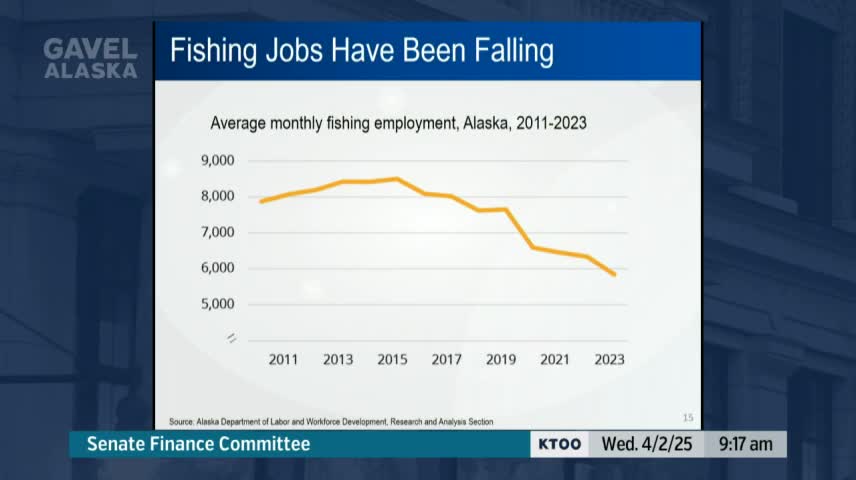
Dan Robinson, research chief at the Alaska Department of Labor and Workforce Development, told the Senate Finance Committee that both fish-harvesting and seafood-processing employment have fallen substantially over the last decade, and that closures or sales of processing facilities raised localized risks for fishermen.
Robinson said annual fish-harvesting job counts fell from roughly 8,300 in earlier years to below 6,000 in the most recent available year. He described the department’s method for assigning jobs to fisheries: geographic location is taken from the permit associated with landings, and monthly landings assign employment to the place of work rather than place of residence.
On processing, Robinson said the department prepared a historical article after Trident, Peter Pan and other processors announced sales or closures. He said processing facilities are geographically concentrated near where catches occur and that about 150 “facilities” of varied sizes exist across the state. Robinson warned that for some local areas a processing facility at risk may have been “all that was available for the fishermen in those areas,” and that alternative processors were not always a realistic substitute.
Robinson also said the share of nonresident workers in seafood processing has trended higher: “it hovered at around this for for a long time we thought of it as two thirds and then we were thinking about about three fourths. And now we're getting… well above that.” He noted data through 2023 and said the department expects the nonresident share likely increased again in 2024, but that 2024 data were not yet available in full.
Senator Keel asked how the department allocates jobs when a worker fishes multiple species or in different months; Robinson replied that landings for each month are assigned to the geographic area tied to the permit, so a single crewmember’s activity can appear as employment in several fisheries and months.
Why it matters: Declines in harvesters and processors, combined with higher nonresident staffing shares and recent processor sales or closures, can reduce local economic options for fishing communities and affect where fishermen can process catch.
Robinson said the department will continue monitoring third-quarter 2024 data to see how processor operations actually changed after announced sales or closures, and he acknowledged limits in identifying origins of nonresident workers (for example, H‑2B visa data are incomplete).