Get Full Government Meeting Transcripts, Videos, & Alerts Forever!
Get email alerts on the Legislation topic
No spam. Unsubscribe anytime.
Committee reports four DNR- and resource-related bills out of executive session
Summary
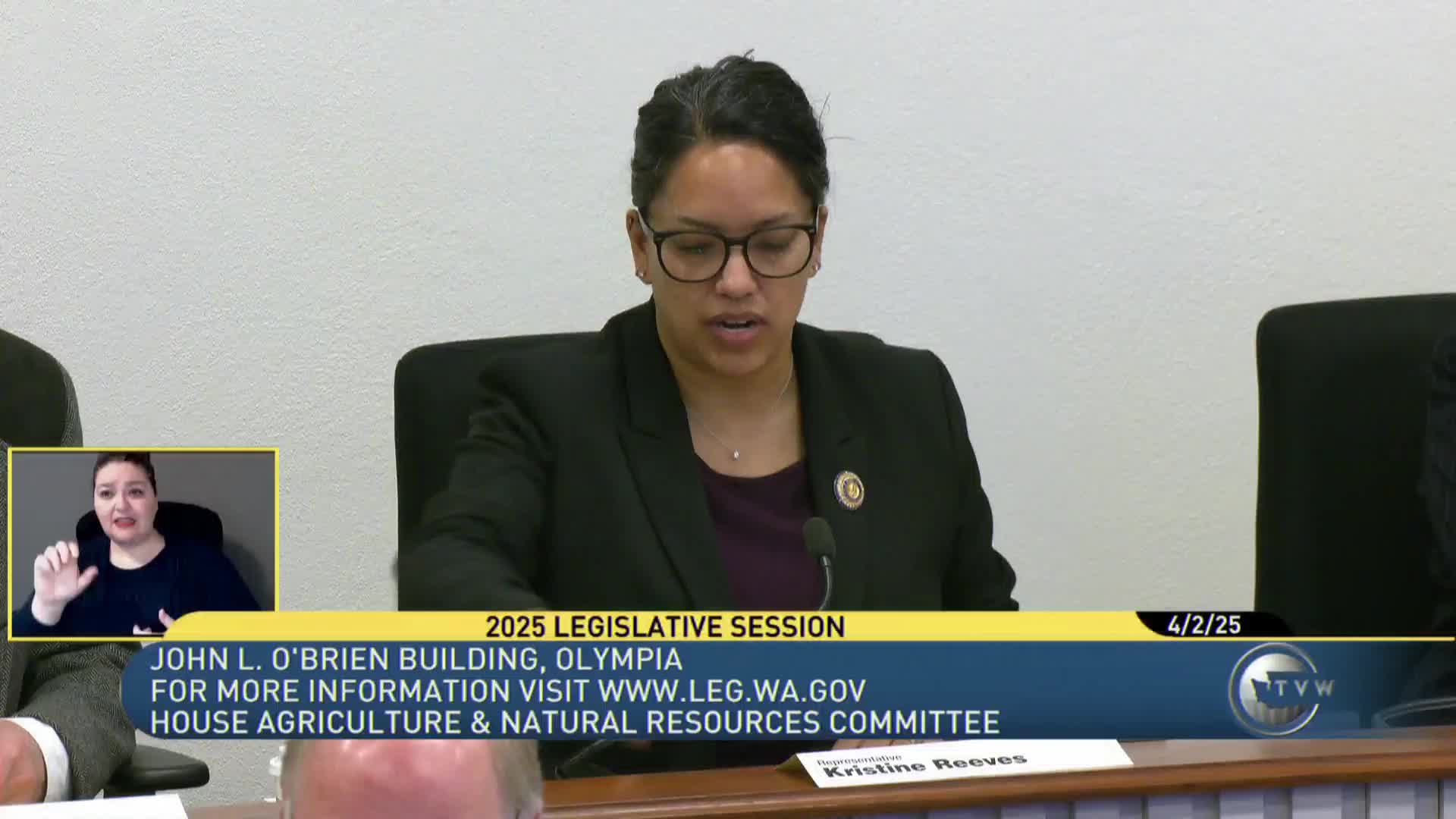
The House Agriculture and Natural Resources Committee met in executive session April 2 and voted to report four Senate bills out of committee with due‑pass recommendations. Votes were taken by voice vote for some bills and by roll call for a complex surface-mining fee bill.
The House Agriculture and Natural Resources Committee voted April 2 to report four Senate bills out of committee with due‑pass recommendations after an executive session and caucus.
The bills addressed notice requirements for Department of Natural Resources (DNR) land surveys, the appeals process for burn‑requirement enforcement, an adjustment to aquatic‑lands inflation metrics, and changes to surface‑mine reclamation fee schedules. Committee staff briefed members before the caucus and the committee returned to take votes.
Why it matters: Each motion advances the named bill to the next stage of the legislative process. One bill on surface‑mine fee schedules drew extended debate and amendment activity before passage as amended; the committee adopted a striking amendment and then reported the bill with a due‑pass, as amended, recommendation.
Key outcomes
- Substitute Senate Bill 51‑70 (DNR land surveys — notice and participation): Reported out of committee with a due‑pass recommendation. Committee staff summarized that the substitute adds notice and opportunity for participation requirements for DNR land surveys, clarifies timing of notice (before the survey), broadens who receives notice to “adjoining landowners” (with a broader ½‑mile impacted‑landowner rule where a lost corner is at issue), expands the opportunity for participation to apply to all surveys, and requires a DNR report to the legislature in five years. Representative Engel withdrew an earlier striking amendment. The committee recorded 9 ayes, 1 nay and 1 excused (Representative McClintock). Representative Nance was recorded as the lone nay on the standing committee report.
- Senate Bill 53‑34 (appeals for burn‑requirement enforcement): Reported out of committee with a due‑pass recommendation. Staff said this DNR‑request bill gives jurisdiction over appeals of enforcement actions for burn requirements to the Pollution Control Hearings Board. The committee recorded 10 ayes, 0 nays and 1 excused.
- Senate Bill 56‑56 (inflation metric for aquatic lands): Reported out of committee with a due‑pass recommendation. Committee members said the bill provides predictability for marina lease rates and is a companion to a House bill considered earlier. The committee recorded 10 ayes, 0 nays and 1 excused.
- Senate Bill 53‑19 (surface mine reclamation fees): After substantial amendment activity and debate, the committee adopted a striking amendment that adjusted fee schedules for small counties and then voted to report the bill out of committee with a due‑pass, as amended, recommendation. The roll call for final passage as amended produced 8 ayes, 2 nays and 1 excused. During debate members emphasized differing views about fee increases and the need to balance rising costs with impacts on small operators and small counties.
What committee members said
Committee staff briefed members about each bill before the caucus. Ranking member Dent and Chair Reeves both urged colleagues to support Substitute Senate Bill 51‑70 to continue negotiations with stakeholders. Representative Orcutt and others urged a yes vote on SB 53‑34 to fill a due‑process gap for people receiving violation notices. The surface‑mine fee bill drew extended remarks from Representative Engel and Representative Schmick about impacts on small miners and small counties; Representative Engel ultimately voted no on final passage as amended.
Next steps
Each reported bill will proceed in the legislative process according to the chamber’s rules for standing committee reports. The committee did not adopt final policy beyond reporting these bills; where bills were reported as amended, members indicated further work could continue in downstream committees or between stakeholders and agencies.
Ending note: The committee recessed for a caucus before its votes and conducted the executive session votes after returning; staff asked members to use the standing committee report form where a roll call was required.