Get Full Government Meeting Transcripts, Videos, & Alerts Forever!
Get email alerts on the Wildlife Rehabilitation Permit topic
No spam. Unsubscribe anytime.
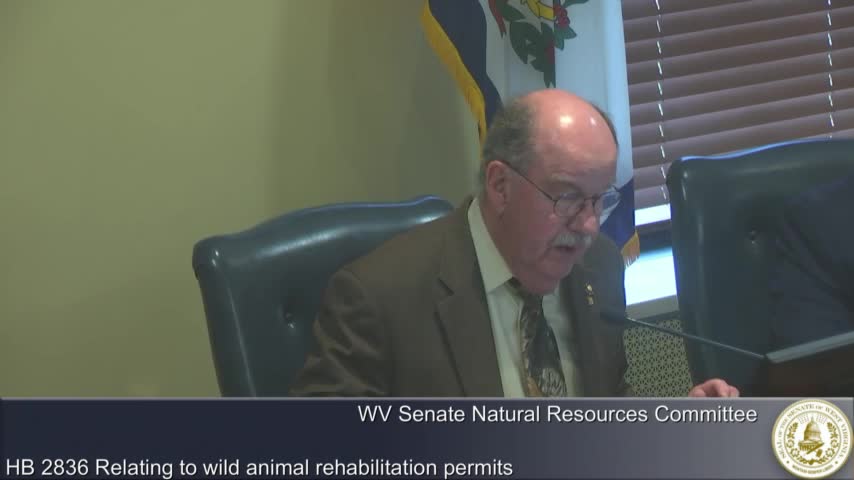
Committee advances bill to establish wildlife rehabilitation permit program
Summary
The Senate Natural Resources Committee voted to report House Bill 2836 to the full Senate with a do‑pass recommendation and referral to the Finance Committee. The bill would create a state permit for wildlife rehabilitators, set qualifications and prohibited activities, and authorize the Division of Natural Resources to adopt rules.
House Bill 2836 would add a new article to the Natural Resources Code to establish a wildlife rehabilitation program administered by the Division of Natural Resources (DNR). The program would create a permitting system allowing qualified persons to hold wildlife temporarily for the purpose of rehabilitation, set minimum qualifications and training, require veterinary consultation, list prohibited activities, and allow the DNR director to promulgate rules to implement and enforce the program. The committee voted to report the engrossed committee substitute to the full Senate with a recommendation that it pass, with referral to the Committee on Finance.
Committee counsel summarized the bill’s major provisions, including a requirement that persons possess a wildlife rehabilitation permit to hold orphaned, sick, or injured wildlife (with limited exceptions for veterinarians and holders of U.S. Fish and Wildlife migratory bird permits), requirements for training and certification, and provisions authorizing permit revocation and penalties for violations. Counsel also noted a fiscal note estimating the cost to implement the program at just under $92,000.
Rebecca Perry Franks, director of Bridal Education and Care at Heritage Farm in Huntington, testified in support and described frequent public requests for help with orphaned and injured wildlife. Franks said many West Virginians call facilities for assistance during "baby season" and that, under current law, rehabilitative care by unpermitted private parties can be illegal: "Currently, our state makes it illegal to provide emergency medical care for these animals," she told the committee. Franks described wildlife rehabilitation as largely donation‑funded and said certification standards and an exam administered under the International Wildlife Rehabilitators' Council model would keep untrained people from converting rehabilitated animals into household pets.
Zack Brown, assistant chief of operations for the wildlife resources section at DNR, told the committee the agency worked with sponsors to add rulemaking authority and that DNR expects to accommodate the program by reallocating duties among current staff rather than hiring new employees. "We would reallocate some duties and, and probably drop a couple of other things, but we would be able to accommodate it," Brown said. He explained the fiscal note reflects dedicating roughly half the time of a wildlife biologist for oversight, travel for inspections, and coordination needed to write rules and inspect permitted facilities.
Committee members asked how the proposed permit would differ from existing menagerie or scientific‑collecting permits. Franks and DNR staff said current permits for display or scientific collecting do not authorize temporary medical rehabilitation and release back to the wild; the new permit is intended specifically to allow professional medical care followed by release. The bill disqualifies applicants convicted of wildlife, animal welfare, or animal cruelty offenses and requires written veterinary cooperation for permit issuance.
The committee approved a motion to report the engrossed committee substitute for House Bill 2836 to the full Senate with a recommendation that it pass and to refer the measure first to the Committee on Finance. The vote was taken by voice; the chair declared the ayes have it and the motion adopted.
What the bill would do: create a state wildlife rehabilitation permitting program; set qualifications including training and an exam, require veterinary cooperation, provide criteria for revocation, and authorize rulemaking and penalties. The fiscal note estimates implementation costs at just under $92,000, and DNR said it expects to reallocate staff duties to administer the program.
Next steps: the bill will be forwarded to the Committee on Finance for fiscal review and returned to the full Senate for further consideration.