Get Full Government Meeting Transcripts, Videos, & Alerts Forever!
Get email alerts on the Managed Timberland Recertification topic
No spam. Unsubscribe anytime.
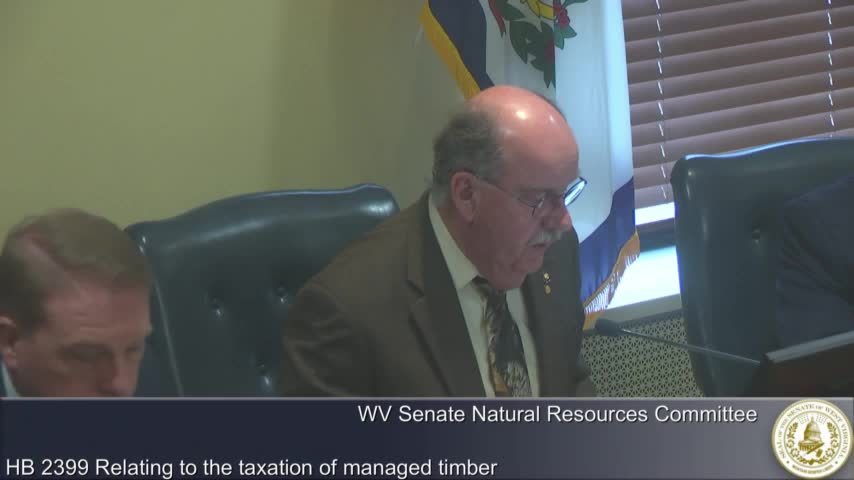
Committee advances bill to change managed timberland recertification from annual to every five years
Summary
House Bill 2399 would change the frequency at which owners of managed timberland must recertify their status with the Division of Forestry from once per year to once every five years.
House Bill 2399 would change the frequency at which owners of managed timberland must recertify their status with the Division of Forestry from once per year to once every five years. The Senate Natural Resources Committee voted to report the engrossed committee substitute to the full Senate with a recommendation that it pass, with the measure first to be referred to the Committee on Finance.
The change was described by committee counsel as an amendment to two sections of the state tax code governing administration of managed timberland property by the Division of Forestry. Committee counsel said the amendment reduces the reporting requirement from one year to five years and also requires the Division of Forestry to promulgate rules to administer the program.
Jeremy Jones, director of the Division of Forestry, told the committee the change reflects recommendations from a 2023 legislative audit and would make administration "more efficient". "To be honest with you, it's really just a paper shuffle exercise," Jones said, arguing the five‑year window would reduce administrative burden on the agency and landowners.
Committee members pressed on how the five‑year recertification interval would interact with private forest carbon agreements that could restrict timber management. Jones said: "It depends. If the carbon program would restrict timber management, then, yes, that would require a review of the status of that property." He added that if a carbon agreement fully restricted timber management, the Division or the county assessor would review the property's status and could remove it from the managed‑timberland classification.
Senator from Randolph asked whether the bill or existing code contains retroactive penalties if a landowner is recertified and later engages in activity that removes the property from compliance. Counsel replied that the longer article contains provisions allowing reclassification of property and that, in the committee counsel's view, the code would allow reclassification where a property no longer meets the managed‑timberland definition. The lead sponsor, Delegate Rick Ellenbrand, described the bill as largely neutral: "it's pretty much a neutral bill ... a smaller government bill and, reduce some administrative efforts," he said, and said he had heard concerns from only a small number of participants in the program.
The committee approved a motion to report the engrossed committee substitute for House Bill 2399 to the full Senate with a recommendation that it pass, and to refer the measure under its original double committee reference to the Committee on Finance. The vote was taken by voice; the chair declared the ayes have it and the motion adopted.
What the bill would do: change recertification from one year to five years; require the Division of Forestry to promulgate administrative rules; preserve existing class 2 managed timberland classification subject to review and potential reclassification if management is restricted.
Questions left for later rulemaking or finance review include whether the bill should explicitly require landowners to report entry into carbon agreements that restrict harvesting, and how county assessors will be notified of such agreements. The Division of Forestry said its current one‑year renewal questionnaire already asks owners whether the property is under a carbon agreement (a yes/no question), and the agency indicated it would review properties if notified of agreements that restrict timber management.
Votes at a glance: The committee moved and approved reporting HB 2399 to the full Senate with a do‑pass recommendation and referral to the Committee on Finance (voice vote; tally not specified).