Get Full Government Meeting Transcripts, Videos, & Alerts Forever!
Get email alerts on the Personal Finance Education topic
No spam. Unsubscribe anytime.
Lawmakers hear competing views on requiring standalone personal finance course and a status report on financial literacy
Summary
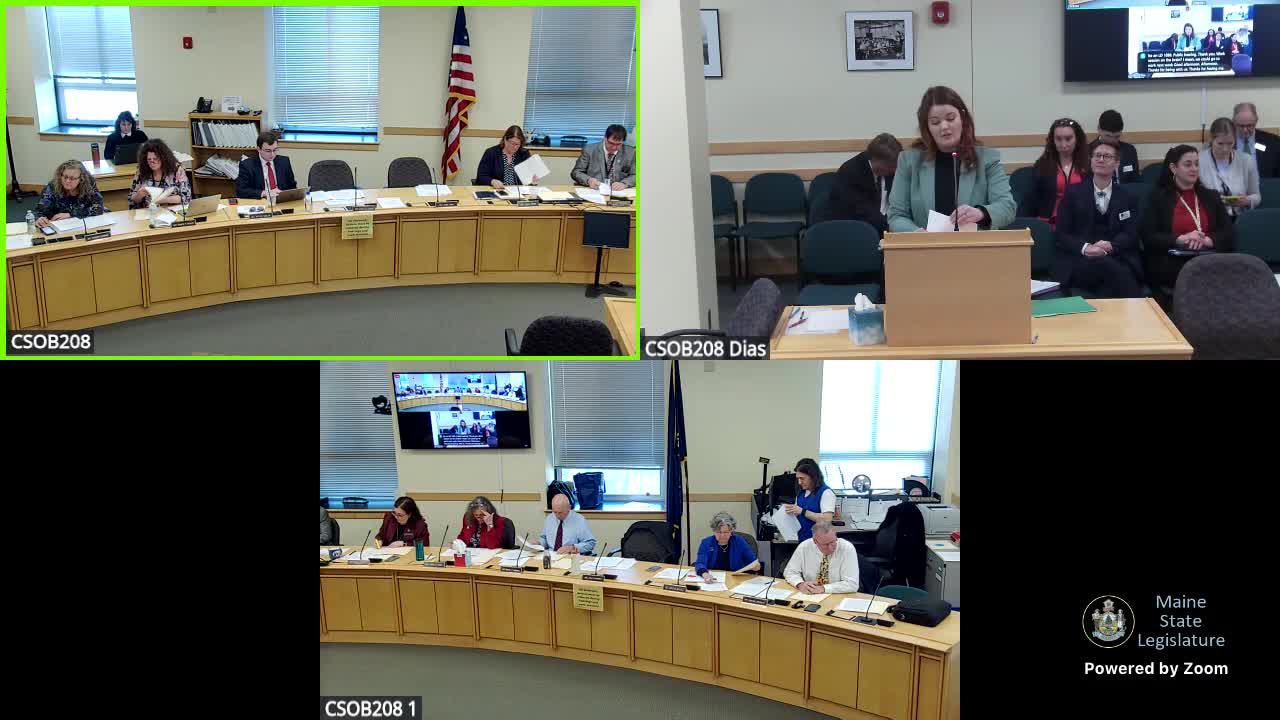
Senate President Maddie Daughtry opened the public hearing on LD 1069, a bill that would require personal finance to be taught as a standalone course as a condition for a high school diploma.
Senate President Maddie Daughtry opened the public hearing on LD 1069, a bill that would require personal finance to be taught as a standalone course as a condition for a high school diploma. Daughtry described the measure as a bipartisan, long-running effort to ensure students graduate with practical financial skills and said a standalone course would guarantee more consistent, comprehensive instruction than embedding units within other classes.
“Students deserve the tools to become self-sufficient,” Daughtry told the committee, arguing that dedicated course time would give students a reliable foundation in budgeting, credit, loans, retirement planning and other everyday financial skills. She said the course could be offered flexibly in local districts but should be a weighty, stand-alone requirement rather than a unit squeezed into another subject.
The committee heard substantial testimony both supporting and opposing the bill. Supporters included Representative Ed Crockett and a range of financial-sector and nonprofit witnesses: Dan Berney for the Maine Insurance Agents Association argued basic budgeting education could reduce evictions and improve long-term financial outcomes; Robert Caverly of the Maine Credit Union League described an existing statewide “financial fitness fair” program that has reached tens of thousands of students and said credit unions stand ready to support curriculum and outreach; Josh Spearman of the Maine Bankers Association and representatives from national education nonprofits urged action and offered existing curricular resources.
Proponents cited national and state data. Witnesses noted that more states have adopted standalone personal-finance requirements and that research shows mandated personal-finance education can improve credit outcomes and reduce severe delinquency in some cases. Mary Dyer of the Maine Jumpstart Coalition and Leslie Finnan of the Council for Economic Education highlighted studies showing measurable improvements in credit behavior in states that require a standalone course and reported that only a minority of Maine students currently attend schools that require a full semester of personal finance.
Opponents and officials raised implementation concerns. Jesse Hargrove, president of the Maine Education Association, said social studies teachers have been incorporating personal finance into K–12 standards and warned that a new statutory standalone requirement could make scheduling more rigid, constrain electives and limit student options such as Career and Technical Education (CTE). The Maine Curriculum Leaders Association and the Maine School Management Association urged caution, citing staff shortages, certification and the fiscal impact of an unfunded mandate. ‘‘Personal finance education is already embedded within the existing social studies standards,’’ Deborah McIntyre of the Maine Curriculum Leaders Association told the committee; she said mandating a specific course would shift local curricular control.
The Department of Education testified neither for nor against LD 1069 and recommended that, if the committee’s goal is to improve financial literacy, the state would achieve better results by investing in educator training, high-quality curriculum resources and flexible local implementation models rather than imposing an unfunded new graduation requirement. Department representatives emphasized that financial literacy already appears as a strand in Maine’s learning results and that schools use a range of methods—standalone courses, embedded units, and CTE and math pathways—to meet those expectations.
Multiple committee members asked for detail at a follow-up work session: how many districts already require a standalone course, whether certified teachers are available statewide to teach additional sections, and what a fiscal note would show for staffing and materials. Several witnesses offered existing curricular resources (Invest, Jumpstart, NextGen Personal Finance, EverFi, Council for Economic Education materials) and said organizations would provide professional development and classroom help.
Later in the session Representative David Rollins introduced LD 701, a resolve directing the Department of Education to report on participation in and implementation of financial literacy standards in Maine’s schools. Rollins said the report should map where and how personal finance instruction appears across K–12, identify gaps, and recommend ways to increase participation and achievement. Several committee members asked whether the department could produce the report without additional funding; Rollins and other legislators indicated they expected the department to provide a feasible timeline and suggested the committee could refine the request in work session.
The committee did not take final action on LD 1069 or LD 701 during the hearing; members asked for further documentation and the Department of Education, school associations and curriculum organizations offered to provide more detailed information at the work session.