Get Full Government Meeting Transcripts, Videos, & Alerts Forever!
Get email alerts on the Veterans Homes Funding topic
No spam. Unsubscribe anytime.
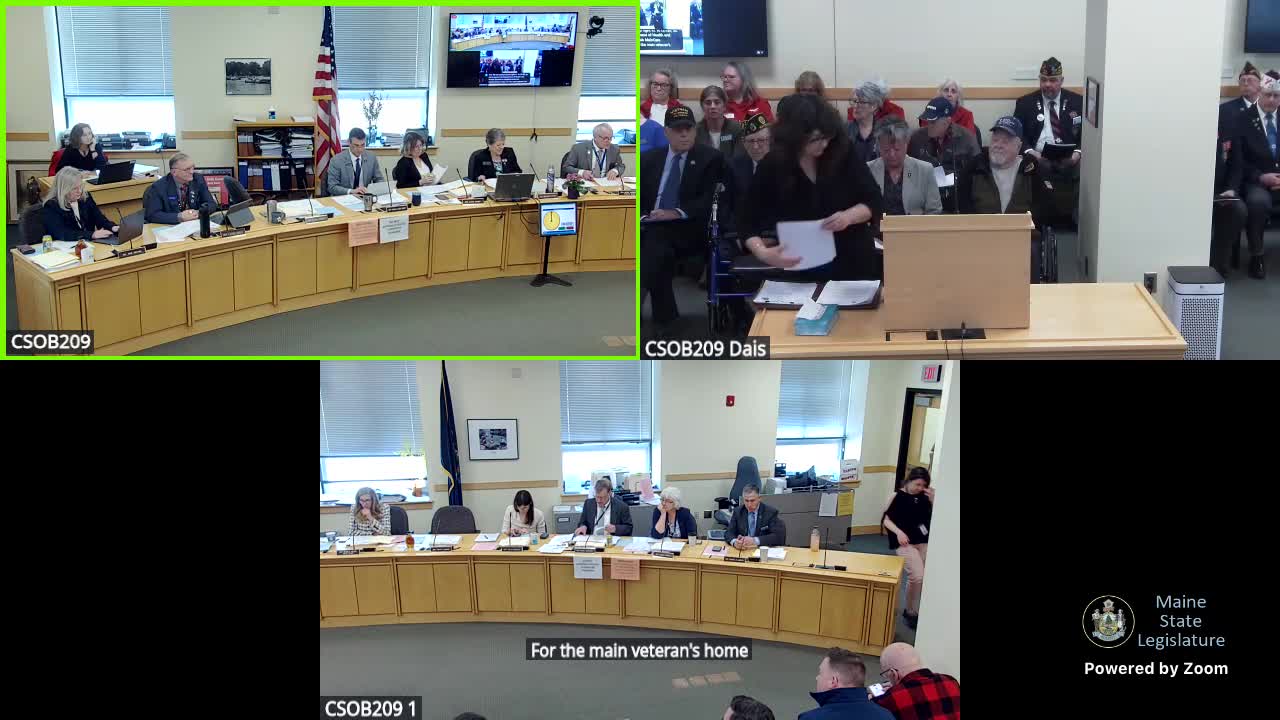
Lawmakers Hear Pleas to Boost Maine Veterans Homes Funding as Facilities Face Operating Losses
Summary
Supporters told the Health and Human Services committee that Maine Veterans' Homes are operating at a substantial loss and need a baseline appropriation to remain open; the sponsor asked to add LD 182 to the legislature’s budget to secure state dollars and a federal match.
Representative Laura Soupica introduced LD 182, asking the joint committee on Health and Human Services to require the Department of Health and Human Services (DHHS) to set MaineCare reimbursement on a per‑resident basis for Maine Veterans Homes (MVH).
The bill sponsor and veteran advocates said the six MVH facilities — in Augusta, Bangor, Caribou, Machias, Scarborough and South Paris — face large operating shortfalls and that short‑term appropriations have not solved the underlying gap. “Without this funding, Maine Veterans Homes will have to continue to draw from its capital investments to meet its operational losses,” Sponsor Laura Soupica said, and she asked the committee to send LD 182 to the full legislature.
Why it matters: Testimony from MVH leadership, veterans’ organizations and family members framed LD 182 as a budget and access question. MVH leaders and the Veterans of Foreign Wars told the committee that current MaineCare rates do not cover the cost of care and that MVH relies on a mix of MaineCare, VA payments and private pay; MVH reported a payer mix of roughly 50% MaineCare and about 25% veterans who are 70% service‑connected or higher.
Key details offered at the hearing: MVH requested a state baseline appropriation of $4,261,615 that its proponents estimate would draw roughly $6,970,897 in federal matching funds for a total of about $11,232,512. MVH officials said the system was operating at a run‑rate loss of about $8.5 million and had roughly $14 million in investments they could draw on — a level they said would make the homes insolvent within about two years if no additional funding came through. MVH CEO Brad Clawitzer told the committee that Maine Veterans Homes are not federal VA facilities but nonprofit providers that also receive a prevailing VA stipend for some veterans and must manage costs such as high‑cost medications that the VA stipend may not cover.
Questions and department context: Committee members asked how the request had been calculated and whether federal funding sources were at risk. MVH leaders said their estimates derive from internal and consultant analyses and cautioned that potential future reductions in federal Medicaid funding or expansion match could reduce the federal share MVH relies on. The DHHS representative and other department witnesses did not provide an immediate fiscal commitment during the hearing. Committee members requested the fiscal note and the stakeholder/OPEGA reports referenced by witnesses for the work session.
What witnesses requested: Speakers asked the legislature to make the appropriation a baseline line item so MVH would not need repeated supplemental funding requests and to preserve care close to veterans’ homes now spread across the state.
Next steps: The hearing closed with committee members asking staff to supply the fiscal note used to evaluate the bill, copies of earlier stakeholder and OPEGA reports, and for MVH to supply documentation behind its estimates. The committee did not vote on LD 182 at this hearing.
Ending: Advocates framed LD 182 as a moral obligation to maintain care access for veterans across Maine’s regions; lawmakers asked for more data and a fiscal analysis before considering a recommendation to the full legislature.