Get Full Government Meeting Transcripts, Videos, & Alerts Forever!
Get email alerts on the Ag Food Forest Fund topic
No spam. Unsubscribe anytime.
Bill tweaks board rules for new Ag‑Food‑Forest investment fund; supporters urge capital infusion
Summary
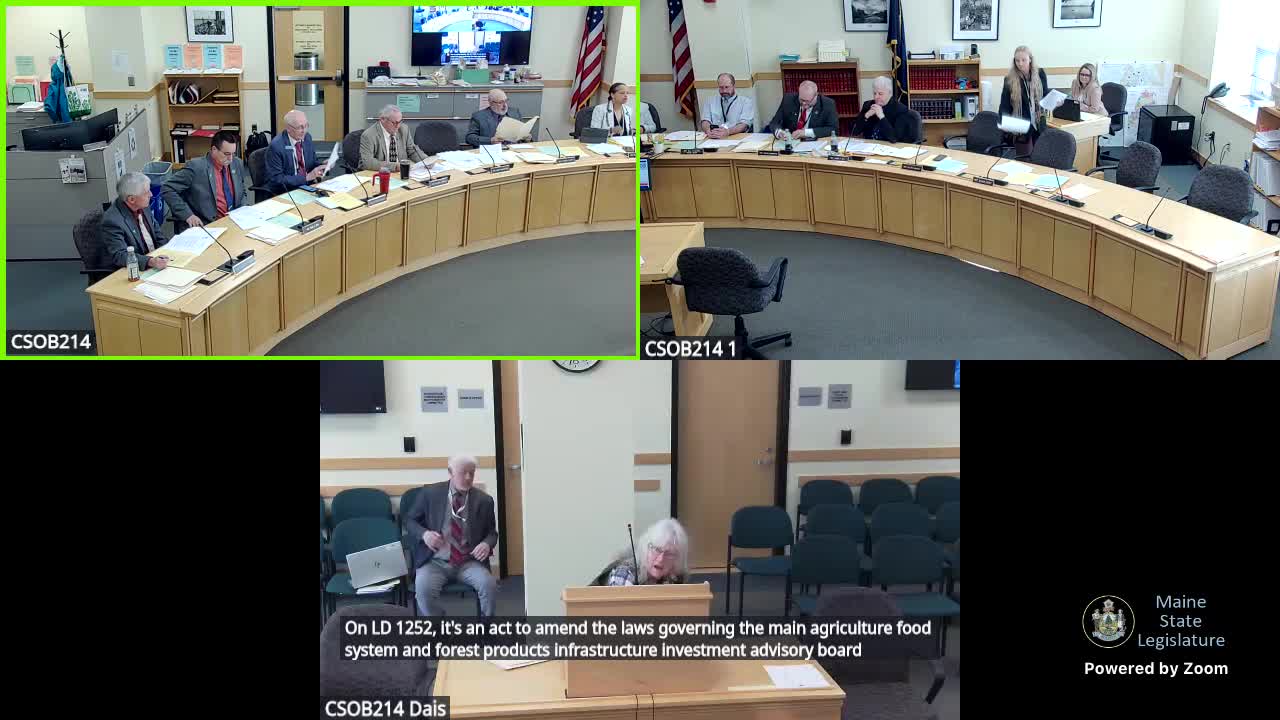
LD 12 52 would adjust eligibility and conflict‑of‑interest language for the Maine Agriculture, Food and Forest Products Infrastructure Investment Fund’s advisory board; witnesses urged the Legislature to provide capital to the fund to meet demand estimated in department records at about $160 million.
Representative Lisonbee Hepler presented LD 12 52, a technical and clarifying amendment to the statute establishing the Maine Agriculture, Food and Forest Products Infrastructure Investment Fund. The proposal updates eligibility criteria to specify that disbursements be limited to producers establishing or operating in‑state processing or manufacturing facilities and strengthens conflict‑of‑interest language for board members.
What the bill changes: LD 12 52 requires that recipients be producers that have, or are seeking to establish, a processing or manufacturing facility located within Maine; clarifies that the advisory board must recuse members who would receive a direct and substantial financial benefit (or whose immediate family would) from any vote; and modernizes language consistent with prior department drafting recommendations.
Witnesses and the case for funding: Coastal Enterprises, Inc. (CEI) and other nonprofit lenders and advisors testified in support, saying the Fund can be a catalytic vehicle for infrastructure loans and grants that fill capital gaps in food and forest business supply chains. CEI described decades of lending experience in the sector and recommended the Legislature provide a program appropriation to capitalize the Fund—the organization suggested that even a modest initial sum would leverage private and federal matching capital. DACF noted the Fund advisory board had recently been appointed and that rulemaking and operations were in progress; the department and CEI highlighted demand evidence, including the 2020 Agricultural Infrastructure Investment Program that received many more applications than funding available and a department estimate of demand in the 100s of millions (DACF cited an illustrative estimate of $160,000,000 in unmet capital need in prior AIP application rounds).
Committee questions: Members asked for a list of advisory board members and for confirmation of how the Fund will coordinate with federal grants such as USDA RFSI and with private lenders. DACF said it will continue work with advisory board, USDA partners, and CEI to finalize program rules and solicit applications once funding is secured.
Next steps: The committee did not take an immediate vote. Supporters urged the committee to consider both statutory authorization and an appropriation so the Fund can begin making investments; DACF asked for time to finish rulemaking and to coordinate an application process once capital is available.