Get Full Government Meeting Transcripts, Videos, & Alerts Forever!
Get email alerts on the Sewer Rates topic
No spam. Unsubscribe anytime.
Council committee advances revised sewer rate package after debate over bond risk and customer relief
Summary
The Honolulu Committee on Budget amended Bill 60 to adopt a one-year, 4% sewer fee increase and sent the measure for second reading while members, department directors and bond analysts debated higher multi-year increases, bond covenant limits and a customer assistance program.
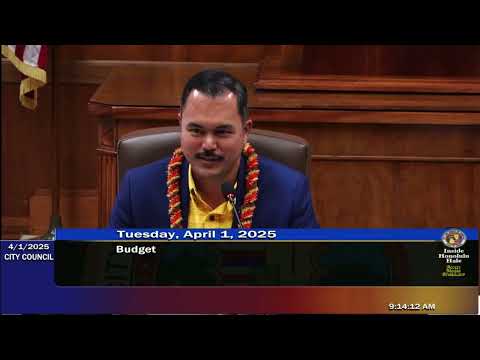
The Honolulu City Committee on Budget on April 1 advanced changes to Bill 60, a proposed 10-year sewer rate package, approving a revised CD1 that sets a 4% increase for 2025 and sends the ordinance to second reading and public hearing while leaving later-year rate figures to be determined.
Committee members and department officials spent more than two hours on the sewer fund's capital needs and the rate study that supports them, focusing on the Sand Island Wastewater Treatment Plant upgrade, multi‑billion dollar capital needs and the tradeoffs between a larger multi‑year rate path and using general fund dollars to blunt rate shock.
The proposed comprehensive rate path presented by the Department of Environmental Services called for a front‑loaded series of rate increases — “9% per year for the first six years, then 8, 7, 6 and 5 percent” — to meet revenue requirements for operations, reserves and a capital program the department estimated at roughly $10.1 billion over 15 years. Director Roger Babcock said the plan comes from a finalized rate study that evaluated alternatives including shifting more charge to volumetric pricing and establishing a customer assistance program.
Why it matters: the sewer enterprise issues revenue bonds whose ratings and borrowing cost depend on the fund’s financial performance. Andy Kawano, director of Budget and Fiscal Services, said the bond documents and rating‑agency expectations effectively require the sewer fund to be self‑sustaining. "The Sewer Fund is supposed to be self sustaining," Kawano said, adding that he does not recommend using general fund transfers as a long‑term subsidy of sewer operations and debt service.
The administration's preferred 10‑year package would raise an additional $2.816 billion in rate revenue across the decade, the presentation showed. Under the more gradual option discussed in committee and reflected in the council chair’s CD1, the gap between the higher and lower rate paths could require hundreds of millions in transfers from the general fund in later years if revenues are not raised elsewhere.
Babcock highlighted constraints and timing on the Sand Island upgrade: Phase 1 is under construction and about 60% complete; Phase 2 is in design and would add about 70 million gallons per day. He said design should be completed by 2028, the city should bid the project no later than 2028 and start construction in 2029 to meet the consent‑decree schedule.
Rate structure changes and customer impacts: the study recommends moving toward a 50/50 split between fixed (base) charges and volumetric charges from the current approximately 73/27 split to improve equity and encourage conservation. Under the presented 10‑year 9% scenario, typical residential examples in the department’s slides showed big differences by water use: a median user (6,000 gallons/month) would see their sewer charge roughly double over the 10‑year period; heavy users would see larger percentage increases. The department proposed an income‑qualified customer assistance program at 80% of area median income, offering a monthly credit ($20–$25) for qualifying households.
Credit rating risk: Babcock read a passage from a Standard & Poor’s document noting that "The preliminary rate adjustments are expected to support healthy financial performance despite considerable additional leverage," and warned that failure to adopt an adequate rate path could prompt a rating downgrade that increases borrowing costs for the sewer enterprise and could affect broader city credit.
Council response and amendment: Council Chair Waters proposed a CD1 that would adopt a 4% increase in 2025 and use identified vacancy savings in the general fund to offset the remainder of this year’s revenue need. Chair Waters noted that about $22 million (the committee discussed a $22–24.5 million range) could be drawn from vacant‑position savings to cover the shortfall for FY26 and buy time for the administration and council to develop a longer‑term plan. The committee’s chair amended the posted CD1 to adopt the chair’s 4% for 2025, blanked future dollar figures for 2026 onward to allow more discussion, and reported the bill out for second reading and scheduling of a public hearing.
Public comment and technical notes: speakers at committee public meetings and town halls were cited by staff as limited in attendance, and the Board of Water Supply told members that any adopted rate change requires lead time to implement in the billing system — three months for simple rate adjustments and up to six months for structural changes (tiered volumetric blocks). A resident testifier who said she uses about 2,000 gallons per month urged the committee to prioritize pay‑down of debt so conserving households do not shoulder disproportionate increases.
What’s next: Bill 60 (as amended to the chair’s CD1) was reported to the full council for second reading and public hearing. The committee left the later years of the rate schedule open for further council‑administration negotiation; staff and council members said they will continue discussing possible offsets including targeted customer assistance, alternative revenue sources and whether limited one‑time general fund support could be used in the near term without violating bond covenants.