Get Full Government Meeting Transcripts, Videos, & Alerts Forever!
Get email alerts on the Minimum Wage topic
No spam. Unsubscribe anytime.
Nebraska senators debate carving out youth and training wages from voter-approved minimum-wage increase
Summary
Lawmakers debated LB258, a bill that would rewrite parts of the voter-approved minimum-wage increase by capping future raises at 1.5% and creating separate youth and training wages. The Legislature voted to end debate but rejected a motion to indefinitely postpone the bill.
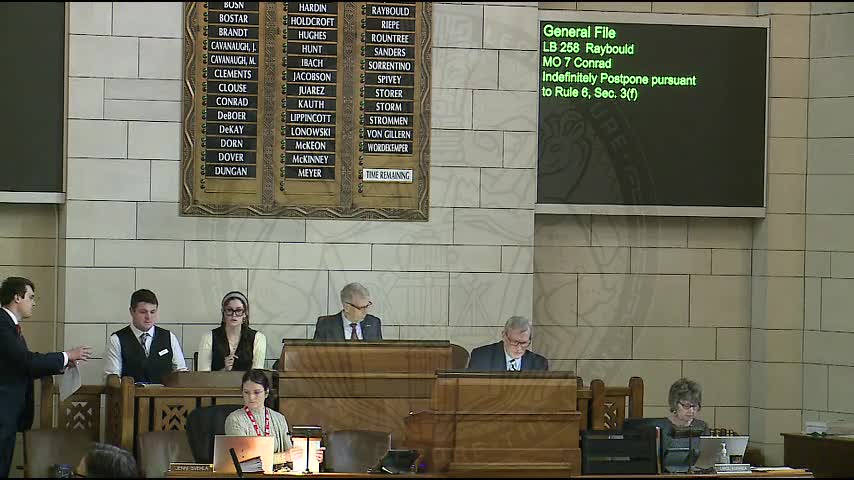
The Nebraska Legislature on the floor spent several hours debating LB258, a bill that would alter portions of the minimum-wage increase voters approved in 2022 by capping routine future increases at 1.5% and creating lower youth and training wages.
Supporters of a motion to indefinitely postpone the bill argued it would undercut the will of voters and reduce earnings for low-income workers and teenagers. Opponents said LB258 provides needed guardrails for businesses and a training-wage structure that protects employers while still raising many workers’ pay.
Senator Connie Conrad, the lawmaker who moved to indefinitely postpone the measure, told colleagues, “I’m asking you to indefinitely postpone this measure, which not only undercuts the will of the voters, but also picks the pockets of Nebraska working families.” Conrad framed the IPP motion as a defense of the 2022 ballot initiative and said the voters intentionally rejected carve-outs and caps.
Senator Raybould, who sponsored provisions in the bill, defended the changes as practical modifications that will help small businesses and preserve youth employment. Raybould listed numerous business groups that testified at committee hearings and said, “These are organizations that represent the small business owners, the day care centers, the restaurants… and I think it's important to remember that.” She urged colleagues to review research she provided showing potential effects on teen employment.
Other senators emphasized different aspects of the debate. Senator John Kavanaugh said he opposed LB258 and supported the IPP motion, arguing the ballot language intentionally tied future increases to a regional CPI measure and that a fixed 1.5% cap would erode purchasing power over time. “If you artificially decrease the increase, which is what Senator Abel is doing here at 1.5, then you are going to continually erode the parity or the value of the minimum wage,” he said.
Proponents of LB258 pointed to three distinct elements in the bill: a cap on annual increases (1.5%), a youth wage for 14- and 15-year-olds set at $13.50, and a raised short-term training wage (currently 75% of the federal minimum wage under Nebraska law) to a higher dollar level so workers are not paid as little as $5.44 during training periods. Supporters argued the training-wage change alone prevents employers from legally paying deeply subminimum amounts during the first 90 days on the job.
Debate on the floor produced two formal roll-call outcomes recorded in the transcript. Senators first voted on a procedural motion to cease debate (a call of the question); the motion passed 34–13. Later, the chamber voted on the motion to indefinitely postpone LB258, moved by Senator Conrad; that motion failed on a roll call, 12 ayes to 34 nays. Senator Conrad then moved to reconsider the IPP vote; the transcript records the motion and an opening statement but not a completed reconsideration vote within the excerpt provided.
Throughout the debate senators cited a mixture of empirical studies, case studies from other states, industry testimony, and lived experience. Supporters of the ballot initiative and opponents of LB258 emphasized household and youth dependence on additional wages; proponents of LB258 highlighted research they said showed teen employment declines after some minimum-wage rises and urged caution for small businesses and childcare providers.
The bill’s proponents and opponents also repeatedly referenced legal and administrative touchpoints that would affect implementation: the state’s current statutory training-wage provision (tied to the federal minimum wage), the regional CPI-U (the measure set in the 2022 ballot language for future adjustments), and the ballot initiative itself. Several senators noted the 2022 initiative received substantial out-of-state financial support during the campaign; proponents of LB258 cited that fact to argue voters had been subject to an outside-funded campaign, while opponents said the outcome still reflected voter intent.
As recorded in the floor transcript, senators weighed potential trade-offs: whether a broadly applied wage increase better preserves family economic security, or whether narrowly tailored youth and training wages reduce barriers to hiring and preserve entry-level opportunities. Several senators urged colleagues to consider local small-business testimony that, they said, favored either side; others repeatedly returned to the core democratic question of respecting or revisiting a voter-approved measure.
The Legislature recessed at the end of the recorded excerpt; the transcript shows the motion to recess carried and debate on next steps continued later. The record in this excerpt stops after the motion to reconsider was made and opened but before a final outcome on reconsideration was recorded.