Get Full Government Meeting Transcripts, Videos, & Alerts Forever!
Get email alerts on the Minimum Wage topic
No spam. Unsubscribe anytime.
Nebraska senators adopt changes to voter-approved minimum wage law after hours of debate
Summary
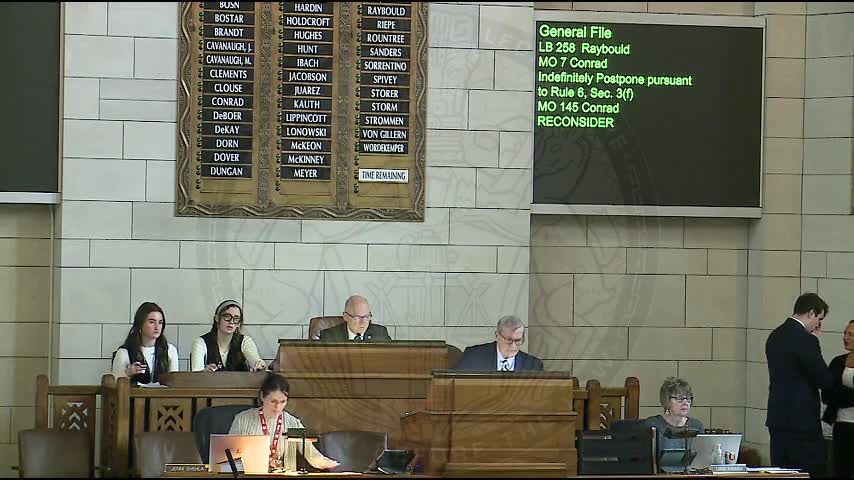
Lincoln — The Nebraska Legislature on April 1 advanced LB 258, a bill from Senator Julie Raybould that would change parts of the voter-approved minimum wage law, adopt a capped indexing formula for future increases and create separate training and youth wage tiers.
Lincoln — The Nebraska Legislature on April 1 advanced LB 258, a bill from Senator Julie Raybould that would change parts of the voter-approved minimum wage law, adopt a capped indexing formula for future increases and create separate training and youth wage tiers. The measure passed through General File after cloture was invoked and a committee amendment (AM 272) was adopted.
The committee amendment clarifies the training-wage and youth-wage language in LB 258. Senator Julie Raybould, the bill sponsor, said AM 272 "was a correction and clarification on the training wage" and described the amendment's mechanics: the training wage would be 90% of the Nebraska state minimum wage for a 90-day training period (applies to ages 16–19), the training wage would increase annually by 1.5% beginning 01/01/2027, and a youth wage for 14–15 year olds would be set at $13.50 with increases of 1.5% every five years beginning 01/01/2030.
Why it matters: Supporters said the bill gives employers predictable, modest annual increases and prevents sudden jumps tied to short-term spikes in regional CPI. Opponents said the changes subvert the 2022 ballot initiative that tied future minimum-wage increases to the Midwest CPI and that the Legislature should not weaken a statutory initiative approved by voters. Senator Megan Conrad argued the will of voters should be respected and said, "It should not be hard to uphold the will of your voters." Senator Jana Hunt said, "The voters of Nebraska already made their decision, and our only job now is to respect it."
What the amendment and bill do: AM 272 (adopted) implements three principal changes that were highlighted repeatedly on the floor: - Training wage: defined for employees age 16–19, set at 90% of the state minimum for up to 90 days, increasing 1.5% annually starting 01/01/2027 (example: projected training wage of $13.50 when state minimum reaches $15). - Youth wage: a separate rate for 14–15 year olds set at $13.50, with a 1.5% increase every five years starting 01/01/2030. - Index cap: after the state minimum reaches $15 on 01/01/2026 (the statutory schedule adopted by Initiative 433), LB 258 replaces the current CPI-U Midwest indexing mechanism with an annual cap of 1.5% (or CPI if lower) for future increases, a change supporters said brings predictability and opponents said would erode purchasing power over time.
Floor debate and main arguments: Proponents, including Senator Raybould, framed the bill as a balance between respecting workers and preserving the viability of small businesses across Nebraska, particularly in rural communities. Raybould said LB 258 "is intended to find a reasonable balance that ensures businesses have predictability and can stay in business to be able to provide basic needs and beyond for Nebraskans everywhere." Several supporters pointed to the volatility in CPI over recent years and to business closings in some retail sectors as evidence that large, sudden indexed increases can be disruptive.
Opponents pressed different points: that the ballot initiative was explicit, that voters approved a CPI-linked schedule, that many young workers and their families will lose income under carve‑outs, and that the Legislature should not undo a citizen-initiated statute without compelling cause. Senator John Kavanaugh urged colleagues to honor the election results and said, "If you are opposed to the bill if you're opposed to it in the current construction I would encourage you to vote no on cloture." Senator Dungan and several others reiterated research and arguments that modest wage increases can boost local spending and help low-income households.
Votes at a glance (floor actions affecting LB 258): the transcript records these actions and tallies on April 1, 2025 — counts below match roll-call announcements and clerk totals recorded on the floor. - Motion to reconsider an earlier vote (on the motion to indefinitely postpone): failed, 15 ayes, 33 nays. (Roll-call recorded by the Clerk.) - Cloture (motion to invoke closure under Rule 7, §10): passed, 33 ayes, 16 nays — the motion to invoke closure was offered by Senator Raybould and carried by roll call. - Committee amendment AM 272 (Business and Labor committee cleanup clarifying training/youth wages): adopted, 33 ayes, 9 nays. - Motion to bracket LB 258 until June 9, 2025 (moved by Senator Conrad): failed, 15 ayes, 34 nays. - Advance to Enrollment and Review (E&R) initial: passed, 32 ayes, 17 nays (bill advanced from General File with AM 272 adopted).
What lawmakers asked staff or wanted clarified: senators pressed for data on county-level voting patterns and for concrete examples of how capped indexing would play out in high-inflation years. Supporters cited a decade-average Midwest CPI calculation to justify the 1.5% cap; opponents said using a short historical window understates recent, relevant inflationary experience and that a cap would systematically reduce future purchasing power. Several senators emphasized the difference between short-run business shocks (bankruptcies, private equity restructurings) and direct causal links to a state-level minimum-wage indexing mechanism.
Outlook: With the committee amendment approved and the bill advanced to E&R initial, LB 258 will return to the Legislature for subsequent steps of the ordinary legislative process. Supporters want predictability for employers; opponents are preparing to press the point that the measure weakens a voter-approved schedule.
Ending note: The debate on LB 258 centered on competing priorities — honoring a clear citizen initiative that set an automatic, CPI‑based increase versus providing statutory predictability and limits to help employers plan. The floor record shows sustained disagreement on both economic effects and on democratic norms about when and how the Legislature should alter voter-initiated statutes.