Get Full Government Meeting Transcripts, Videos, & Alerts Forever!
Get email alerts on the Diversity Equity Inclusion topic
No spam. Unsubscribe anytime.
Hundreds of public comments urge CCSD to restore Intercultural Development office after recent elimination
Summary
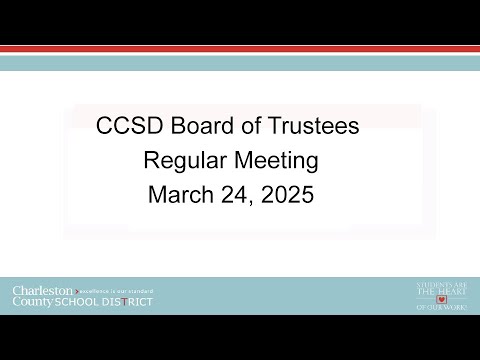
Scores of speakers at the March 24 Charleston County School District Board meeting criticized the district’s decision to eliminate the Intercultural Development office and raised concerns about civil rights, transparency and impacts on students of color and other protected groups. The superintendent said the decision followed legal counsel and a
Scores of residents, educators and faith leaders urged the Charleston County School District Board of Trustees on March 24 to reverse or explain a recent decision to eliminate the district’s Intercultural Development office and the executive director post that led it. Speakers framed the removal as a rollback of supports for students of color, multilingual learners, students with disabilities and other groups; many asked for public explanation and transparency.
Multiple speakers cited federal law and civil-rights obligations. At the meeting student speaker Zuri Yamatsaka said removing the office signaled a “politicization of education” that invalidated students’ identities. Several retired educators and former office staff, including Vyette Akins, described the Intercultural Development office as central to reducing longstanding achievement gaps and asked why the role and department were eliminated rather than renamed. Others — clergy and community leaders — called the move a “disgrace” and asked for public input and for the district to restore leadership that protects civil rights.
Board members and Superintendent Huggins addressed the room near the end of public comment. Huggins said the district sought legal counsel and reviewed executive orders and a Dear Colleague letter related to recent federal guidance; she said the decision to eliminate the office followed counsel because of potential risk to funding that supports programs for students served by Title I, Title III and IDEA. Huggins said the district receives about $55 million in federal funds that primarily support students of color and low-income students and that administrators judged the legal risk significant enough to alter organizational structures. She also said the employee whose position was eliminated was offered alternative vacancies.
Why it matters: The Intercultural Development office coordinates programming and supports intended to reduce disparities for historically marginalized students. Residents and former staff said its elimination removes a district-level advocate for civil-rights compliance and culturally responsive practice; district leaders said they acted after legal advice to protect federal funding.
What the record shows: Public commenters sought clearer explanations, named the office’s work on civil-rights enforcement and asked for community engagement. The superintendent publicly cited Executive Order 14,151 and an accompanying Dear Colleague letter in explaining legal risk; the public record does not show a board vote to permanently eliminate the role at this meeting. Trustees heard dozens of speakers during the allotted public-comment period and agreed to meet with community clergy after the meeting.
Speakers quoted are identified in the public transcript and include students, retired educators, faith leaders and local advocates: Zuri Yamatsaka (student), Vyette Akins (retired educator), Shar Fitzwater, Sydney Van Bulleck, Reverend Cynthia Lane Smalls, Lou Anne Rosenzweig, Sylvia Wright, Courtney Waters and Andy Massey, among others.