Get Full Government Meeting Transcripts, Videos, & Alerts Forever!
Get email alerts on the Pharmacy Benefits Regulation topic
No spam. Unsubscribe anytime.
Senate committee hears bill to license third‑party administrators and pharmacy benefit managers
Summary
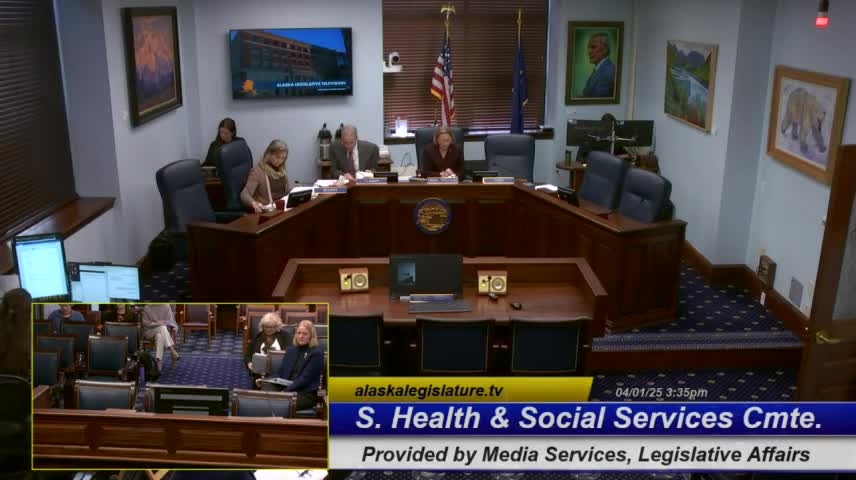
Sen. Giesel, vice chair of the Alaska Senate Health and Social Services Committee, opened the committee's first hearing on Senate Bill 134 on April 1, 2025, a bill that would require third‑party administrators (TPAs) and pharmacy benefit managers (PBMs) operating in Alaska to hold state licenses and give the Division of Insurance broader oversight.
Sen. Giesel, vice chair of the Alaska Senate Health and Social Services Committee, opened the committee's first hearing on Senate Bill 134 on April 1, 2025, a bill that would require third‑party administrators (TPAs) and pharmacy benefit managers (PBMs) operating in Alaska to hold state licenses and give the Division of Insurance broader oversight.
The bill matters because it would change how the state monitors entities that administer pharmacy benefits and sometimes operate across insurers, pharmacies and PBMs, potentially creating opaque corporate structures. "Under a registration scheme, we did not have the authority that a full licensure would give the division in terms of oversight," said Heather Carpenter, deputy director of the Division of Insurance.
Carpenter and committee staff, Jane Rohrer, summarized the bill's structure: sections 1–4 would let the Division examine TPAs and require those entities to pay market‑conduct exam costs; sections 5–7 replace the term "registered" with "licensed" and add TPAs and PBMs to licensing requirements; section 8 creates an exam exemption allowing a compliance officer to take required exams before an entity's license is issued; sections 9–24 establish licensing and annual certification requirements for designated compliance officers and certain exempt TPAs, including a February 1 annual filing deadline; sections 25–31 require licensure to operate in Alaska and authorize fees set to cover salaries, benefits, technology and continuing education; section 33 sets an effective date of Jan. 1, 2026.
Carpenter told the committee the change from registration to licensure follows work done on House Bill 226 and mirrors steps taken in other states. She said the change would address difficulties the division has had tracing ownership and activity where insurers, TPAs, PBMs and pharmacies are vertically integrated. "We've seen a lot of concerns with vertical integration and folks trying to get around licensure requirements," Carpenter said, adding the update to the PBM definition would apply "regardless of ownership."
Sen. Klayman asked whether vertical integration is inherently a problem or only when it prevents transparency; Carpenter said the primary issue is transparency and the division's ability to obtain information when entities are owned within a larger corporate structure. Sen. Hughes pressed whether the changes are intended to rein in PBM practices that contribute to higher costs; Carpenter said the bill's examination and reporting requirements, compliance‑officer contact, and fee structure aim to give the division tools to better protect consumers.
Committee members asked for clarifications about the statutory definition of "person" used in certification requirements and whether the certification requirement is narrowly tailored to third‑party administrator statutes; Carpenter said the provision appears in the TPA licensing chapter (cited in committee discussion as 21.27.6.30) and thus applies to TPAs in that chapter.
No formal motion or vote was taken on SB 134 at the hearing; the committee "set the bill aside" to give members time to consider it.
The bill would impose new licensing duties on TPAs and PBMs doing business in Alaska, require designated compliance officers, allow the division to collect fees sufficient to cover oversight costs, and take effect Jan. 1, 2026. The committee invited members to review the draft and return with questions at a later meeting.
The committee's next scheduled meeting was April 3, 2025.