Get Full Government Meeting Transcripts, Videos, & Alerts Forever!
Get email alerts on the Economic Development topic
No spam. Unsubscribe anytime.
Alaska development authority defends role in job creation, outlines projects and risk policy
Summary
At a joint House and Senate State Affairs hearing April 1, Alaska Industrial Development and Export Authority leaders reviewed ADA’s history, finances and projects, disputed a critical economic report and described new investment rules and community outreach plans.
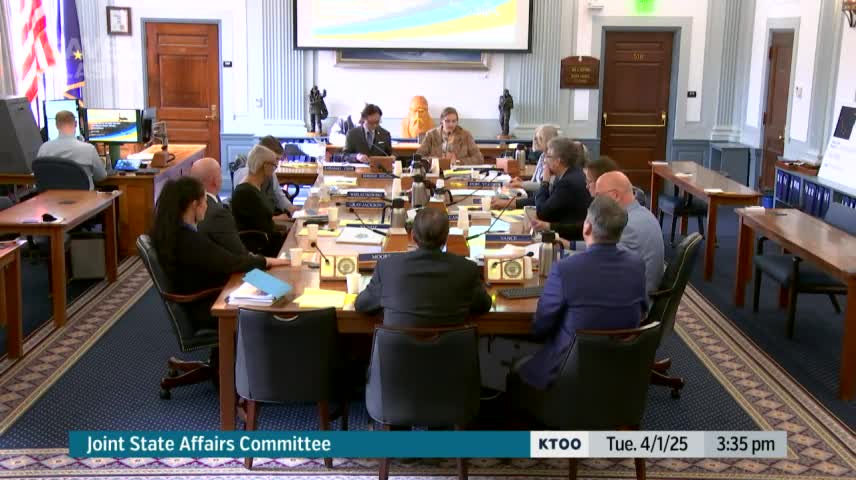
ANCHORAGE — At a joint hearing of the House and Senate State Affairs Committees on April 1, Director Randy Raro, executive director of the Alaska Industrial Development and Export Authority, told legislators ADA’s mission is to promote economic growth and job creation in Alaska and described the authority’s recent finances, projects and risk-management steps.
Raro said ADA operates under statute (AS 44.88.010) and Alaska constitutional provisions on resource development and that its work is distinct from the Alaska Permanent Fund because ADA focuses on economic development and job creation while the Permanent Fund is intended to conserve revenue for future generations. “When ADA is successful with a project like the Red Dog mine, the returns from that project show up in our dividend,” Raro said.
The presentation matters because legislators continue to debate ADA’s performance, the size and scope of state support for development projects, and the tradeoffs between risk, public dollars and long-term returns. Several committee members pressed ADA on program oversight, investment returns, project selection and community engagement.
Raro summarized ADA’s history and statutory basis, noting early legislative action in the 1960s (Senate Bill 153 in 1961; House Bill 14 in 1967) that led to the authority’s present mandate in AS 44.88.010. He described the authority’s current fiscal position and recent activity: ADA reported roughly $1.49 billion in net position for fiscal year 2024, made roughly $150 million to $200 million of new investments in the most recent year, and recorded what he described as the “highest statutory net income in the history of ADA” at about $65 million. The board set the 2026 dividend at $20 million.
Raro provided a breakdown of the net position, saying about $500 million of that total is loan participation program (LPP) loans; $200 million to $250 million are fixed assets such as the Red Dog road; and accounts receivable are roughly $50 million to $100 million. He cautioned that the net position is “not cash.”
On investment policy and performance, Raro said the board has adopted a new policy allowing up to 20% of investable assets in equities to seek higher returns than fixed income alone. He disputed findings from an external analysis cited by legislators and said that resource projects produce additional state revenue streams — royalties, production taxes and corporate income tax — that should be included when measuring ADA’s net contribution. “I do respectfully disagree with those findings,” Raro said in response to a cited Barker and Erickson report.
Committee members pressed ADA on both successes and past failures. Legislators cited historical losses on projects such as the Healy Clean Coal project and others; the transcript records a committee citation that projects have lost about $233.3 million cumulatively and that ADA reported negative returns in 17 of 35 years. Raro acknowledged past failures but pointed to what he described as strong returns on some recent resource investments, and said ADA uses internal staff plus outside experts for due diligence to “derisk” projects before recommending them to the board.
Raro outlined several active or proposed projects and financing tools: Red Dog (road and possible expansion), Anwar lease interests (he said the leases were recently reinstated by the court), Ambler Road / Arctic infrastructure projects, a proposed Cook Inlet reserve-based lending facility and specific company financings including AliasChem and Hex (HexFury). He said ADA is finalizing a $50 million revolving line of credit for Hex Cook Inlet and that ADA has financed projects including conduit revenue bonds for native health clinics and a downtown hotel renovation (Aviator Hotel). He also identified nascent interest in AI/data centers, chemical manufacturing, and critical-mineral processing as areas ADA is tracking.
On the question of job and social benefits, Raro said ADA has asked the contractor that is preparing an independent economic analysis to expand its scope to estimate social benefits of jobs and to calculate a broader internal rate of return that includes royalties, production and other spillover effects. He said the contractor is Northern Economics and that the authority expects to finish the work shortly; Raro told the committee he hoped the report could be completed “in the next two weeks.”
Committee members asked about coordination with other state finance entities. Raro said ADA communicates with the Division of Investments, the Alaska Permanent Fund and CFAB and noted two ADA loan programs are administered out of the Division of Investments. On public engagement, Raro said ADA holds publicly noticed board meetings and conducts community outreach, including hiring local representatives or tribal members as paid consultants to assist stakeholder engagement in rural communities; he said ADA uses nondisclosure agreements at times to protect sensitive commercial information while projects are under review.
Several legislators explicitly questioned ADA’s risk policy and whether some loans duplicated private-sector lending. Raro said the loan participation program is a statutory program created by the legislature and that ADA participates only when a local bank seeks ADA participation to reduce risk and allow a loan to proceed. He argued that without ADA participation, some projects would not have gone forward.
The session included multiple requests for documentation. Members asked for the S&P study Raro referenced on permitting timelines, the bibliography for claims about black carbon and Arctic impacts, and the expanded economic analysis when it is complete.
The presentation closed with legislators continuing to question ADA staff about small-business lending, workforce training opportunities related to AI/data centers and outstanding site issues such as cleanup obligations at a Skagway facility. Raro said ADA had recovered roughly $50,000–$60,000 from a previous tenant and offered those funds to the borough for basic cleanup while noting other parties also bear cleanup responsibility.
Looking ahead, Raro said ADA expects greater activity in resource and energy projects and in emerging sectors that may include small-scale data centers. He told lawmakers the authority is pursuing a blend of due diligence, outside expertise and a changed investment mix to improve returns while balancing the agency’s statutory job-creation mission.
Discussion points: ADA’s statutory mission and history (AS 44.88.010; Alaska Constitution Articles 7 and 8); net position and asset composition; project examples (Red Dog, Anwar leases, Ambler Road, AliasChem/Ali Eschem, Hex/HexFury, Aviator Hotel); community engagement approach; questions about past losses and measurement of ADA’s net return.
Directions from ADA during the hearing: the independent contractor (Northern Economics) was asked to broaden the economic analysis to include social benefits and a fuller return calculation; ADA said it will provide additional citations and documentation to committee members.
Formal decisions: none taken at this hearing. The session was informational and produced requests for follow-up materials and the pending independent analysis.
"We have put roughly, between HexFury and Ali S Kim and, the Aviator Hotel and some other investments, we have put roughly 150 to $200,000,000 on the street this year in new projects," Raro said. "That return will provide even higher gains in years going forward."