Lifetime Citizen Portal Access — AI Briefings, Alerts & Unlimited Follows
AIDEA presents ANWR, Ambler and access-road plans; North Slope and Interior residents press for jobs and training
Loading...
Summary
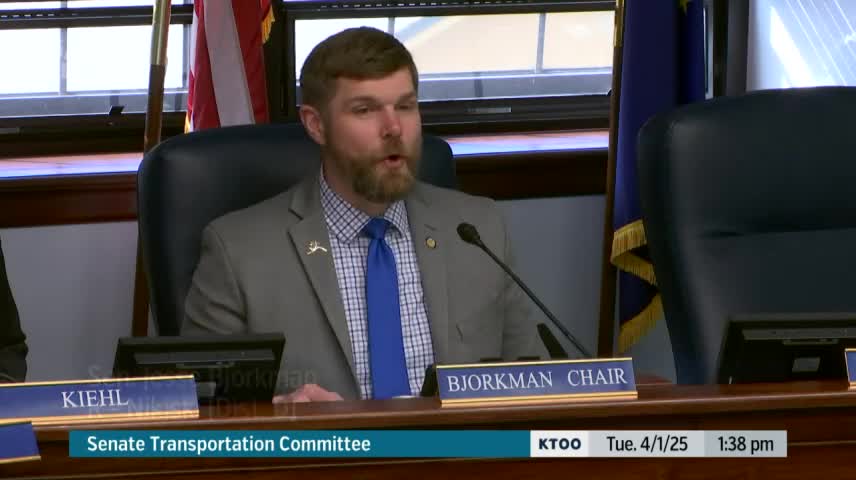
The Senate Transportation Committee on April 1 heard an update from the Alaska Industrial Development and Export Authority (AIDEA) on major projects — including coastal-plain leases in the Arctic National Wildlife Refuge (ANWR), the Ambler Road to the Ambler Mining District, the West Susitna access corridor and continued investment around Red Dog Mine — and received testimony from North Slope and Interior community leaders pressing for jobs, training and year‑round access.
The Senate Transportation Committee on April 1 heard an update from the Alaska Industrial Development and Export Authority (AIDEA) on major projects — including coastal-plain leases in the Arctic National Wildlife Refuge (ANWR), the Ambler Road to the Ambler Mining District, the West Susitna access corridor and continued investment around Red Dog Mine — and received testimony from North Slope and Interior community leaders pressing for jobs, training and year‑round access.
AIDEA’s executive director told the committee the authority’s net asset position rose to about $1.49 billion in fiscal 2024 and the board approved a $20 million dividend to the state. “We very firmly believe that there are billions of barrels of oil” in parts of the coastal plain, AIDEA’s executive director said while describing AIDEA leases and geologic work near state lands adjacent to ANWR. The presentation also reviewed AIDEA-funded road and port projects such as Red Dog and proposals for new access corridors aimed at mineral development and energy transmission.
The update matters because AIDEA projects can produce significant state revenue, local jobs and long‑term infrastructure — and because they raise questions about public access, environmental permitting and how communities will share in benefits. Committee members and tribal leaders focused on three recurring themes: ensuring meaningful local consultation and timely public notice during permitting; training and workforce development for rural Alaska residents; and whether proposed roads should be open to general public use or restricted for industrial access.
AIDEA financials and project scope AIDEA’s presentation described a mix of loan portfolios, hard assets and a revolving fund that together produced the net asset number. The executive director told the committee the authority has returned roughly $500 million to the state treasury since 1997 and that recent investments have positioned AIDEA to grow returns. He cited an estimated federal study figure of roughly $2 billion a year in potential state revenue under a full development scenario for the ANWR coastal plain (production taxes, royalties, property taxes and related receipts), and said AIDEA’s leases in the coastal plain include parcels near proven state acreage.
On Red Dog Mine, AIDEA staff described AIDEA’s role financing road and port infrastructure in the 1980s and later expansions; AIDEA receives approximately $22 million a year from Red Dog-related payments, the presentation said. AIDEA described the West Susitna Access Project as an 80‑mile corridor from Alexander Creek northwest to mining areas that could also carry transmission for a planned wind farm. The Ambler Road was presented as a roughly 200‑mile route from the Dalton Highway into the Ambler Mining District, serving private patented mines and hundreds of thousands of acres of state mining claims.
Community testimony: jobs, royalties, access and training Multiple village leaders and corporate representatives said their communities back development, arguing it provides revenue for schools, clinics, fuel and other essentials. Matthew Rexford, tribal administrator for the Native Village of Kaktovik, said the tribal government, village corporation and city government are aligned in supporting oil and gas exploration in the ANWR 1002 area and asked for opportunities to participate in permitting and outreach. Charles Lampe, president of the Kaktovik Inupiat Corporation, said his corporation owns about 92,000 acres of private land within the coastal-plain boundary and welcomed AIDEA’s lease reinstatements following recent court decisions.
Leaders from Interior and northwest Alaska communities pressed the committee for workforce training and local hiring commitments. Fred Sun, president and chair of the Native Village of Shungnak, cited Red Dog Mine’s long-term employment and said tribal revenues have funded schools and village services; he urged that new projects provide stable jobs and lower local costs for fuel and goods. PJ Simon, first chief of Allakaket, asked for heavy‑equipment and commercial driver training, millwright and culinary programs and suggested mobile or locally based training centers to prepare rural residents for work on mining and road projects.
Access, public vs. industrial roads, and legal rights Several witnesses discussed federal legal access rights. AIDEA staff noted ANILCA (the Alaska National Interest Lands Conservation Act) provisions guaranteeing certain corridors and that ANILCA section 1110 (as discussed in testimony) requires particular access in some contexts. Committee members probed whether projects such as the Ambler Road would be open to public use. AIDEA described Red Dog’s road as having restricted public use in places due to land-management constraints, while the West Susitna proposal was described as intended for open public access. For Ambler, several village resolutions and speakers favored industrial‑access design (commercial/industrial use with limited general public access), saying local communities preferred that approach while still seeking options to bring goods and services to villages.
Permitting, public process and reclamation AIDEA staff told senators that the Army Corps of Engineers and other federal permitting agencies will lead NEPA reviews for major road segments and that public comment periods and tribal outreach will occur as part of those processes. Senators asked about timing for state DOT public comment on the West Susitna project; AIDEA staff said the DOT phase and AIDEA phases are separate processes and that AIDEA will work to coordinate stakeholder outreach. On long‑term maintenance and closure, AIDEA noted federal permit requirements typically include reclamation funds and bonding mechanisms; the staff acknowledged questions remain about who would maintain roads after mine closures and suggested local communities and AIDEA would weigh options once projects reach that stage.
No formal committee votes or decisions on AIDEA projects were recorded during the April 1 meeting. The committee scheduled its next meeting for April 3, when it will consider Senate Bill 138 and a Department of Transportation presentation on coordination with Alaska tribes.
Quotes in committee "We very firmly believe that there are billions of barrels of oil" — Randy Buraro, executive director, Alaska Industrial Development and Export Authority (AIDEA), on coastal-plain geology. "We are a community that is at a crossroads… we are here to support AIDEA's moving forward with leases" — Charles Lampe, president, Kaktovik Inupiat Corporation. "Resource development in our region is huge. Red Dog Mine has been the largest employer of our shareholders for 40 years now" — Fred Sun, president and chair, Native Village of Shungnak. "Opportunities for our next generation means so much to them" — PJ Simon, first chief, Allakaket Tribe, on workforce prospects.
Ending Committee members thanked the witnesses and AIDEA for the briefing and public testimony. The committee took no formal action; members instructed staff to follow up on questions about permitting timelines and coordination. The Senate Transportation Committee will next convene on April 3 for additional bills and a DOT presentation on tribal coordination.