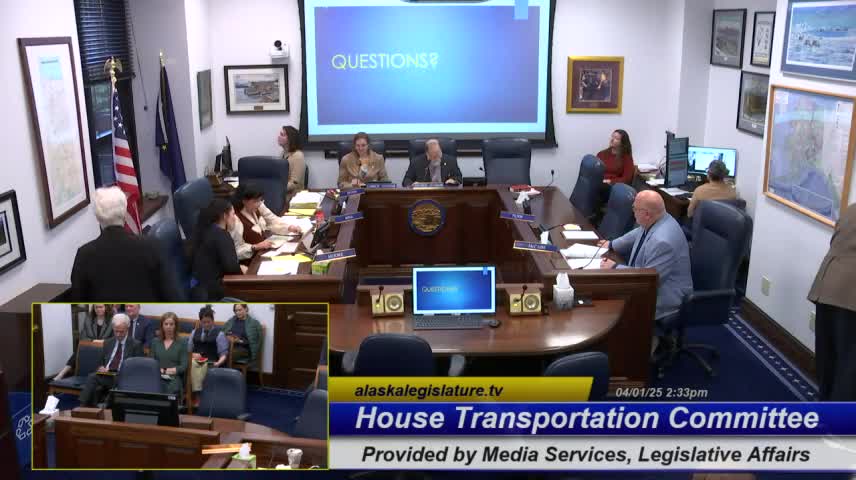
Representative Kopp introduces bill to limit railroad "exclusive use" claims; homeowners, railroad and legal experts testify
Loading...
Summary
Representative Chuck Kopp introduced House Bill 136 to clarify management of the Alaska Railroad right of way where it crosses private homestead patents, citing concerns that courts or railroad practice could permit exclusionary or monetizing uses of easements.
Representative Chuck Kopp introduced House Bill 136 on April 1 to clarify how the Alaska Railroad Corporation manages the railroad right of way where it crosses privately held homestead patents.
Kopp said the measure would affirm the state’s right to set policy and would preserve non-interfering uses by underlying landowners where an easement crosses private property. “This bill simply affirms the state's right to manage the Alaska right of way as a nonexclusive easement when it crosses these homestead patent lands,” Kopp told the committee.
The hour-plus presentation reviewed federal and state legal history cited by the sponsor — the 1875 General Railroad Right of Way Act, the 1914 Alaska Railroad Act, the Alaska Railroad Transfer Act (ARDA) of 1982 and subsequent court decisions including Marvin Brandt Revocable Trust and Alaska Supreme Court decisions — and culminated in the recent dispute decided in the Ninth Circuit involving the Alaska Railroad Corporation and the Flying Crown Homeowners Association. Kopp argued the Ninth Circuit decision reading an “exclusive use” easement across large portions of the right of way created harms when applied to homestead-patented lands.
Alaska Railroad officials defended their actions and explained why the railroad pursued a quiet-title suit. Bill O’Leary, president and CEO of the Alaska Railroad, said the quiet-title action “was not something that was taken lightly” but was sought after “a series of events” and competing claims that the railroad’s board believed needed judicial clarity; he added the railroad paid legal fees for the homeowners association to mitigate impacts. Megan Clements, director of external affairs for the Alaska Railroad, pointed committee members to the district court and Ninth Circuit opinions for the legal reasoning behind the railroad’s claim of an exclusive-use easement in the disputed segments.
Property owners and invited witnesses described practical effects they said resulted from railroad permitting and fee practices. Joe Mathias, whose family holds a homestead patent, told the committee his family has been charged permit fees to maintain a private crossing and an underground electric line and estimated the family paid about $20,000 over the last 10 years for crossing and permit-related charges. Mathias described $500 annual fees per permit and recurring five-year contract renewals with administrative costs. John Fletcher, a South Anchorage property owner and chair of a local railroad committee, recounted past railroad letters threatening liens and described the residential-right-of-way program and its permit requirements as burdensome.
Legal and policy testimony offered differing views on remedies. Ivan London, a senior attorney with Mountain States Legal Foundation, said the legislature can regulate the Alaska Railroad Corporation and that HB 136 “does not” undermine the Ninth Circuit decision. He said the bill addresses corporate conduct rather than altering private property rights.
Sponsor staff summarized the bill’s statutory changes: Section 3 would create a new AS 42.44.15 clarifying that the Alaska Railroad Corporation “shall allow an owner of real property subject to an easement in favor of the corporation to use their property” where such use does not unreasonably interfere with the easement’s purpose. Sections 1 and 2 would make the corporation’s authority to lease or grant easements subject to that new section.
The committee conducted invited testimony and questions; no formal vote was taken and HB 136 remains at its first hearing. Members asked the railroad about ownership (the state of Alaska owns the Alaska Railroad) and about why the railroad pursued litigation; O’Leary said the suit sought clarity after a long-running dispute.
Why it matters: Sponsor testimony and homeowner accounts framed the bill as an effort to prevent private-property owners from losing safe, non-interfering use of land their patents grant, or from being charged recurring fees to cross or use that land. The railroad argued the litigation was intended to establish clear title and operating rights where multiple ownership claims overlapped. The committee did not take final action; the measure will continue through the legislative process.