Get Full Government Meeting Transcripts, Videos, & Alerts Forever!
Get email alerts on the Aerospace And Research Infrastructure topic
No spam. Unsubscribe anytime.
Geophysical Institute tells Legislature Alaska is poised to be an aerospace hub
Summary
Dr. Robert McCoy of the University of Alaska Fairbanks Geophysical Institute told the Alaska Legislature that the state’s rocket ranges, satellite ground stations, drone program and HAARP facility position Alaska to expand defense and commercial aerospace activity, while funding uncertainty from the Pentagon remains a concern.
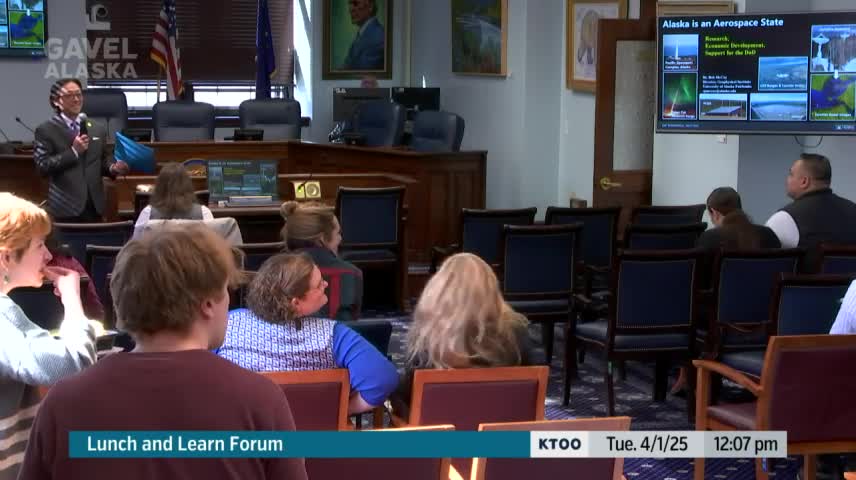
Dr. Robert McCoy, director of the Geophysical Institute at the University of Alaska Fairbanks, told members of the Alaska Legislature during a presentation that the state’s combination of rocket ranges, satellite ground stations, a large drone program and the HAARP facility position Alaska to expand both commercial and defense-related aerospace activity.
"We're well positioned for a lot of things happening here," McCoy said, describing Alaska as a geophysical laboratory with assets that include the Poker Flat Research Range, facilities on Kodiak operated by Alaska Aerospace Corporation and a dozen satellite dishes in Fairbanks. He said the Geophysical Institute (GI) employs about 500 people and had operating expenditures of roughly $115,000,000 last year, about $10,000,000 of which came from the state for drone and earthquake work.
The GI runs multiple programs that support both science and defense customers. McCoy said the institute became a University Affiliated Research Center (UARC) in 2018, a designation that has expanded contracting opportunities with the Department of Defense. The institute operates the Alaska Volcano Observatory (sponsored by the U.S. Geological Survey), an earthquake center funded in part by the state, and a global network of listening stations used for nuclear nonproliferation monitoring.
McCoy outlined recent and recurring launch activity at Alaska ranges: "We just launched three rockets the last couple of weeks. We launched one two days ago," he said, describing suborbital flights from Poker Flat and the potential to develop orbital launch operations. He noted operational differences between Kodiak and Poker Flat: Kodiak launches typically put stages into the ocean, while Poker Flat recovers payloads and upper stages on land using parachutes.
The institute and Alaska Aerospace Corporation are discussing a joint effort to build hypersonic test-range capability and to use movable rail-based launch infrastructure to expand where launches can be conducted. McCoy said the effort would require coordination with federal authorities and FAA licensing to support both DoD and commercial launches.
On remote-sensing and data capabilities, McCoy said Fairbanks ground stations receive polar-orbiting radar satellite passes about 14 times a day and that the GI pulls down imagery and radar data used for volcano and landslide monitoring, maritime surveillance and other research. He noted the incoming NISAR radar satellite will generate an estimated 50 petabytes of data per year and described plans to store and serve large satellite datasets via commercial cloud services.
McCoy described HAARP — a high-power transmitter the Department of Defense built and the GI now operates — as an ionospheric research facility funded by the National Science Foundation under a multi-year grant. He said HAARP can be used for scientific experiments and has potential applications for over-the-horizon sensing and tracking.
The GI also highlighted non‑aerospace research and economic activities, including a long-standing drone test program used for cargo delivery and pipeline support, an Alaska Critical Minerals Collaborative built around hyperspectral airborne surveying, and exploratory work on naturally occurring geological hydrogen near mining sites such as Red Dog Mine.
Asked about federal funding and Pentagon interest, McCoy said there is uncertainty: "At the moment, I'm mostly seeing confusion," he said, adding that the GI’s UARC status and work on nuclear nonproliferation, hypersonic test support and HAARP give it an argument for continued support but that future funding decisions are still unsettled.
McCoy closed by inviting legislators to visit GI facilities, noting an upcoming open house at HAARP and opportunities for tours of Poker Flat and other sites.