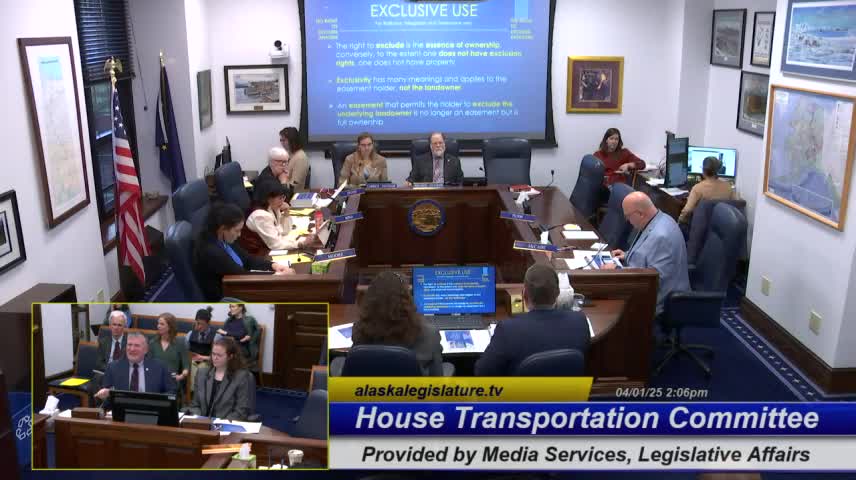
House committee hears wide-ranging public testimony supporting statewide public and community transit plan
Loading...
Summary
The House Transportation Committee on April 1 opened public testimony on House Bill 26, a measure from Rep. Genevieve Mina to require the Department of Transportation and Public Facilities to lead a statewide public and community transit planning process.
The House Transportation Committee on April 1 opened public testimony on House Bill 26, a measure from Rep. Genevieve Mina to require the Department of Transportation and Public Facilities to lead a statewide public and community transit planning process.
The bill would expand the department’s responsibilities to make transit planning “more than just transportation for people who drive,” Rep. Genevieve Mina, sponsor and representative for House District 19, said in a brief reintroduction before testimony.
Supporters told the committee the bill would address gaps in rural and community transit, accessibility for people with disabilities, and options for residents without cars. Bridger Reid Lewis, a disability advocate and board member of the Alaska Mobility Coalition, urged amendments to expand rides for people on food assistance and proposed making basic transit free. “I believe that getting around should be a right,” Lewis said. Michelle Giro, executive director of Hope Community Resources and chair of the Key Coalition of Alaska, said, “Alaskans with disabilities face really unique challenges… but transportation is often at the top of the leaderboard.”
Testimony highlighted distinct geographic issues. Britney Robbins, a civic engagement coordinator and borough assembly member from a remote southeastern island, said islands lack frequent ferry service and other shared options that once helped school travel and lowered district costs. “The only option is to fly, and that is private,” Robbins said, recounting costly travel that can force residents to leave home to get medical care. Jason Norris, testifying from Anchorage, tied the bill to pedestrian safety and urged planners to prioritize people who walk, bike and use transit.
Other speakers described local benefits of community transit. Jared Hope, government relations director for the Sitka Tribe of Alaska, said tribal and community transit programs have struggled to “get a seat at the table” within the department and that tribal stakeholders have long supported including community transit in statute. Cynthia Long, a lifelong public-transit user from the Kenai Peninsula, said local transportation services had helped prevent isolation after her husband lost his ability to drive.
Committee procedure: public testimony opened at about 1:08 p.m. and was limited to three minutes per speaker; the committee closed public testimony at about 1:22 p.m. Co-chairs set an amendment deadline for House Bill 26 of Monday, April 7 at 5:00 p.m.
The committee did not take a vote on HB 26 during the April 1 meeting. The bill will return to the committee for amendment consideration before further action.
Why it matters: Supporters said a state-led planning process would coordinate urban, rural and tribal needs and improve access for seniors, youth and people with disabilities. The bill would formalize a statewide role for the Department of Transportation and Public Facilities in public and community transit planning and aims to direct future investments and coordination across jurisdictions.
The committee’s next scheduled meeting is April 3; representatives noted the MPO (metropolitan planning organization) boundary and formation discussion scheduled that day could bear on implementation questions for the statewide plan.