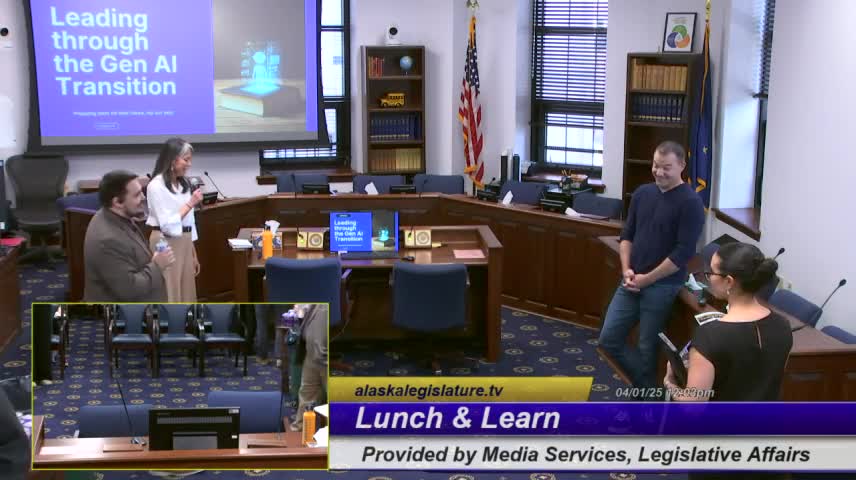
Alaska lunch-and-learn: Educators hear how generative AI could reshape teaching and a call for child-safety research
Loading...
Summary
At an ACSA “lunch and learn,” presenter Jeff Utech outlined generational differences and practical classroom uses of generative AI, citing state guidance work and research on AI benefits; an attendee urged funded research into possible psychological harms to children using chatbots.
Jeff Utech, a presenter and former teacher, told Alaska educators at a lunch-and-learn hosted by a legislative office and the Alaska Council on School Administrators that generative artificial intelligence is a ‘‘great transition’’ that will affect education and the workforce and urged schools to prepare students for new kinds of jobs.
Utech described how different generations — from baby boomers to Gen Z and Gen Alpha — view work and learning differently and said those generational differences shape how schools and districts should introduce AI tools. He said states are already producing guidance: he helped write AI guidance for the Washington Office of Superintendent of Public Instruction in January 2024 and said 26 states had since released guidance. "We need teachers talking about this with students now to understand what they are, how they work, how do you leverage them in meaningful ways," Utech said.
Why it matters: Utech framed generative AI as a general-purpose technology that will change many jobs and enable new classroom tools while raising implementation and ethical questions. He cited recent research and practical benefits — including studies and vendor examples — showing AI can augment instruction and save teachers time, but he and attendees emphasized a research gap on child mental-health effects from conversational chatbots.
Utech told attendees that well-designed AI tutors can improve outcomes and that teachers who receive training can recoup significant time. He cited national research that teachers who spend roughly three to four hours training on AI tools can save five to seven hours a week on routine tasks. He also referenced external studies and reports presented during the talk: a World Economic Forum projection that generative AI will transform a large share of businesses and produce new roles while changing others, a recent Australian study reporting high diagnostic accuracy for an AI cancer tool, and a Harvard study showing benefits from AI-designed tutoring when properly implemented.
In a question-and-answer period, an attendee who identified themself as a member of the National AI Task Force and the National Conference of State Legislatures expressed concern about psychological and behavioral risks for young children who interact with chatbots. The attendee referenced a news case of a 12-year-old who used a chatbot and later died by suicide and asked whether research exists about children forming emotional attachments to chatbots. "My concern is you've got a little child, the chatbot learns all their favorite things ... I could see a child might prefer that time with the chatbot than with people in the classroom," the attendee said.
Utech agreed research is needed and said the conversation must extend beyond classrooms to parents and communities. He described work he has done with superintendents and principals in Alaska, training more than 100 teachers virtually and meeting with the state department and local districts to promote a statewide approach to using AI "in authentic and meaningful ways and make sure that students are using it for the right reasons and not the wrong reasons." He said he will return to Alaska to continue principal and teacher trainings.
The presentation included policy and practice points attendees can follow up on: states' AI guidance development, teacher training hours and estimated time savings, examples of classroom uses (study guides, drafting constituent communications, meeting prep, and tutoring), and a call from attendees for funded research into child-chatbot interactions. Utech encouraged parent education events and district-level policymaking to pair tool adoption with ethics and usage guidance.
The session closed with organizers scheduling additional training and outreach; no formal motions or district votes were taken at the event.