Get Full Government Meeting Transcripts, Videos, & Alerts Forever!
Get email alerts on the Commercial Roofing License topic
No spam. Unsubscribe anytime.
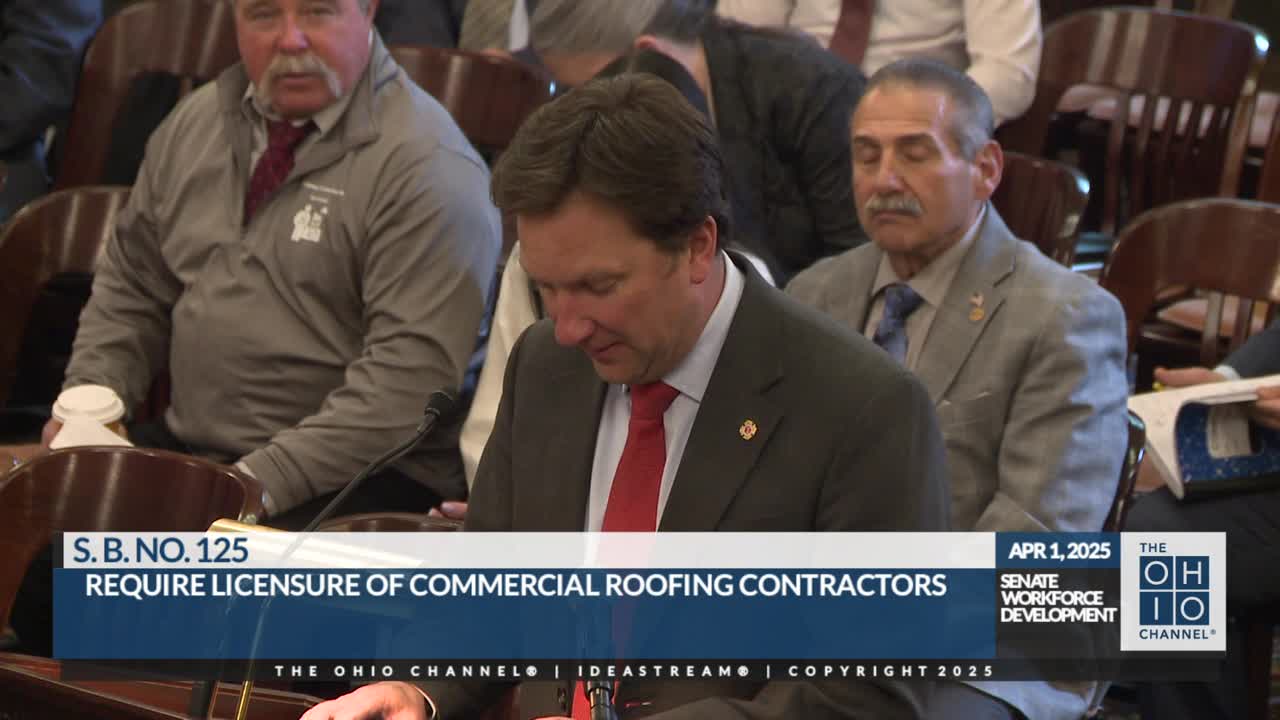
Proponents tell Senate committee commercial roofing licensing would improve safety, curb fraud
Summary
At a second hearing on Senate Bill 125, industry groups, roofing contractors and a firefighting association urged adding a commercial roofing license section to the Ohio Construction Industry Licensing Board to raise standards, protect workers and reduce contractor misclassification.
The Ohio Senate Workforce Development Committee held a second hearing on Senate Bill 125 and heard proponent testimony from roofing contractors, industry associations and firefighters urging creation of a commercial roofing license section under the Ohio Construction Industry Licensing Board (OCILB).
Speakers said licensing would raise professional standards, improve public safety and reduce employment misclassification. Sam Gemetro, president of Northern Ohio Firefighters, told the committee that commercial roofing work affects first responders because roof construction and quality influence fire operations and building safety. "The way the roof is built and who's putting it on makes a big difference to us firefighters," Gemetro said.
Fred Horner, president and CEO of Advanced Industrial Roofing and president of the Ohio Roofing Contractors Association (ORCA), outlined the bill’s structure as presented to the committee: a roofing section within OCILB, a $60 annual license fee, a minimum liability insurance requirement of $500,000, a process for grandfathering workers with three years’ experience, and industry-specific testing administered by a third-party contractor at multiple locations and in multiple languages. Horner said OCILB has operated for nearly 20 years and that the bill assigns one license-holder per company, with continuing-education requirements.
Other proponent testimony came from Kara Markley, vice president of Advanced Industrial Roofing, who described family-business continuity and workforce impacts, and Bill Kilcoyne, a roofing consultant with decades of industry experience who urged the committee to pass the measure to improve building safety and reduce fraud that he said harms law-abiding contractors.
Witnesses said the licensing structure is intended to create a level playing field for large and small contractors, limit schemes that misclassify workers or use 1099 arrangements to avoid taxes and benefits, and provide training on codes, business practices and safety. They told the committee municipalities would still be able to collect local fees but could not bar in-state licensed contractors from operating.
The committee did not take a vote on the bill at the hearing. The chair indicated written testimony was available on members’ iPads and the matter stood as a second hearing.