Get Full Government Meeting Transcripts, Videos, & Alerts Forever!
Get email alerts on the Charter Review topic
No spam. Unsubscribe anytime.
Stow City Charter Review Commission outlines proposed changes to succession, notice and timeline at town hall
Summary
At a town-hall presentation, the Stow City Charter Review Commission described draft charter changes including clearer acting-official succession, a reduced public-posting minimum with social-media notice, an earlier ballot timeline deadline and proposed provisions for acting department directors; no formal votes were taken.
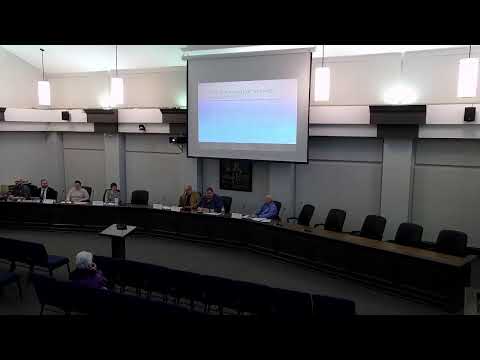
Dennis Campbell, chair of the Charter Review Commission, opened a town-hall meeting to describe the commission’s process and a series of draft charter changes the panel has discussed, emphasizing the group has not yet voted on any proposals or sent them to City Council.
The commission is proposing clarifications to succession language for an acting mayor, a reduction in the minimum number of physical public-posting locations from six to three coupled with a requirement to post notices on the city’s social media platforms, an earlier internal deadline for sending charter amendments to council (moving materials from Aug. 1 to July 1), and explicit language allowing appointment of acting directors for the finance and law departments during periods of incapacity. Commissioners also discussed asking Council to convene a separate commission to study wards and redistricting.
“Nobody on this commission can change the charter — we only make recommendations that, if sent to council and approved there, could appear on the ballot,” Campbell said. He summarized the process: the commission drafts recommendations with legal counsel, Council would then review and must secure five votes of seven to place a charter amendment on a general-election ballot, and voters would make the final decision at the polls.
On public-notice changes, the draft would set a minimum of three physical posting locations rather than the current enumerated six (City Hall; the Safety Building; Firehouse 2 and Firehouse 3; the library; and the senior and community center). The proposal would also require that meeting notices be posted to whatever social-media platforms the city uses, without naming specific platforms. During public comment, resident Angie Charles asked whether social-media notice would include email; a City staff member replied, “Legally, no. It doesn't.” Campbell said the commission noted the request and would discuss adding email as a notification channel at a future meeting.
The commission described timeline concerns raised by the Summit County Board of Elections: under current practice, the commission’s schedule and an Aug. 1 deadline create a compressed review window that can force emergency Council meetings to meet county election printing schedules. The commission’s draft would require the commission to convene by the last meeting in January and to deliver items to Council by July 1 to allow sufficient time for Council review and for the county to print ballots.
Commission members also addressed gaps in the charter for continuity of operations. Article 6, the commission said, currently lacks authority to appoint an acting finance director in cases of incapacity; the commission proposes adding language analogous to existing mayor-succession provisions so an acting finance director (and similarly an acting law director) may be named temporarily to avoid service disruption.
On wards and redistricting, commissioners said Stow currently has four wards that have not been revised since the charter’s adoption (the commission cited the charter’s implementation on Nov. 4, 1958). Commissioners said the research and public hearings required to consider changing ward boundaries are substantial and they may recommend Council convene a special commission to study wards and redistricting rather than try to complete that work within the charter-review time frame.
Campbell and other commissioners encouraged residents to provide feedback in meetings, by email or via business cards shared at the meeting. He said the commission is meeting nearly weekly, will post materials to the city website, and intends to forward items to Council individually when they are ready rather than holding back batches. There were no formal motions or votes taken at the town hall; the items discussed remain draft recommendations to be reviewed and, if adopted by the commission, forwarded to Council for its consideration.