Get Full Government Meeting Transcripts, Videos, & Alerts Forever!
Get email alerts on the School Accountability topic
No spam. Unsubscribe anytime.
Senate committee weighs measures to identify and intervene in persistently low-performing schools
Summary
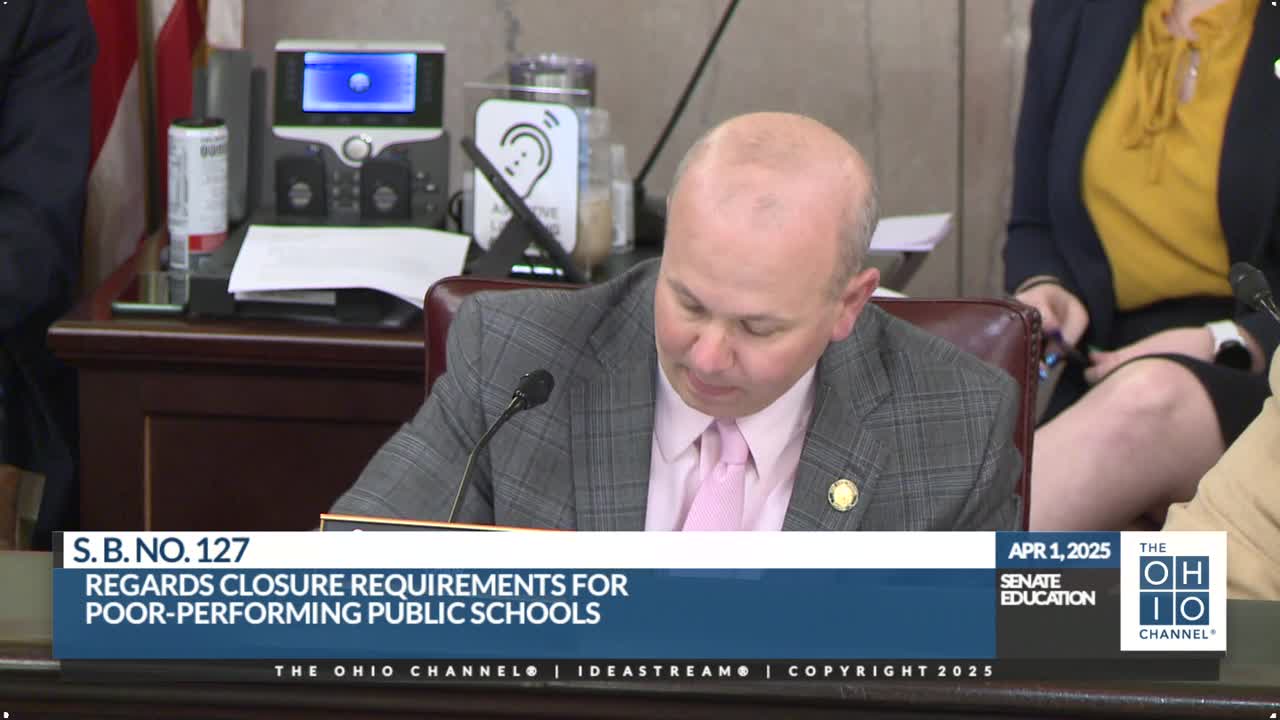
Senate Bill 127, a proposal to identify and intervene in persistently low-performing school buildings across Ohio, drew extended testimony and questions at the Senate Education Committee’s third hearing.
Senate Bill 127, a proposal to identify and intervene in persistently low-performing school buildings across Ohio, drew extended testimony and questions at the Senate Education Committee’s third hearing.
Supporters said the bill brings consistent standards and accountability to schools that repeatedly show weak academic performance; opponents warned that the bill's reliance on narrow test-based cutoffs and mandated remedies risks destabilizing already struggling schools and communities.
The bill would use state report card measures — a bottom-5 percent statewide performance index (PI) and a bottom-10 percent value-added or growth measure across three consecutive years — to identify chronically underperforming school buildings. Once identified, buildings would be required to adopt one of several structured interventions, which could include closure, restructuring, transfer to an external operator, or other remedies laid out in the bill.
Greg Lawson, senior policy witness for the Buckeye Institute, argued the state must apply a consistent accountability framework to district and charter buildings. "We have to bring accountability. We have to improve quality," Lawson said, urging that stronger incentives are needed so children "have the skills necessary to be competitive and successful." Lawson told the committee the bill focuses on buildings rather than systems and that a multi-year threshold prevents immediate, short-term consequences.
Chad Aldis of the Thomas B. Fordham Institute said the bill moves Ohio toward uniform identification across sectors but proposed technical changes. "Senate Bill 127 is a commendable effort to unify and strengthen Ohio's approach to consistently low performing schools," Aldis said, and recommended (1) using Ohio’s existing one‑star rating as the growth measure rather than a percentile rank, (2) treating identification uniformly but limiting some interventions (such as restructuring) to district schools, and (3) preserving prior years of low performance rather than wiping older report cards from consideration.
Scott DeMauro, president of the Ohio Education Association, testified in opposition. He called the bill "heavy handed and overreaching," saying its mandated remedies would "harm students and communities" by disrupting schools and overriding local bargaining agreements. DeMauro cited research indicating that school closures and other punitive actions often do not place the most disadvantaged students into higher-performing schools.
Committee members asked how many buildings might be affected and how funding and governance would operate if a building is managed by a third party. Aldis estimated, based on currently available report-card distributions, "probably 40 to 50 traditional public schools" could meet the bill’s criteria after accounting for growth measures; he called that a back-of-envelope estimate pending the next official report card. Members also pushed witnesses on whether punitive actions improve outcomes. Aldis pointed to Ohio’s past Student Improvement Grants (SIG) research showing positive effects in the state, and Lawson urged patience for multi-year reform effects.
Several senators emphasized the deep correlation between poverty and school performance. Senator Theresa Smith asked whether the bill would address root causes that keep children in poverty; witnesses and committee members agreed poverty and community supports matter, but differed on whether the proposed statutory approach is the right lever.
Witnesses raised implementation questions the bill does not fully specify in transcripted testimony: how state aid and local tax funds would flow if a building’s management changed; how sponsor evaluation (for charter schools) should be strengthened; and whether resetting the accountability clock to exclude pre‑2024 report cards would let chronically low performers escape established consequences.
The committee did not take a final vote on Senate Bill 127 at this hearing. Members indicated interest in technical amendments and further analysis of the expected number of affected buildings, sponsor-accountability mechanisms, and funding mechanics.
Looking ahead, witnesses said detailed cost and implementation studies and clearer language on interventions and sponsor oversight will be needed before the committee advances the bill. The committee concluded the third hearing on Senate Bill 127 and moved to other agenda items.