Port Richey workshop reviews broad rewrite of city sign code; businesses press for digital, temporary-sign clarity
Loading...
Summary
City staff presented a proposed rewrite of Port Richeysign regulations; public commenters from sign contractors and small businesses asked for clearer definitions for activated (digital) signs, sandwich-board placement and window signs, and raised safety and economic concerns.
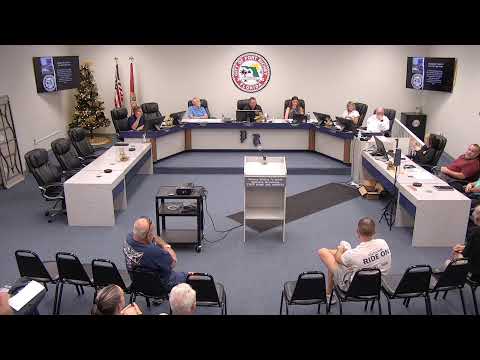
City staff opened a public workshop on a proposed rewrite of Port Richey City sign regulations, laying out broad changes that would treat temporary signs uniformly, ban several categories of signs and tighten rules for nonconforming signs.
The proposals presented would remove content-based labels (for example "political" versus other temporary signs) and make compliance depend on physical characteristics, such as size, height, setback and duration. Staff said permit applications would be reviewed within 30 days and a new appeal process would be created for disputes over building official decisions.
The rewrite would also ban certain sign types citywide, according to the presentation: inflatable signs and devices, vehicle signs used as stationary advertising, roof signs, projected-light signs, signs that obstruct visibility or traffic signals, and new billboards/off-site advertising. Nonconforming signs would need to be removed or brought into compliance within 90 days after an ordinancepassage, the presentation said.
Del Aitcheson, owner of PASCO Signs and Printing, asked whether the proposed language would bar sign spinners and people holding commercial mascot or arrow signs in public rights-of-way. "That is what that's intending to eliminate for commercial reasons," he said, describing the provision that targets people displaying commercial messages on public sidewalks or rights of way.
Sign contractors and business owners pressed the board for clearer definitions and exceptions. Chris Mayer, who said he is opening a car dealership on U.S. 19, asked whether an "activated sign" would ban modern digital displays. Staff read the ordinance definition aloud, noting an "activated sign" would include signs that change appearance automatically or depict copy that moves, which participants said would capture many LED electronic message boards. "So it sounds like any digital sign is banned?" Mayer asked. A staff member replied, "I believe so, at this point." Several business owners urged limits such as mandatory dimming at night and minimum dwell times for messages rather than an absolute ban.
Waterfront business owners argued the Waterfront Overlay District creates different needs. Mike Lowe of Catches Waterfront Grill said waterfront businesses rely on visible signage for motorists and boaters and pushed for a district-specific approach. Board members and staff acknowledged the overlay district imposes separate rules and that variances can be sought through the Board of Adjustment.
Other recurring public concerns included: - Feather and ground flags and the need to define "flag" in the code so businesses know whether feather flags (often 89) are allowed; - Window signs: the existing 25% limit on window coverage and whether that percentage applies to a single window or the aggregate of all windows; residents said the current draft uses the word "aggregate," which can change enforcement; Danielle Merkel (5614 Queener Ave.) sought clarification for small storefront windows; - Sandwich-board (A-frame) signs: the draft limits placement to no farther than 5 feet from a main entrance in nonresidential districts, a rule some business owners said effectively hides the sign from passing traffic if a building is set back from U.S. 19; - Murals versus wall signs: several commenters asked whether painted murals that include a business name or logo would be treated as signage subject to size limits or exempt if they are considered artwork; - Temporary signs and wind safety: longtime business owner Dan Timmer urged the city to require temporary signs to be removed nightly or otherwise secured to prevent them becoming airborne debris in storms.
Staff said the draft encourages monument signs over pole signs, would require landscaping around monument signs where feasible, and includes stricter maintenance standards for signs. Staff also said they would research Pasco and Pinellas county ordinances and return with examples and recommendations; the next workshop/meeting to continue the discussion was scheduled for May 13 at 1 p.m.
No final ordinance vote was recorded during this workshop. Instead, attendees and the board discussed definitions, enforcement, and possible district-specific exceptions, and staff were directed to gather model language and county references for further review.