Get Full Government Meeting Transcripts, Videos, & Alerts Forever!
Get email alerts on the Redevelopment Project Area 2 topic
No spam. Unsubscribe anytime.
Mesquite agency approves redevelopment project area 2; sets 90‑day challenge period
Summary
The Mesquite Redevelopment Agency on March 18 approved Resolution R25‑4 to create Redevelopment Project Area No. 2, a 30‑year tax increment financing district focused on the city area south of Interstate 15. The board approved required governing documents and will notify county and state officials during a mandatory 90‑day challenge period.
The Mesquite Redevelopment Agency on March 18, 2025 approved Resolution R25‑4 to create a new redevelopment district called Redevelopment Project Area No. 2, moving the city into a mandatory 90‑day challenge period before redevelopment activity may begin.
The approval came after a presentation by Fred Steinman, director of the University Center for Economic Development in the College of Business at the University of Nevada, Reno, and remarks from Martine Green, Redevelopment Agency Director. "It's required. So, after tonight, we're going to sit for 90 days, we're going to wait it out and then we'll be able to just jump right in and have the new redevelopment agency," Green said.
The action establishes a 30‑year redevelopment plan and associated owner participation rules required under Nevada law and authorizes use of tax increment financing to fund future projects in the new district. Steinman told the board redevelopment tools focus on encouraging infill development rather than outward expansion. "Redevelopment ... is really about encouraging infill development and pushing existingly, developed property to higher and more productive use within the boundaries of a municipality," Steinman said.
Why it matters: the new project area encompasses the portion of Mesquite south of U.S. Interstate 15 and is intended to address physical, socioeconomic and housing conditions Steinman said his team identified in the city’s south side. The technical reports included with the agency packets document findings the presenter summarized as: a high share of residential parcels, low density along Main Street, an older housing stock approaching the end of its 50‑year depreciation schedule, and more vacant or underutilized parcels than elsewhere in the city.
How financing would work: Steinman walked the board through tax increment financing as described in the redevelopment plan and the accompanying materials. He said the district would capture a portion of four component property tax rates to form the agency's incremental revenue stream: 0.552% (Mesquite city rate), 0.75% (county school maintenance and operation), 0.4599% (Clark County general operating) and 0.17% (Clark County capital). Together those rates total 1.319% of incremental assessed value to be allocated to the redevelopment agency over the district’s 30‑year life, the presentation states.
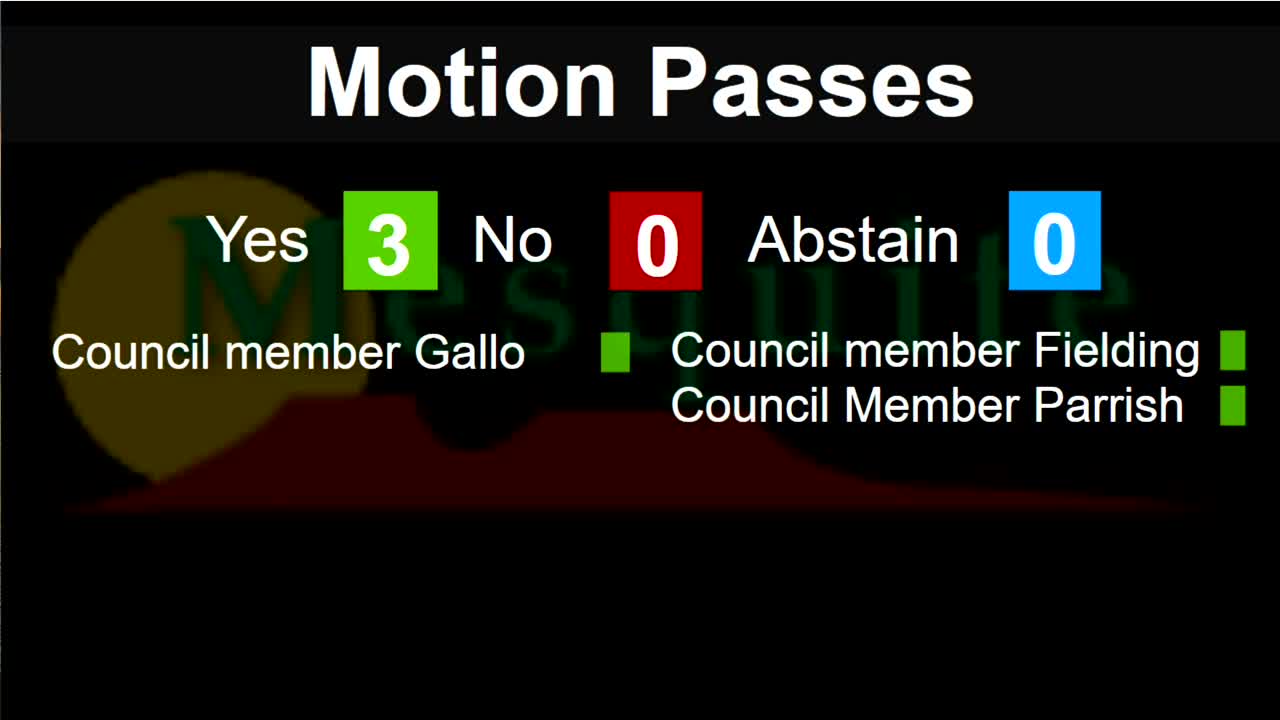
Board action and next steps: Councilwoman Filley moved to consider Resolution R25‑4; Board Member Gallo seconded, and the board voted to approve the resolution. The board then will notify the Clark County clerk (who in turn coordinates with the assessor and treasurer) and the Nevada Department of Taxation, after which a 90‑day period for procedural legal challenges begins. If no valid challenge is sustained, activity may begin on day 91, including disposition and development agreements, infrastructure projects and owner participation agreements described in the agency’s rules.
Public comment: Rick McIntyre, president of the Falcon Ridge Community Association, addressed the board during the public hearing and expressed support for the redevelopment effort.
The presentation materials and two University Center technical reports — the owner participation rules and the redevelopment plan with a legal description and maps — were entered into the record. Agency staff said the owner participation rules are a process the agency uses to evaluate requests from property owners and do not compel private owners to participate.
The redevelopment plan and owner participation rules are statutory documents and, as the director explained, are not strategic plans of goals and actions but the governing documents that document blighting conditions, financing method and conformity with city codes and ordinances. After the 90‑day challenge period the agency may begin project work that could include infrastructure, facade programs, housing initiatives, remediation and other infill activities discussed in the packet materials.