Get Full Government Meeting Transcripts, Videos, & Alerts Forever!
Get email alerts on the Battery Energy Storage topic
No spam. Unsubscribe anytime.
Edgar County board hears battery storage concerns, votes to impose moratorium and review ordinance
Summary
After a public hearing on a proposed battery energy storage (BESS) ordinance, the Edgar County Board voted to declare a moratorium and review the draft ordinance following developer and public concerns about permitting, financial assurances and safety requirements.
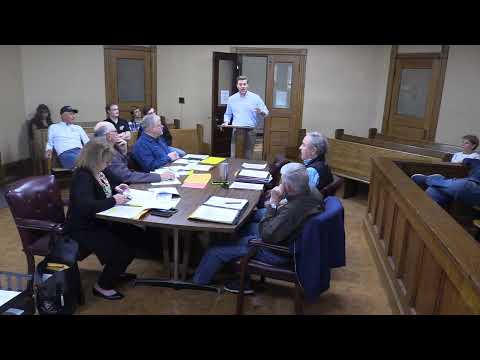
Edgar County board members held a public hearing on a proposed ordinance governing battery energy storage systems and then voted to impose a moratorium and direct staff to review the draft.
The hearing drew a presentation and questions from Ian Evans, a representative of AIPA Power, a utility-scale developer. Evans said three provisions in the draft ordinance would be “completely unworkable” for large developers: a requirement to secure an interconnection agreement before filing a county permit application, a proposed financial assurance equal to 10% of total project cost, and an open-ended ability for the county to increase required liability insurance. “Requiring an interconnection agreement prior to application isn't workable,” Evans said. He explained the interconnection process with MISO and noted developers often face phased security requirements that can reach “multiple millions of dollars.”
State's Attorney Philip told the board he preferred a moratorium to allow staff time to review the concerns and prepare a revised ordinance. “Without knowing the concerns that were brought up at the earlier hearing, I would say the moratorium,” he said.
Why it matters: county officials said they want local standards in place before projects come forward. County staff and several board members described the draft ordinance as a way to avoid a regulatory gap if projects applied before county rules existed, but they also acknowledged developer concerns about feasibility for large projects.
Key points from the hearing
- Interconnection timing: AIPA Power said MISO's interconnection study and agreement process occurs in phases with rising financial security requirements; the developer seeks the county permit before committing the larger sums required later in the MISO process.
- Financial assurance: The draft's 10%-security provision was characterized by Evans as impractical for a large hybrid solar-plus-battery project. He estimated a large battery addition could make the applicable security requirement hundreds of millions of dollars and said posting that cash or equivalent would be infeasible for developers.
- Insurance language: The draft allows the county to increase required umbrella liability limits; the company warned lenders would not underwrite construction financing if insurance demands could change without an established process.
- Safety and emergency planning: Evans said developers routinely prepare emergency response plans, include 24/7 remote monitoring, and coordinate with local fire and emergency management. He also noted industry standards such as NFPA 855 guide modern facility design; he told the board many high-profile incidents involved facilities built before 2019 standards were in place.
Board action and next steps
After public comment and board discussion, members voted to impose a temporary moratorium on accepting new battery energy storage permit applications while staff reviews the draft ordinance and the concerns raised. The board recorded the motion and followed with a roll call approving the moratorium and directing staff to work with stakeholders on revisions. State's Attorney Philip was asked to assist with the review. The board closed the public hearing and moved on to the regular agenda.
What the ordinance would have required (as discussed in the hearing)
- Interconnection agreement: The draft required an interconnection agreement prior to application (developer described this as incompatible with the multi-phase MISO interconnection timeline).
- Financial assurances: Draft language mentioned posting security roughly equivalent to 10% of project cost at or immediately after application (developer estimated that would scale to hundreds of millions for large hybrid projects; amount not specified by staff during the hearing).
- Liability insurance: The draft included a high umbrella amount and allowed increases; developer urged fixed insurance levels or a clear path for adjustments to avoid undermining lenders.
Comments from local officials and the public
Local officials and at least one public commenter said the county benefits from having local rules in place rather than relying solely on future state law. One county official described the ordinance as a way to avoid a “Wild West” situation if projects applied before standards existed.
Ending: The board’s moratorium gives staff and the county attorney’s office time to reconcile developer concerns with county protections for emergency response, decommissioning, and financial responsibility. The board asked staff to consult the ordinance template’s author and return with recommended revisions and a timeline for a revised draft.