Get Full Government Meeting Transcripts, Videos, & Alerts Forever!
Get email alerts on the Overdose Prevention topic
No spam. Unsubscribe anytime.
Nashville officials say One Box naloxone program helped save lives as overdoses shift toward xylazine-adulterated fentanyl
Summary
Metro officials reported a 31.4% drop in overdose deaths in 2024, but a March 2025 spike and growing xylazine in the fentanyl supply prompted calls for wider One Box naloxone deployment, a proposed $2 million opioid-settlement outreach request and discussion of a sobering center.
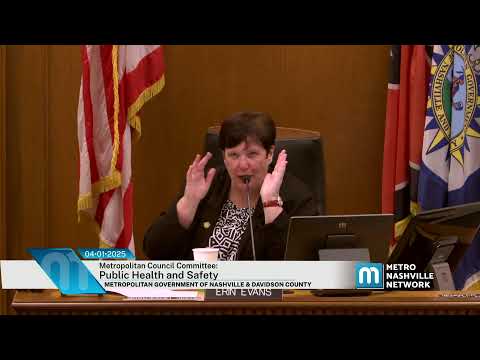
Chair Evans convened the Public Health & Safety Committee and heard an update April 14 on the city’s One Box naloxone program and recent overdose trends from Metro Nashville Police Department officials and the Office of Nightlife.
Sergeant Michael Hotz, who leads overdose outreach work for the police department, told the committee that "we saw a 31.4 percent reduction in overdose fatalities in Nashville" in calendar year 2024, then warned that 2025 figures have trended up, with a sharp March spike that briefly doubled the week-to-week average.
The spike in March included a week in mid‑March when the city’s weekly average of overdose events rose from an annual average of about 8.3 to as many as 23 incidents, Hotz said. He said the department identified widespread powdered fentanyl in several colors (white, green and purple), indicating multiple sources, and reported an increase in xylazine adulteration: "we estimate that there is significant quantities of xylazine enough to produce a narcotic effect in over 80% of the fentanyl supply that's on our streets," Hotz said.
Hotz clarified the clinical implications: "There is no agonist that'll reverse a xylazine overdose," and while naloxone will reverse the opioid portion of a mixed overdose, it does not reverse xylazine. He also described wound care challenges from xylazine-related skin necrosis and said those wounds often do not cause pain and so people avoid seeking care.
As background on the harm-reduction hardware, Hotz described the One Box kit purchased with a council allocation of $20,000 last year and additional donated supplies. "I've installed, with the help of Director McDonough, 83 One Boxes in venues across the city," he said, adding that each kit typically contains two doses of naloxone, a personal-protective kit (gloves and a rescue breathing mask), test strips for xylazine and fentanyl, and a small video screen that provides step-by-step training and a Spanish-language option.
Benton McDonough, director of the Office of Nightlife and Metro Board, said the office coordinated installations with downtown venues and sports facilities and has begun conversations with Metro Nashville Public Schools and transit. "They do have Narcan in the high schools, but they also stated that they would like to see the One Boxes added to middle schools and elementary schools," McDonough said. He added the office is in early pilot discussions to place One Boxes on WeGo buses and at transit hubs and has installed units at Bridgestone Arena and in other music and sports venues.
Hotz said the program tracks installations but intentionally does not require formal incident reporting from venues to avoid discouraging use: "If the naloxone is used or even if it's stolen ... I'll replace it. No questions asked." He estimated the One Box purchases have directly saved "over 10 lives," while acknowledging that usage reporting across the city is not comprehensive by design.
Policy and funding items discussed included an upcoming departmental request: Hotz said the police overdose unit will send a proposal to Metro Public Health to request approximately $2,000,000 from opioid-settlement funds for opioid-related outreach. He also proposed council consideration at a later date for expanded funding (council discussion has included a rumored additional $40,000) and suggested installing One Boxes in Metro government buildings, including police stations and courthouses.
Metro Public Health Department representatives reported federal grant uncertainty after recent federal-level funding actions. Tom Sharp of Metro Public Health said several larger grants have arrived in smaller initial amounts and the health department has had to reassign or lay off a small number of staff. Dr. Melville Chester said one local grant (Community Violence Intervention and Prevention/BJA) remained intact.
Committee members asked operational questions about placement, maintenance and shelf life. Hotz said most naloxone products "have a shelf life of about three years" and that the One Box video screens require periodic charging (about three times a year). He recommended that venues assign a manager to check units roughly every four months.
On formal business taken at the meeting, the committee approved a six-item consent agenda (items RS2025-1109, RS2025-1111, RS2025-1112, RS2025-1116, RS2025-1117, RS2025-1118) by voice vote: 8 in favor, 0 opposed, 0 not voting. The committee also recommended indefinite deferral of RS2025-1129 (a resolution requesting procurement of license plate readers) by voice vote: 8 in favor, 0 opposed, 0 not voting. The committee approved RS2025-1119, accepting a donation of a life‑saving medication to the Metropolitan Nashville Police Department, by voice vote: 8 in favor, 0 opposed, 0 not voting.
The meeting closed with committee members asking staff to continue outreach and coordination on One Box placements and with Metro Public Health continuing to monitor federal grant impacts and to manage staffing effects.