Get Full Government Meeting Transcripts, Videos, & Alerts Forever!
Get email alerts on the District Heating topic
No spam. Unsubscribe anytime.
Rochester District Heating asks city for $35,000 match to study geothermal system for Inner Loop North redevelopment
Summary
Rochester District Heating (RDH) asked the City of Rochester for a $35,000 match to complete a NYSERDA-funded scoping study that would evaluate a central geothermal bore field and distribution network for the Inner Loop North redevelopment.
Rochester District Heating (RDH) asked the City of Rochester for a $35,000 match to complete a NYSERDA-funded scoping study that would evaluate a central geothermal bore field and distribution network for the Inner Loop North redevelopment.
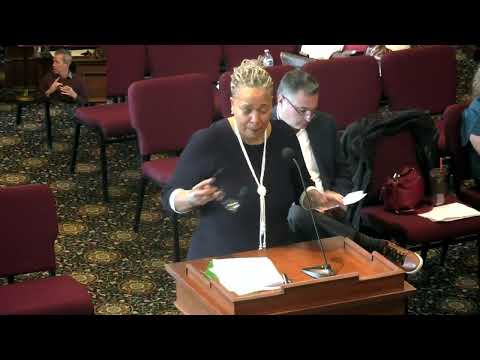
The study, RDH General Manager John Deschano said, has an estimated cost of $138,000 and would be 75% funded by NYSERDA, leaving a $35,000 local match. "We supply superheated steam to 50 buildings in the city of Rochester," Deschano said, describing RDH as "a member-owned nonprofit cooperative" established in 1985 that operates a city steam distribution system and is exploring electrification and decarbonization options.
The request matters because the study will assess whether a shared geothermal exchange can enable new buildings in Inner Loop North to be constructed as fully electrified under New York's all-electric building laws. "It would allow for those buildings to be built as electrified buildings for the All Electric Buildings Act," Deschano said, and RDH hopes a central system would spread capital costs across multiple developments and support long-term agreements for distribution.
City council members pressed RDH on technical and geographic scope. Councilmember Patterson urged RDH to consider expanding the study area northward into adjacent residential neighborhoods, asking, "Would you be interested in ... expanding your reach into those specifically and particularly residential neighborhoods?" Deschano replied that expansion is being considered but that the scoping study will first determine whether the initial bore field can supply sufficient thermal energy "to ensure that the buildings remain functional for the life of the system." Councilmember Madison and others asked about potential sources of thermal exchange; RDH said prior scoping work analyzed river water and aquifers but concluded those options posed heavy regulatory and permitting burdens and were not financially practical for this project. Instead, RDH reported they had repeatedly returned to using wastewater system exchange in earlier work for nearby projects.
Deschano outlined the proposed study tasks: concept development, data collection, energy and economic analysis, and a final report across five tasks taking about 44 weeks. He said RDH's board approved moving ahead at risk through task 2 pending the match, and that if the city did not provide the match RDH might pause the study after task 2 and absorb up to about $5,000 of risk. RDH noted that under the Department of Public Service's July 2024 rulemaking for thermal energy networks, systems operated by cooperatives may remain nonregulated utilities, which RDH said preserves its business model as a nonprofit member-owned cooperative that sets its own rates.
Councilmembers asked whether the project would be feasible before construction begins at Inner Loop North; Deschano said he expects the study schedule to align with the development timeline and confirmed "I think it's safe to say" no shovels are expected in the next 52 weeks. Several councillors thanked RDH and encouraged consideration of other neighborhoods, including the South District and parcels north of the Inner Loop.
No final vote on city funding for the RDH scoping study was taken at the committee meeting; Deschano and RDH staff said they will stay in touch with city staff and council as the study progresses.
RDH said the project would support state and local climate action plans and act as a proof of concept for community-scale electrification; RDH added it is pursuing other decarbonization opportunities including sewer heat recovery and reducing fossil fuel use at its existing steam plant.
The council did not vote on the funding request during the committee meeting; RDH and city staff said any formal commitment would follow further administrative review and discussions with relevant departments.
Sources and next steps: RDH requested the $35,000 match so a NYSERDA scoping study can proceed; final study reports will be submitted to NYSERDA and (if complete) become public-facing after NYSERDA review, per Deschano.