Get Full Government Meeting Transcripts, Videos, & Alerts Forever!
Nevada County holds public workshop on updating cell tower ordinance; debate centers on setbacks, notice and safety
Summary
Nevada County planning staff held a public workshop in Grass Valley to gather input on revisions to the county's 20-year-old wireless facilities ordinance, presenting options including larger notice zones, third-party RF certification after installation, and possible setback choices of roughly 250, 500 or 1,000 feet.
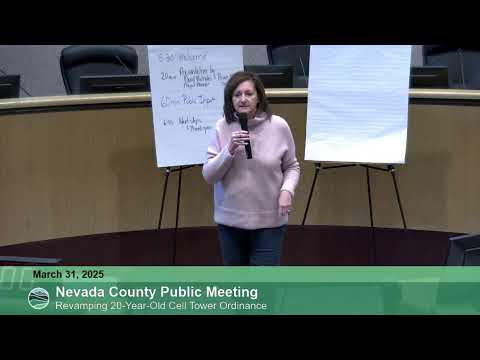
Nevada County planning staff on Tuesday held a public workshop in Grass Valley to gather input on proposed revisions to the county's approximately 20-year-old wireless facilities ordinance, presenting several options for notice, setbacks, permitting and post-installation testing and asking the public for priorities and concerns.
David Nicholas, the project planner, said the county is at an early stage of drafting and that the goal is to align local code with federal rules while preserving local review where possible. "What we have to adhere to is there's limitations on how we can regulate towers based off of RF frequency," Nicholas told the audience, and he said the county must also account for federal "shot clock" timelines for processing applications.
The proposal options staff outlined would not ban towers but would add requirements and clarifications the county could impose where state or federal law allows. Nicholas summarized potential changes that staff will consider while drafting the ordinance: requiring pre- and post-installation certifications from third-party engineers showing compliance with Federal Communications Commission (FCC) exposure standards; stronger recordkeeping and maintenance requirements for facilities; expanding the mailed/public-notice distance from the current 300'500 feet to as much as 1,000 feet; allowing administrative review for lower-impact installations such as small wireless facilities or towers under a certain height; clarifying what "effectively unnoticeable" means (for camouflage or stealth designs); and considering an increased setback option (presented as 250, 500 and 1,000 feet) for new towers.
Why this matters: the proposed changes respond to two competing community priorities that emerged in public comment: residents, particularly in…
Already have an account? Log in
Subscribe to keep reading
Unlock the rest of this article — and every article on Citizen Portal.
- Unlimited articles
- AI-powered breakdowns of topics, speakers, decisions, and budgets
- Instant alerts when your location has a new meeting
- Follow topics and more locations
- 1,000 AI Insights / month, plus AI Chat