Get Full Government Meeting Transcripts, Videos, & Alerts Forever!
Get email alerts on the Cell Tower Ordinance topic
No spam. Unsubscribe anytime.
Nevada County holds public workshop on updating cell tower ordinance; debate centers on setbacks, notice and safety
Summary
Nevada County planning staff held a public workshop in Grass Valley to gather input on revisions to the county's 20-year-old wireless facilities ordinance, presenting options including larger notice zones, third-party RF certification after installation, and possible setback choices of roughly 250, 500 or 1,000 feet.
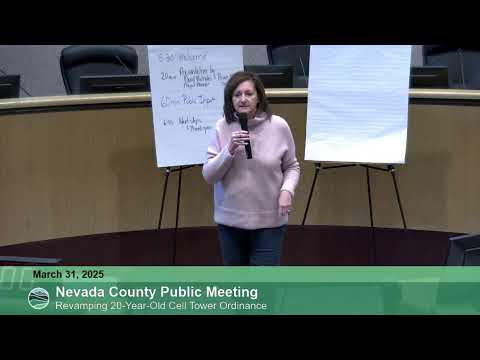
Nevada County planning staff on Tuesday held a public workshop in Grass Valley to gather input on proposed revisions to the county's approximately 20-year-old wireless facilities ordinance, presenting several options for notice, setbacks, permitting and post-installation testing and asking the public for priorities and concerns.
David Nicholas, the project planner, said the county is at an early stage of drafting and that the goal is to align local code with federal rules while preserving local review where possible. "What we have to adhere to is there's limitations on how we can regulate towers based off of RF frequency," Nicholas told the audience, and he said the county must also account for federal "shot clock" timelines for processing applications.
The proposal options staff outlined would not ban towers but would add requirements and clarifications the county could impose where state or federal law allows. Nicholas summarized potential changes that staff will consider while drafting the ordinance: requiring pre- and post-installation certifications from third-party engineers showing compliance with Federal Communications Commission (FCC) exposure standards; stronger recordkeeping and maintenance requirements for facilities; expanding the mailed/public-notice distance from the current 300'500 feet to as much as 1,000 feet; allowing administrative review for lower-impact installations such as small wireless facilities or towers under a certain height; clarifying what "effectively unnoticeable" means (for camouflage or stealth designs); and considering an increased setback option (presented as 250, 500 and 1,000 feet) for new towers.
Why this matters: the proposed changes respond to two competing community priorities that emerged in public comment: residents, particularly in rural neighborhoods, stressed safety and connectivity needs (for emergency calls and disaster response), while many others urged stronger notice, larger setbacks and procedural protections to protect property values, scenic views and public health concerns.
Public comment: about 20 speakers used the 60-minute public-comment period. Speakers voiced recurring concerns about notification, review process and safety.
- "This is a little different from our typical county process because I think it's really important for all of us to listen to the community about what they would like to see in this ordinance," said Supervisor Lisa Swartout, who opened the meeting and described the county's intent to gather public input before drafting code language.
- Several residents said notice should reach more than immediate neighbors. "Notice must include door to door flyers, signage at the proposed site, and notice in local newspapers and online platforms," said one commenter, arguing that a thousand feet may still not capture all affected property owners.
- On technical and enforcement details, Nicholas said the county is considering requiring that an applicant provide a third-party certification from a California-registered electrical engineer and that the certification be provided by the applicant as part of the permitting process. "It would be the responsibility of the applicant to provide those certifications," he said in response to a question about who would pay for testing.
- Multiple speakers pressed the county to require more robust review for small wireless facilities and towers under 100 feet. "A tower 99 feet and below must still have a conditional use permit so we can enjoy that public process," said Johanna Finney, who urged procedural review rather than administrative approvals for projects she called cumulatively large.
- Safety and resilience were raised repeatedly. Residents from rural roads described life-or-death incidents where lack of cell coverage delayed emergency response and urged well-located coverage. Others said backup power at sites is critical: "The main issue during emergencies...is power," said Denise Philberg, urging requirements for automatic backup generators and monitoring so towers remain operable during disasters.
- Fire risk and maintenance also drew concern. Speakers described debris from camouflaged antenna appendages and asked the county to require companies to maintain sites so falling parts or flaming equipment do not increase wildfire risk. Jeff Milo, who said he had technical background in electrical engineering, warned that tower equipment can ignite and be difficult to fight immediately because utilities must be shut off.
- A Verizon representative, Yvonne Pinto, said the company would make experts available to answer technical questions and would participate in further informational presentations.
Data and tradeoffs staff presented: Nicholas showed a countywide parcel analysis to demonstrate how different setback options would affect where towers could be sited. The staff summary listed roughly 64,000 parcels countywide; using the 250-foot setback option left roughly 12% of parcels eligible, 500 feet left about 4%, and a 1,000-foot setback left about 1.23% (staff cautioned those percentages do not account for zoning, topography or other constraints). Staff also demonstrated coverage maps for a previous proposed Dog Bar Road site showing low-band coverage ranges of roughly 1.5 to 2.5 miles and mid-band (data) coverage of roughly 0.5 to 1.5 miles, and said larger setbacks reduce the number of feasible sites.
Process and next steps: Nicholas said staff will incorporate public comments into a draft ordinance, circulate a public review draft for a formal comment period (he noted 30 days as the likely public-review window), take the draft to the planning commission for a recommendation and then to the Board of Supervisors for final action. He asked residents to email written comments to the address shown during the presentation to become part of the administrative record.
What was not decided: the meeting was an information-gathering workshop. No ordinance text was adopted, no formal motions were made, and no final determinations were taken on setback distances, permitting thresholds or notice requirements. Staff presented options and solicited input that will shape a future draft.
Context and common themes: speakers split into two broad priorities'those who pressed for more cell coverage and resilience in remote areas for emergency response, and those who asked for stronger procedural protections, wider notice and larger buffers for health, aesthetic and property-value concerns. Several commenters asked that the county avoid relying solely on administrative approvals for small cells and urged full public hearings and appeal rights.
The county emphasized constraints from federal law and FCC requirements; at the same time staff described several locally enforceable measures the county would study, such as post-installation compliance testing, maintenance and recordkeeping requirements, and adjustments to noticing and hearing procedures.
Ending: staff closed by thanking attendees, repeating that the input will inform the draft ordinance process and reminding residents that the forthcoming draft will be posted for public review and comment, then proceed through planning commission review and a board hearing.