Get Full Government Meeting Transcripts, Videos, & Alerts Forever!
Get email alerts on the Creekside Development topic
No spam. Unsubscribe anytime.
Planning commission recommends Creekside rezoning and final development plans amid habitat and height concerns
Summary
The Homewood Planning Commission voted to forward rezoning and final development plan recommendations for the Creekside mixed‑use project to city council while commissioners and the developer discussed stormwater, salamander habitat, traffic and hotel height limits and added an advisory‑group stipulation to one approval.
The Homewood Planning Commission on an April 2025 night voted to forward rezoning and final development plan recommendations for the Creekside mixed‑use project to the city council while pressing the applicant on environmental protections, stormwater, traffic and the height of a proposed hotel.
The recommendation matters because the commission’s votes move the rezoning and development plans to the council for final decisions; several commissioners said they wanted clearer commitments on habitat protection and design limits before council action.
Landmark Development representative Bob Dunn told the commission the applicant team — which includes Samford University and a Johnson Controls affiliate — has pursued broad community engagement and technical review and plans to form a development advisory group to work with technical experts on a comprehensive Creekside master plan and recorded covenants. “We feel strongly that this process is working,” Dunn said. He added, “Trust us to do this well. Trust us to do this right.”
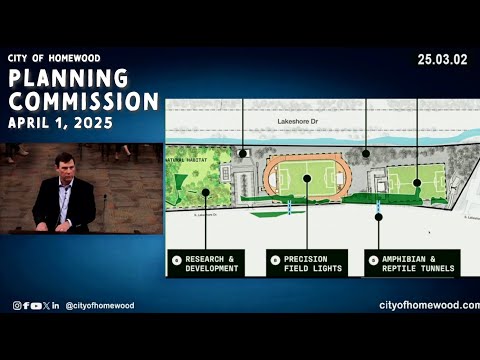
Commissioners and speakers repeatedly raised the project’s potential impacts on the Shades Creek watershed, including vernal pools and salamander breeding habitat, stormwater management, light and sound from athletic fields, traffic around Lakeshore Drive and the scale and location of taller buildings on the site. Dunn said the team has begun targeted outreach, has shared a packet of community engagement materials with the commission and will continue technical design work once a development framework is approved.
Dunn said the team proposes a single taller hotel building (the plan lists a 150‑foot height for the hotel) with smaller mid‑rise buildings elsewhere. He and others said a vertically smaller aggregate footprint could reduce surface impacts; Dunn said the 150‑foot figure corresponds to a roughly 10–12‑story hotel in his estimate and that the project team is willing to work toward a cap expressed in stories rather than an exact foot height as the building program is finalized.
On habitat and stormwater, Dunn said the submission to the city “meets all the technical requirements” and that detailed engineering and design — including possible repositioning of athletic fields to avoid vernal pools, low‑impact stormwater practices and migration tunnels under South Lakeshore Drive — will be developed with the advisory group and technical consultants. He said the team cannot promise that every concern will be resolved to every individual’s satisfaction but expressed confidence the process can reach acceptable engineering solutions.
Several commissioners urged the applicant to use the time before the council hearing to hold deeper technical discussions with local environmental stewards; a commissioner who will see the project later at city council said they expect conversations with groups such as Friends of Shades Creek and the Alabama Audubon Society.
Commissioners discussed how the city’s final development plan mechanism and administrative approval thresholds work: if the developer stays within the approved development plan parameters, later building permits can proceed without returning to the commission; deviations beyond the plan will require amendments and a return to the commission. Commissioners asked for clarity about what sorts of changes (for example, moving a field versus adding a swimming pool or relocating a building footprint) will require commission review; staff and Dunn said minor adjustments within set limits may be approved administratively but larger changes must return for review.
Votes at a glance
- RZ (Creekside West rezoning): recommendation to city council — positive, 9‑0. - FD 250303 (Final development plan, Creekside West): recommendation to city council — positive with advisory‑group stipulation, 6‑3. - RZ 250304 (Creekside East rezoning): recommendation to city council — positive, 7‑2. - FD 250305 (Final development plan, Creekside East): recommendation to city council — positive, 5‑4.
The commission’s favorable recommendations send the rezoning and development plans to city council, where the council will hold a public hearing and vote. Commissioners and the applicant agreed the development advisory group the applicant proposes should include community and city participation; the commission appended an advisory‑group stipulation to at least one development‑plan recommendation.
The commission’s discussion repeatedly framed the project as multi‑phase and multi‑year; Dunn estimated design and covenant drafting could take roughly four to six months after council approval and that first‑phase construction could begin in roughly six to eight months thereafter, depending on final approvals and design progress. Dunn said the applicant will continue community outreach and technical engagement and will upload the meeting packet to the project website for public access.
The commission’s recommendations are advisory; the council will make the final decisions and will hold additional public hearings. Several commissioners said they expect further technical dialogue with environmental groups and the city before the council acts.
What remains: the council will receive the commission’s recommendations and set hearings. The applicant and commission said the public will have further opportunities to comment at council committee and public hearings.