Get Full Government Meeting Transcripts, Videos, & Alerts Forever!
Get email alerts on the Tax Increment Financing topic
No spam. Unsubscribe anytime.
Germantown plan commission postpones vote on Tax Incremental District No. 10 after lengthy public hearing
Summary
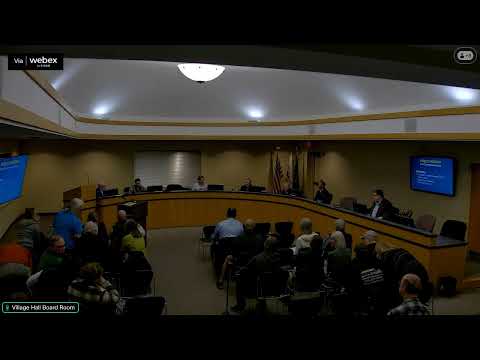
Dean Walter, village president and planning commission chair, opened a public hearing on March 31 on a proposal to create Tax Incremental District (TID) No. 10 in the village center and to adopt a project plan and boundaries. After presentations from village staff and consultants and nearly two hours of public comment, the Plan Commission voted to postpone action on the resolution until its April 14 meeting by a 4–1 vote.
Dean Walter, village president and planning commission chair, opened a public hearing on March 31 on a proposal to create Tax Incremental District (TID) No. 10 in the village center and to adopt a project plan and boundaries. After presentations from village staff and consultants and nearly two hours of public comment, the Plan Commission voted to postpone action on the resolution until its April 14 meeting by a 4–1 vote.
The proposal presented to the commission would create a rehabilitation TID covering roughly 42 acres in the Pilgrim Road–Mequon Road area and fund redevelopment activities including land acquisition, demolition and cleanup, public infrastructure, developer incentives and professional services. Jeff Ratzloff, the village’s director of community development, and consultants from Copeland Companies and financial advisor Ehlers walked the commission through the project goals, the draft project plan and a financial feasibility analysis.
Why this matters: the project plan estimates roughly $49 million in eligible project costs and anticipates an increase in taxable value from redevelopment of roughly $84 million (figures vary slightly by slide). Supporters say the TID would enable redevelopment of underused parcels, create housing and retail tied to the village center vision, and allow infrastructure and cleanup costs to be repaid from future increment generated by new development. Opponents and many public commenters raised concerns about uncertain assumptions in the cash‑flow analysis, environmental cleanup costs at a former gas station, the loss of an existing medical clinic, potential impacts on local schools and neighborhoods, and the risk that costs could shift to taxpayers.
What was presented and the plan’s assumptions John Cameron, senior municipal adviser with Ehlers, described the statutory process and the project plan’s financial assumptions. He said the proposed TID is a rehabilitation district with a statutory maximum life of 27 years and that the plan estimates total project costs of about $49 million and estimated incremental value of roughly $84 million. The project plan anticipates development in multiple phases: the presentation identified “Phase 1” as primarily multifamily housing (several parcel areas were described, including a 210‑unit area and a 104‑unit area on Pilgrim Road, and another parcel estimated at 90 units) and “Phase 2” as additional multifamily and retail on the Mequon–Pilgrim corner. The plan includes an assumption of 2% annual appreciation on increment and a small annual decline in the village’s tax rate (0.025 percentage points) used in the cash‑flow model.
Cameron said the plan assumes a conservative $2.1 million in land sale revenue to the village and lists $6 million of “other revenue and grants” as part of the broader financing picture for later phases. He noted that some project costs (property acquisition, demolition, infrastructure) are shown as financed in the plan but that listing those costs does not legally commit the village to a specific financing vehicle; the village could issue conventional general‑obligation debt or use other tools such as municipal revenue obligations or developer‑led financing to shift risk.
Key numerical details in the plan (as presented) - Total estimated project costs (project plan headline): about $49,000,000–$49,200,000 (figure varies slightly between slides). (source: Jeff Ratzloff; John Cameron) - Estimated increase in taxable value from improvements: roughly $84,000,000–$84,600,000 (source: Jeff Ratzloff; John Cameron) - Estimated Phase 1 project costs (land acquisition, demolition, infrastructure, professional services): about $11,000,000 (not including interest). (source: John Cameron) - Land acquisition assumptions shown in the plan (Phase 1): Flower Source site $1,000,000; Ascension vacant parcel $700,000; Ascension primary parcel $5,000,000; remnant pieces $645,000 (source: John Cameron) - Assumed land sale revenue to village (stress test): $2,100,000 (source: John Cameron) - Current village equalized tax rate cited in the plan: $13.48 per $1,000 of equalized value (source: John Cameron) - TID life (rehabilitation category): up to 27 years under state statute (source: John Cameron)
Public concerns and comments The public hearing drew many residents and more than a dozen speakers. Common concerns included (summarized): potential student enrollment pressure on the Germantown School District and whether the district’s forthcoming enrollment study would change the village’s analysis; uncertainty about environmental cleanup costs at the BP gas station parcel and potential liability; whether the village should spend public dollars to purchase and later sell parcels to developers; the adequacy of parking and traffic analyses for the proposed number of housing units; and the loss of an existing Ascension clinic and its effect on seniors and nearby retirement communities.
Residents voiced their objections at the podium. "Most of us here don't understand...most of the residents do not want rental properties. They do not want TIDs," said Miss Bendars, a resident. Charles Hargan, another resident, asked commissioners to note the village's current three‑story maximum in zoning: "I don't know if the planning commission and the board has voted no more than 3 stories high. But...that's the code right now." Steven Wasilowski, a member of Germantown’s Utility Advisory Board, said, "I'm not for apartments. Don't want them here." Those concerns about density, traffic and school impacts recurred through public comments.
Responses from staff and consultants Staff and consultants said some of the issues raised are part of the next steps and would be handled in future work. Jeff Ratzloff emphasized that creating a TID is only one financing tool among others; he said the village has closed on two of three parcels and that the third parcel is scheduled to close in June, meaning the village has already committed to acquisitions the village must fund one way or another. John Cameron explained how TID increment interacts with school funding under Wisconsin’s equalization aid system and said the school district is effectively held harmless during the life of a TID; he also said the joint review board (JRB) would review the project plan later and that the plan must satisfy statutory requirements including the “but‑for” test under Wis. Stat. §66.1105.
Formal action and outcome The Plan Commission considered a resolution (Resolution No. 01‑2025) that would recommend creating TID No. 10 with the boundaries and project plan attached to the village board and the joint review board. After discussion and a lengthy public hearing, Commissioner Trustee Baum made a motion to postpone action on the resolution until the commission’s next meeting on April 14; the motion was seconded by Mr. Williams and passed 4–1. The meeting record shows one commissioner voiced opposition; the clerk recorded the final count as four in favor and one opposed. By postponing, commissioners left time to obtain additional information — including the Germantown School District enrollment analysis that officials expect in early May — before making a formal recommendation to the village board.
What’s next The Plan Commission’s postponement means the commission will revisit the resolution at its April 14 meeting unless the board reschedules. The village board was originally scheduled to consider the district on April 21; the joint review board plans a final review in May. If the Plan Commission ultimately recommends the TID, the village board and the joint review board will each send instructions to their designees about how to vote at the final JRB meeting; the Department of Revenue receives files on approved TIDs later in the year. Staff said the village will continue to pursue grants and other funding to reduce the public cost and that development agreements and RFPs will refine unit counts, design standards and financing details.
Documentation and authorities mentioned Speakers repeatedly cited Wisconsin statutes governing notices and the TIF process (Wis. Stat. §§19.83, 19.84 and 66.1105). The resolution considered was identified as Resolution No. 01‑2025 and the draft project plan and maps were published in the meeting packet and made available for public inspection.
Ending Commissioners and staff said they will use the intervening weeks to gather requested analyses and clarifications — including more detail on the cash‑flow assumptions and pending school studies — before the Plan Commission revisits the proposed TID. The postponement preserves the timeline for additional review by the village board and the joint review board and leaves open multiple outcomes depending on what follow‑up information shows.