Get Full Government Meeting Transcripts, Videos, & Alerts Forever!
Get email alerts on the New Markets Tax Credit topic
No spam. Unsubscribe anytime.
Ogden approves New Markets Tax Credit financing; Municipal Building Authority to participate
Summary
Ogden City Council approved a resolution to participate in a New Markets Tax Credit (NMTC) financing package that will provide roughly $2 million in net, non‑repayable funds for the Marshall White Community Center project; the Municipal Building Authority adopted companion resolutions and a budget amendment to receive and manage the funds.
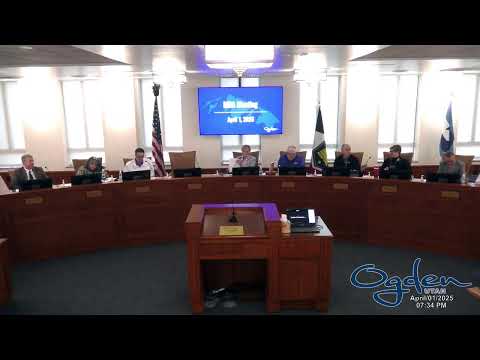
Ogden City Council voted unanimously April 1 to authorize the city’s participation in a New Markets Tax Credit financing package for the Marshall White Community Center, a financing structure city staff say unlocks more than $2 million in net project funds.
The vote authorizes the city to proceed with a structure that uses a community development entity allocation, a private investor and a special‑purpose nonprofit to channel tax credit equity into the project. Council Member Jared Ritchie moved to adopt proposed Resolution 2025‑6; Vice Chair Hyer seconded and the roll call was unanimous.
At a public presentation earlier in the meeting, Cody Rogers, an attorney the city retained for the transaction, described how the program works and how the Marshall White Center financing will be structured. Rogers said Community Development Finance Alliance (CDFA) has allocated $10,000,000 of NMTC authority to the project. That allocation yields $3,900,000 in federal tax credits, which U.S. Bank will claim over a seven‑year compliance period. U.S. Bank agreed to invest at $0.80 per credit, producing about $3,120,000 in equity to the project; after fees and closing costs, Rogers estimated the net benefit to the project at “over $2,000,000 that the project is receiving essentially for free.”
Rogers and city staff described the structure in detail: the city will long‑term lease the property to a specially formed nonprofit special‑purpose entity (SPE), which will receive NMTC‑related loans. The SPE will reimburse the city for prior project expenditures; the Municipal Building Authority (MBA) will serve as the leveraged lender and will receive loan payments during the seven‑year compliance period. Rogers estimated the MBA will receive roughly $97,000 per year in loan interest and noted the city’s annual participation costs are small—about $2,500—while the lease payment from the city to the SPE is approximately $100,000 per year during compliance.
In council discussion, Council Member Jared Blair asked for a short list of intended uses for the newly available funds; Ed (staff) said the money will pay for landscaping, exterior lighting, sidewalk improvements, interior equipment, fencing and new pickleball courts. Rogers said closing costs and fees are estimated at about $300,000 plus modest miscellaneous expenses.
After the council vote, the Municipal Building Authority (MBA) held a separate consent and resolution process to accept the leveraged‑lender role and amend its budget. MBA trustees voted to adopt proposed Resolution 2025‑2 and Resolution 2025‑1 and approved a budget amendment to record the flow of funds related to the transaction. Justin Sorensen, MBA staff on the call, confirmed the accounting entries and noted the budget amendment figures in the staff presentation; he said the working number sent earlier was $6,880,000 though the draft amendment text in the packet listed $6,900,000 (staff flagged the discrepancy during the meeting for clarification).
Why it matters: the NMTC structure is intended to attract private capital into low‑income communities by giving an investor federal tax credits in exchange for equity. City staff said the arrangement lets Ogden add project elements that had been cut for budget reasons without transferring ownership of the center: “the city continues to own it,” Rogers said, while the SPE and MBA handle the compliance and funding flow.
Council and MBA votes at a glance: Council adopted Resolution 2025‑6 (motion: Council Member Ritchie; second: Vice Chair Hyer) by roll call (Blair: aye; Chburka: aye; Graff: aye; Myers/Meyers: aye; Ritchie: aye; Hyer: aye; Chair White: aye). The MBA adopted proposed Resolutions 2025‑2 and 2025‑1 by roll call (Trustees Graff, Ritchie, Blair, Cheburka/Chburka, Vice Chair Hyer and Chair White all voted aye).
City staff said they will return with closing documents and additional implementation steps required by the NMTC compliance schedule. Rogers and MBA staff answered technical questions at the meeting but no substantive changes to the approved structure were made.
Clarifying details: CDFA (Community Development Finance Alliance) provided a $10,000,000 allocation of NMTC authority; that allocation converts to $3,900,000 in tax credits; U.S. Bank committed $3,120,000 in equity at $0.80 per credit; estimated closing costs $300,000; estimated net grant‑like benefit to the project > $2,000,000; expected annual city lease payment to the SPE ~ $100,000; MBA estimated to receive ~ $97,000 annual interest during compliance; municipal participation costs roughly $2,500 per year.
What’s next: staff will finalize loan and closing documents, reconcile the budget amendment numbers for the MBA, and return with the final closing schedule and any additional council or trustee actions required under the NMTC compliance regime.