Get Full Government Meeting Transcripts, Videos, & Alerts Forever!
Get email alerts on the Passenger Rail topic
No spam. Unsubscribe anytime.
Committee hears bill and Amtrak briefing setting measurable targets for Amtrak Cascades service
Summary
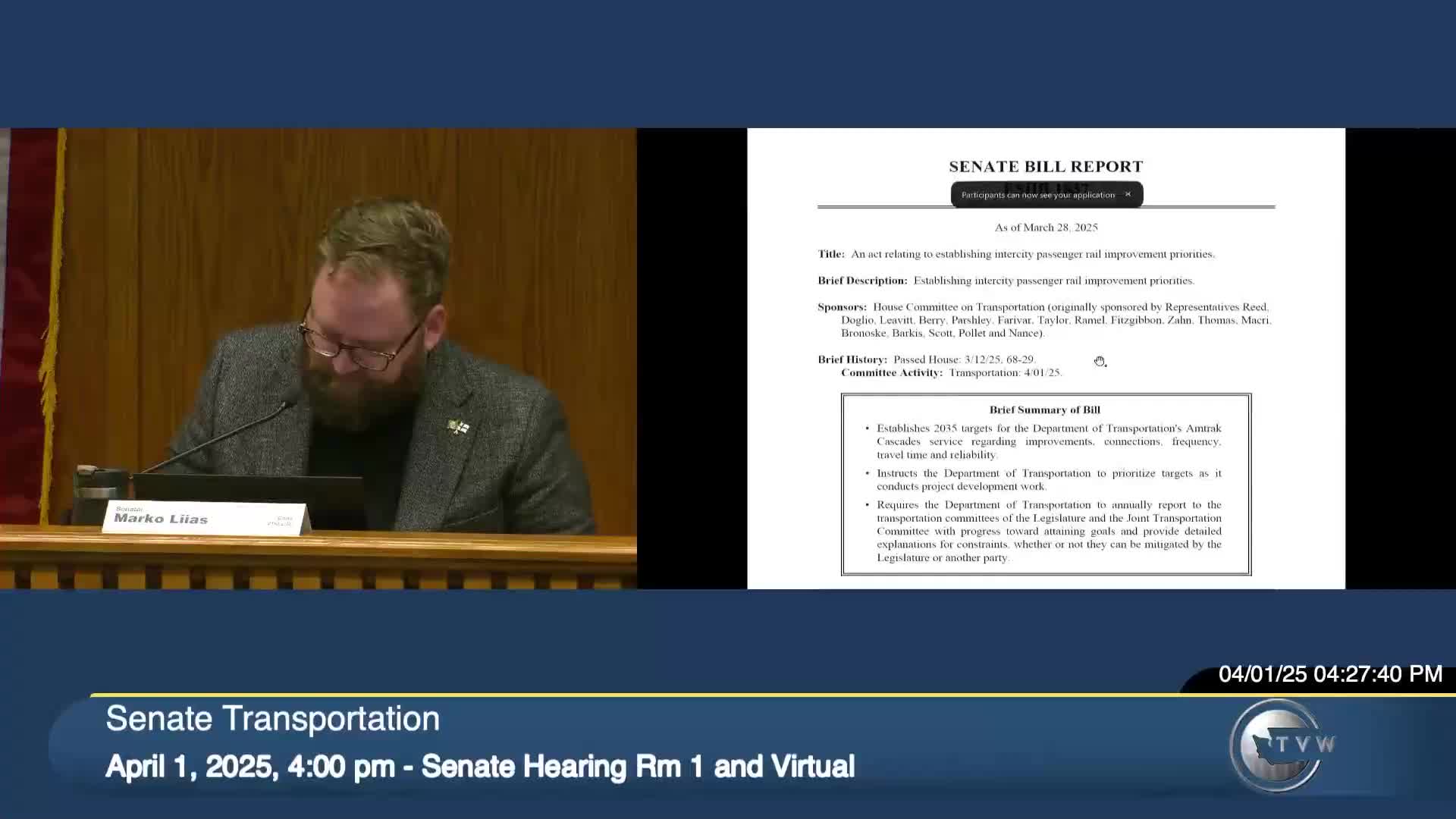
Engrossed Substitute House Bill 18-37 would task WSDOT to pursue specific, measurable performance targets for Amtrak Cascades (frequency, on-time reliability, and trip times) by 2035 and to report annually; a concurrent Amtrak briefing described a temporary fleet withdrawal of 70 Horizon cars for corrosion inspections and a plan to restore full
Engrossed Substitute House Bill 18-37 would set measurable, time‑bound targets for the Amtrak Cascades corridor and direct WSDOT to prioritize those goals in project development: 14 round trips per day between Seattle and Portland, five round trips between Seattle and Vancouver, B.C., minimum trip reliability of 88 percent on‑time performance, and shorter travel-time targets (for example, a 2 hour 45 minute Seattle–Portland target) to be met by 2035, with annual reporting to the legislature, according to staff and sponsor remarks and testimony on April 1.
Representative Julia Reed, prime sponsor, told the committee the intent is to give WSDOT measurable goals to guide planning and investments and to spur urgency in the state’s service-development planning. “You cannot manage what you cannot measure,” Reed said, arguing that specific targets will produce clearer decision points and trade-off analysis as the department develops a long-range service plan.
Amtrak briefing and equipment withdrawal: the committee also held a work session with Amtrak representatives who described a national, proactive withdrawal of 70 Horizon passenger cars after inspections found corrosion in structural steel components. Chase Kitchen, Amtrak government affairs manager, said inspections and follow-up work with Alstom revealed additional areas of concern and prompted removal of the entire Horizon fleet as a precaution. That action temporarily reduced Cascades service to one daily round trip until substitute equipment or buses could be provided. Amtrak said it has chartered buses for affected trips, issued refunds and service alerts, and set a goal to restore full Cascades frequencies by Monday, April 7, 2025; Amtrak also said new “Airo” trainsets will begin service in 2026.
Amtrak emphasized safety and collaboration: Steve Predmore, Amtrak executive vice president and chief safety officer, described the removal as a proactive safety action after corrosion was discovered in inspections at Amtrak’s heavy repair facility. Predmore said Alstom confirmed the findings and Amtrak withdrew the fleet to inspect and evaluate options for restoration; he called the decision necessary to “proactively assure the safety of our customers and our crews.”
Impacts and repairs: Amtrak said the Horizon cars were about 35 years old, that the corrosion appears to be linked to cumulative exposure to water, ice and de-icing treatments, and that the company is working with Alstom on repairs. Amtrak reported heavy reliance on a limited national fleet and said assistance from other state-supported services was necessary to restore frequencies; Amtrak expects to reintroduce additional round trips as repaired equipment arrives and cited the coming new trainsets in 2026 as a long-term solution.
Public witness and rail-industry testimony: dozens of public witnesses — riders, rail labor, climate and transit advocates, local officials, and rail consultants — testified strongly in favor of ESHB 18-37’s targets. Technical witnesses with decades of railroad experience testified that the trip-time and reliability goals are achievable but require infrastructure work such as additional third main tracks south of Tacoma and a second main north of Everett, and significant capital investment. Tom White, a former BNSF dispatcher and consultant, said the targets were “relatively achievable” with appropriate infrastructure and dispatcher training and cited prior long-range plans (2006 state long-range plan) as the technical basis for the targets.
Cost and timeline context: staff said an initial feasibility study would likely cost between $1.6 million and $2.15 million to scope the work needed to meet targets. Witnesses pointed to federal grant opportunities (Corridor ID and project-development funding) and to examples around the country where state-supported corridors achieved high on‑time performance and frequent service on host freight rail lines with appropriate investments and coordination.
Ending: The committee heard a mix of technical, labor and community testimony in broad support of measurable targets; Amtrak presented an unfolding equipment and safety issue that reduced service temporarily and prompted a near-term restoration plan. The bill sets annual reporting requirements and would force WSDOT to explain any constraints to meeting targets if they are found unattainable.