Get Full Government Meeting Transcripts, Videos, & Alerts Forever!
Get email alerts on the Fish Habitat Funding topic
No spam. Unsubscribe anytime.
Fish passage funding proposal divides local governments and tribes; bill would create dedicated utility tax revenue stream
Summary
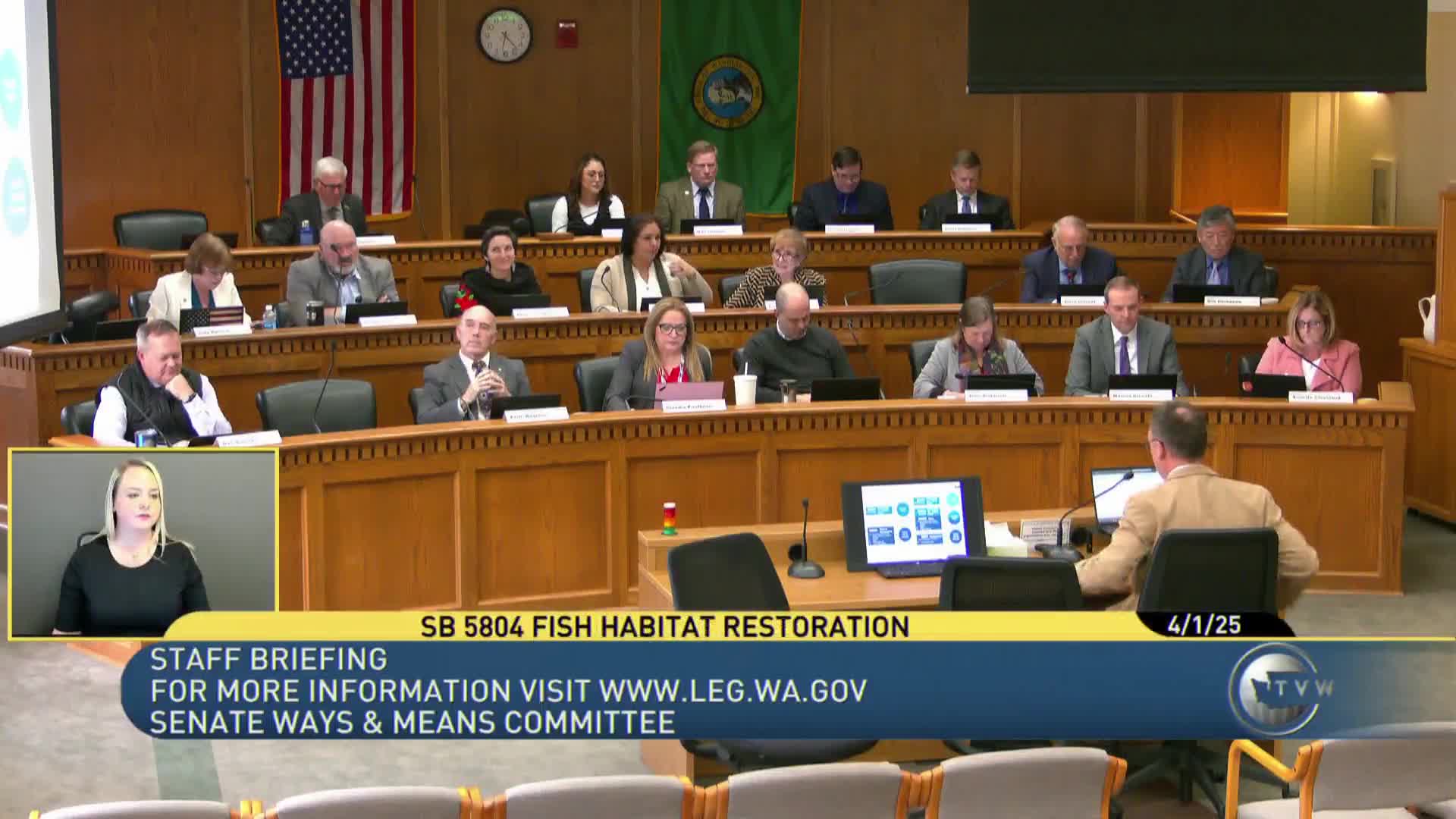
Staff briefed the Ways & Means Committee on Senate Bill 5804, a proposal to dedicate part of the public utility tax on light and power to a new fish‑habitat account and authorize up to $5 billion in special tax‑backed bonds to fund salmon‑recovery work ordered by a federal injunction; tribal leaders and restoration groups supported the funding plan while local governments, PUDs and the Public Works Board warned the measure would jeopardize the Public Works Assistance Account.
A staff briefing described the proposal and its legal context before the committee heard competing testimony on whether the bill's revenue structure should replace existing local infrastructure funding. "By way of background," Michael Buzanson told senators, the federal court issued "a permanent injunction requiring the state to provide and maintain fish passage for salmon and numerous culverts under state owned roads," and the cost to correct the remaining barriers has been estimated in excess of $5,000,000,000.
Senate Bill 5804 would create a new dedicated account funded by a restructured public utility tax on light and power utilities and authorize $5,000,000,000 in special tax‑obligation (revenue) bonds to pay for fish‑passage projects tied to the injunction. The bill redirects taxes that currently flow to the Public Works Assistance Account into the state general fund to keep the general fund whole and dedicates the light‑and‑power portion to the new fish‑habitat account; loan repayments would continue to flow to Public Works under the proposal, according to staff analysis.
Tribal leaders and restoration groups testified in support of the bill as a necessary step to meet treaty and court obligations. Rosemary LeClere, chair of the Nooksack Tribe, said restoring access to blocked habitat "is one of the most critical and cost‑effective steps" to reverse salmon declines and described the legislation as a necessary funding mechanism to carry out the state's legal duties.
Local governments, the Public Works Board and utility associations opposed the measure or urged major changes, saying the bill would hollow out the Public Works Assistance Account. Marie Sullivan, representing the Public Works Board, warned that the proposed statutory revenue shifts would remove the program's principal revenue sources and leave the revolving loan fund to rely on loan repayments and minimal bonding. "The portions of the ... taxes deposited monthly in the account are the lifeblood that sustains this national model that has supported infrastructure projects in your communities for over 40 years," Sullivan testified.
Public utility and local‑government witnesses said the change would raise long‑term costs for local ratepayers and jeopardize planned projects. Bill Clark of the Washington PUD Association and John Rothlin of Avista said the proposed nexus between electric utility taxes and transportation‑related culvert repairs is tenuous. Cities and counties said they remain ready to coordinate watershed‑level prioritization, but warned that reassigning long‑standing revenue streams risks creating gaps in drinking‑water, sewer, stormwater and other public‑works programs.
Several witnesses suggested alternate approaches such as watershed‑based prioritization, federal funding applications and a mix of bond proceeds and targeted state funds rather than a permanent revenue shift. Committee members pressed staff and witnesses for details about the interaction of revenue sources and the Public Works Assistance Account, and staff noted that the bill would include an authorization up to $5 billion but that interest rates and capitalization assumptions remain unknown.
Ending: Senators closed the hearing and agreed to consider amendments. The bill’s ultimate shape will depend on negotiations among the Senate, the House and the executive branch and on the mediation process with tribal plaintiffs that staff said is ongoing.