Get Full Government Meeting Transcripts, Videos, & Alerts Forever!
Get email alerts on the Capital Budget topic
No spam. Unsubscribe anytime.
Ways & Means hears capital budget briefing; housing, behavioral health and schools draw broad support
Summary
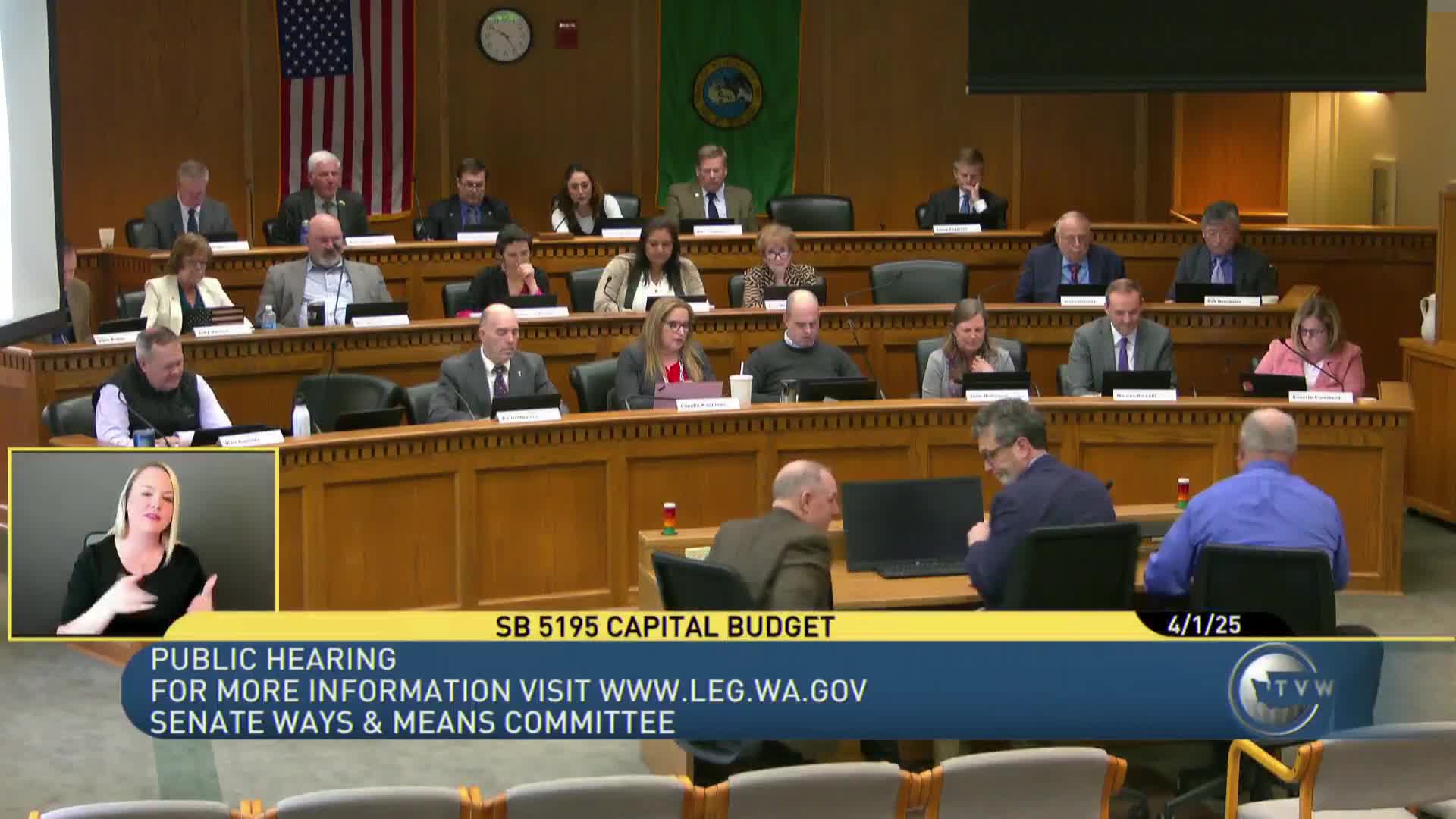
Senate Ways & Means Committee received a staff briefing on the proposed substitute capital budget (Senate Bill 5195) and heard more than two dozen public testimonies urging sustained or increased investments in affordable housing, behavioral health facilities, early learning and school seismic and modernization grants.
Michael Buzanson, staff to the Ways & Means Committee, briefed senators on the proposed substitute capital and bond bills and summarized the spending in broad categories. "Starting with 5 one 94, the bond bill, that bill would authorize $4,900,000,000 in debt," Buzanson said, and he outlined major capital investments, including an estimated $747,000,000 in new housing spending, $282,000,000 for behavioral health projects including Western State Hospital, and over $563,000,000 for the School Construction Assistance Program.
The committee heard sustained public testimony supporting housing trust fund dollars, preservation of manufactured-home communities, and project-level requests. Ryan Donahue, chief advocacy officer at Habitat for Humanity Seattle-King-Kittitas, thanked the committee for investments that his organization says will expand affordable homeownership and singled out a $10,000,000 CHIP allocation for the Fort Lawton project and $4,500,000 for the Orchard Gardens project in Bellevue.
Advocates for refugee housing and wraparound services, including Jim Castro Lang of Thrive International, spoke in favor of $2,000,000 in the Senate budget to support Thrive's Thrive Center in Tacoma. Jeff DeLuca of Washington State Community Action Partnership praised funding for weatherization and home repair but urged the committee to consider higher allocations in conference.
Behavioral health providers told the committee the capital proposal would allow new long‑term beds, parent-and-pregnant-women programs and community treatment capacity. Steve O'Ban described a provider plan for 115 behavioral-health beds in Yakima and asked for $5,000,000 in state support. Evergreen Recovery Centers, represented by Brad Banks, noted the budget items that would expand units for pregnant and parenting women.
Education and early-learning interests praised grants for seismic safety, small‑school modernization and early‑learning facilities. Melissa Gumboski of ESD 112 and Tyler Mensch of the Office of the Superintendent of Public Instruction said the school seismic safety grants and small‑district modernization dollars support student safety and small-district viability; both speakers urged the committee to reconsider projects left off the grant list.
Local and regional project sponsors — ports, community health centers and nonprofit developers — presented project‑specific requests tied to the capital package. Testifiers asked the committee to hold funding levels for Alliance Place (a transit‑oriented development in Lynnwood) and other locally prioritized projects, and port and public‑safety witnesses described infrastructure effects if requested grants and loans are reduced.
Michael Buzanson closed the staff briefing noting the proposed capital and bond totals and an estimated $222,000,000 ending fund balance. The committee then opened the public‑testimony portion and set a strict one‑minute timer to accommodate the volume of speakers.
Ending: Committee members said the budget will move to conference with the House and that negotiations will determine final funding levels. Staff and many testifiers asked senators to "hold the line" on housing and behavioral health allocations during those discussions.